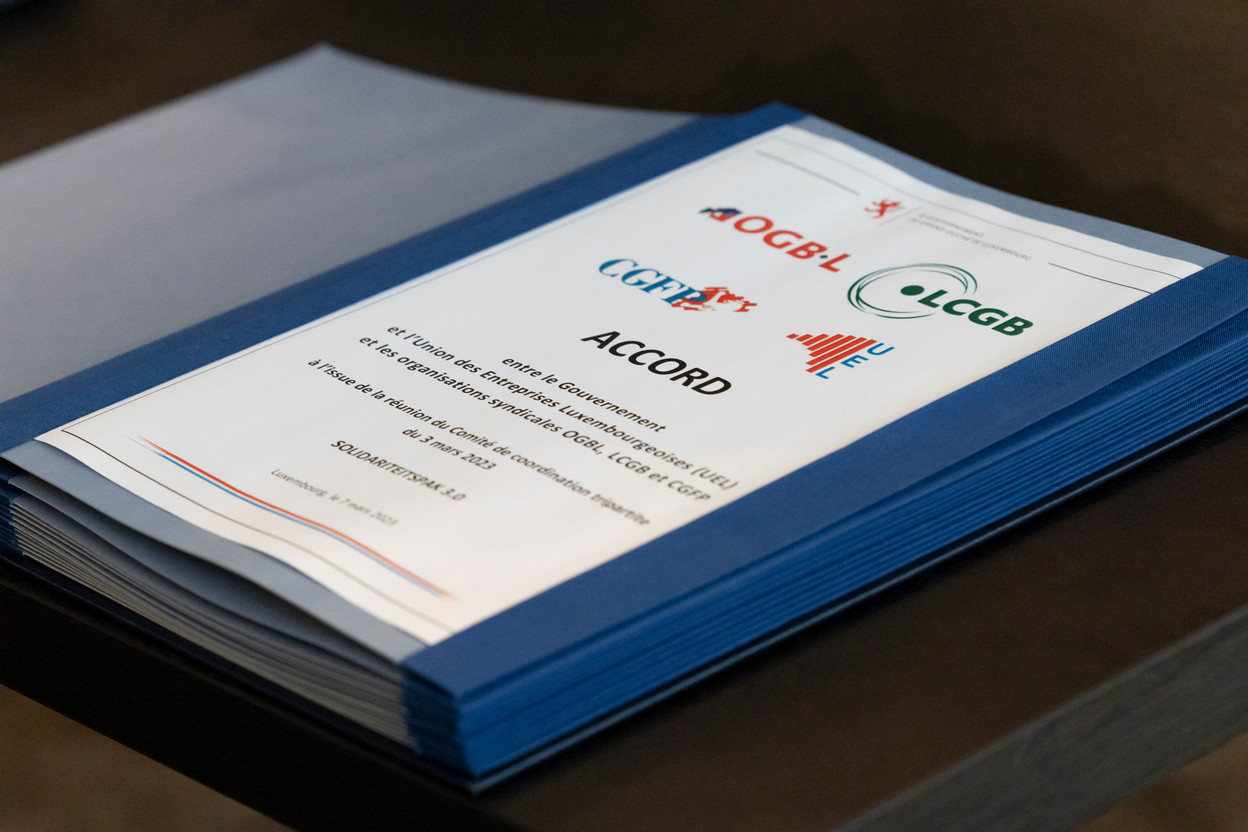
The government, labour unions and business groups in March agreed to implement a tax credit on the indexation of wages to ensure that more of the salary increase ends up in people’s pockets.
This had been a central demand of the OGBL labour union, which had said that the wage increase for a salary of €5,000 wasn’t 2.5% but only 1.7% after taxes. Under the plans, a tax credit equivalent to the taxation of two indexation payments will apply retroactively from January and until the end of the year.
The council’s opinion was key to pushing the draft law forward as all bills must be analysed by the council for their compliance with Luxembourg’s constitution and other applicable laws.
It issued no formal opposition to the text--its highest form of sanction--but proposed some edits for clarity and style.
The document submitted to parliament on Tuesday allows the chamber’s finance committee to get the draft law into ship shape, finalise its report and submit it to the plenary.
Gilles Baum, the rapporteur of the bill, told Delano by email that the finance committee will tackle the state council opinion in its session on Friday and that he is aiming to push the item on the agenda of one of the plenaries scheduled for the last week of June.
Also under the plans, tax brackets will be adjusted by 2.5 indexation payments (6.25%) starting next year. The OGBL had advocated for a more comprehensive tax reform, which the government had pledged in 2019 but then shelved during the pandemic.
Two petitions calling for the tax burden for singles and single parents to be reduced are pending a debate in parliament, and with elections coming up in October, reform proposals are likely to feature as a campaign topic.
During a first energy crisis tripartite in March 2022, the government had adopted and implemented a tax credit aimed at boosting purchasing power instead of one indexation payment.
The OGBL labour union at the time didn’t support the deal because it messed with the index system, postponing the adjustment of wages to inflation in order to protect companies from exploding payroll costs. With the indexation of wages in April 2023, the tax credit expired, resulting in a lower net salary for many employees.
The Chamber of Employees had welcomed the updating of the tax brackets next year, saying the last time they were adjusted for inflation was in 2017. Since then, however, eight indexation tranches have been paid out, with only 2.5 compensated under the new law.
For a salary of €5,000 the adjustment from next year will result in €59 more in the bank per month. For eight tranches, this would have been €197, the chamber said in its opinion submitted to parliament.