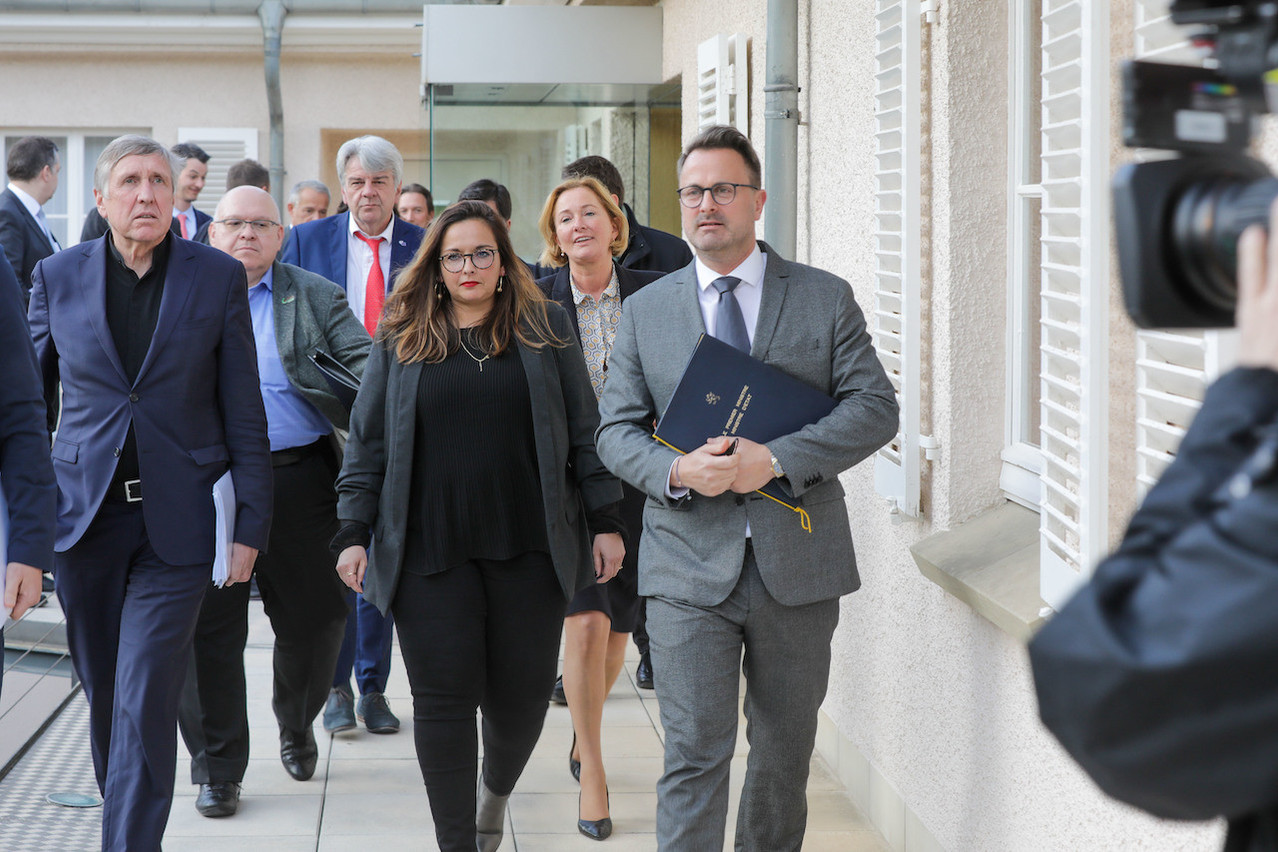
Talks to find some sort of common strategy to help households and businesses cope with rising costs, particulalry energy prices, that have been excaerbated by the Russian invasion of Ukraine will enter a third day on 31 March after a failure to reach agreement on Wednesday.
Talks had begun on Tuesday and lasted well into the night. The government, employers’ representatives and trade unions reconvened on Wednesday lunchtime and by early evening had at least been able to announce an initial series of measures proposed by the government.
One of the major announcements is that there will be no second indexation of salaries in 2022. State statistics office Statec had predicted that a second tranche of the automatic increase in salaries could be triggered by rising inflation as early as August this year, but the tripartite has agreed to postpone it until April 2023. They also agreed that if an additional index tranche were to fall in 2023, it would then again be offset by 12 months.
However, the first indexation planned for the second quarter of this year, most likely to be triggered in April, will be maintained. "We are not calling into question the index system, which is a guarantee of social peace," said prime minister Xavier Bettel (DP). Employers’ representatives had been calling for a discussion that could overhaul the indexation system, but that continues to be a red line for trade unions.
Measures to assist households
However, households suffering from a loss of purchasing power will be compensated through a tax credit, the exact amount of which has yet to be defined. The government has also agreed to introduce a reduction of 7.5 cents/€ per litre of fuel by the end of July 2022 – something that energy minister Claude Turmes had previously said would be counterproductive in the fight to cut so-called “petrol tourism” to the grand duchy. The CO2 tax credit is also likely to be revised.
The government also wants to introduce a rent freeze until the end of this year--it had imposed a similar measure during the first covid wave--and an increase in rent subsidies for the lowest income households is also under discussion. The "Prime House” subsidy for energy renovation is also to be made more social.
A specific aid for companies affected by energy prices is also likely to be introduced and will take account of the energy transition needs of enterprises.
The unions and employers’ representatives now have a week to discuss these measures internally before the tripartite reconvenes on Thursday 31 March at 9am.
Competitiveness must be maintained
Reaction to the outcome of the two-day meeting were mixed. "The social dialogue is alive,” said OGBL union president Nora Back. Her counterpart at the LCGB union, Patrick Dury, thanked the UEL umbrella organisation for private-sector businesses for the positive climate of the talks. However, compromises still need to be found, added Romain Wolff, president of the CGFP which represents civil servants.
"We have just come from a covid crisis during which the financial reserves of companies suffered and they now have to face a new and very serious energy crisis,” said UEL president Michel Reckinger. He added that companies are also having to deal with tensions in supply chains and a rise in the cost of raw materials. In this context, and in addition to the aid to be given to companies and individuals, the UEL wants to ensure that the attractiveness of Luxembourg is maintained.
Xavier Bettel spoke of an "important moment in the social dialogue" which should lead to the adoption of the whole package by the government and the social partners next Thursday. The prime minister will then make a statement in parliament on behalf of the government.