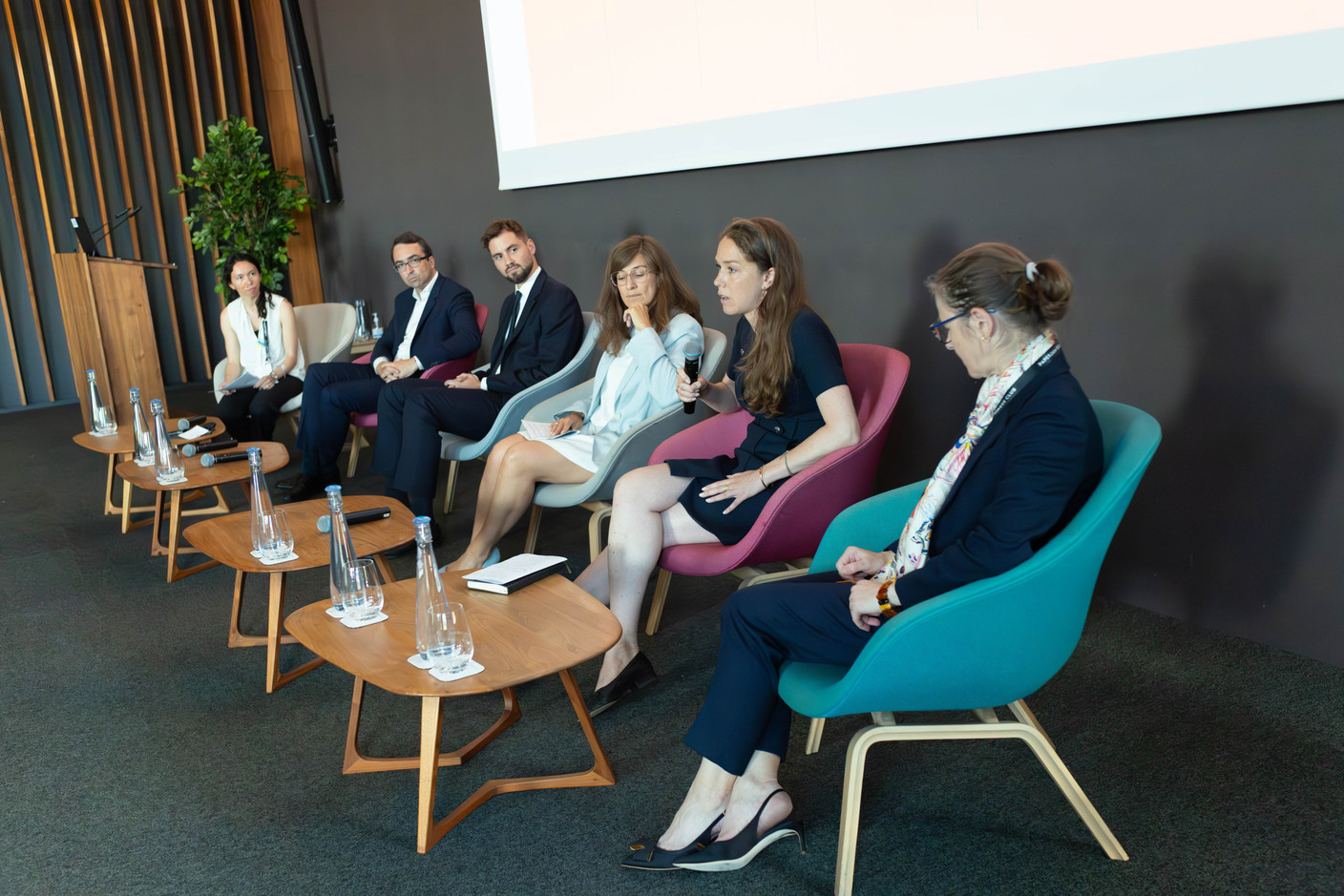
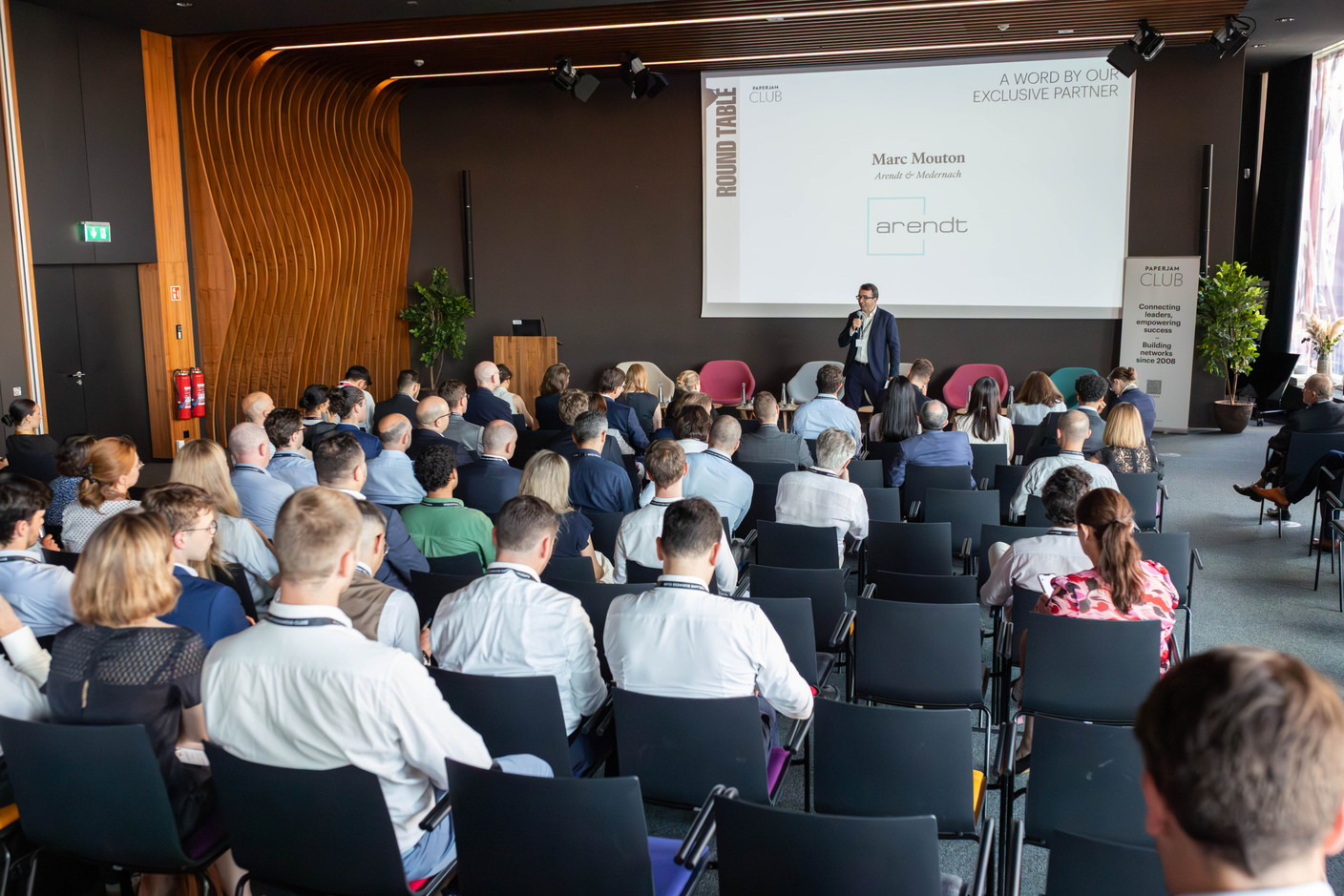
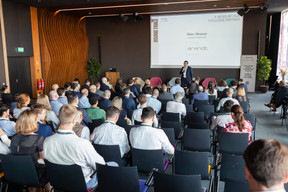
The tokenisation and cryptocurrency space has seen several announcements in the past few weeks: crypto exchange Coinbase received its Mica licence from Luxembourg’s Financial Sector Supervisory Commission (CSSF) on 20 June; Blackrock registered a Bitcoin exchange-traded product (ETP) in Luxembourg at the end of June; and Apex Group on 21 May announced that it had acquired a majority stake in Luxembourg fintech Tokeny, with Apex to take 100% control over the next three years. Experts from Coinbase, Blackrock and Apex, along with legal experts from Arendt & Medernach, were on hand to share their perspectives on the topic during a Paperjam Club roundtable held at the law firm’s offices in Kirchberg on 1 July.
The Markets in Crypto Assets Regulation (Mica), which institutes uniform EU market rules for crypto assets, entered into force in June 2023 and became applicable in 2024. Is this a welcome development, and does it still pose challenges for the market?
“Mica is huge. That’s the bottom line,” replied Corrina Fehst, interim CEO of Coinbase’s Luxembourg entity and the firm’s head of international strategy. “It’s the EU’s first kind of comprehensive regulatory regime for crypto and basically dispatches a patchwork of member state-specific crypto or Vasp [virtual asset service provider] regimes. For us, it’s been a very welcome development a long time in the making, and we’ve been very much looking forward to it.”
Mica brings several key benefits. “The first one is that it brings regulatory clarity to Europe,” Fehst said. Second, “it harmonises regulations across the entirety of the EU--so, one regime for the entire EU--and that kind of links to the third piece, which is [that] we’re able to run and operate our entire EU business under one single licence.”
Challenges, however, remain. The regulation is “demanding” and has led to changes in how the company operates and structures its products, noted Fehst. “We want to continue to see a sensible balance around global access, global infrastructure, global resources whilst balancing that with local control. For example, we want to continue to allow European users access to global liquidity or to the infrastructure that we run globally around custody.”
Another challenging area is that Mica curtails access to certain products or makes it a bit more “tricky” to launch certain products in Europe. “That’s something that the industry is going to have to work through as we go along.”
When it comes to trends on the crypto side, “we see European investors being a bit more conservative and a bit more traditional” compared to the US, said Fehst. “We see less investment, less crypto penetration, less investment outside the kind of top tokens, less engagement with more new products, new features. But that is changing. We’re kind of seeing that pick up and progressing--and that’s obviously exciting news for ourselves.” With Mica, she added, “we’ve just made this huge seismic shift.”
Interest from Luxembourg and abroad
“There is definitely interest in this topic in the market,” added Frédéric Schmit, counsel in the banking and financial Services practice of Arendt & Medernach. And this interest in not only coming from Luxembourg. “The interest we’re seeing is from firms all across the globe who are looking into Mica, who’ve looked into Luxembourg, or who are looking into Luxembourg to consider setting up their European operations in Luxembourg.”
He also covered the process that companies undergo when approaching the CSSF for a crypto asset service provider (Casp) licence, noting the multitude of texts and guidances that need to be taken into consideration when preparing such an application. The CSSF, Schmit added, focusses on conflicts of interest, how the custody of crypto assets is organised, how to ensure the local entity keeps control over assets--the CSSF is “very mindful” of consumer protection issues--best execution and local substance.
Blockchain laws in Luxembourg
We’ve indeed seen a lot of interest and exploration in the market, said 
The CSSF is “tech agnostic” and “very open” in terms of the type of ledger technology, whether it’s a public or private blockchain, for instance. “There’s a lot of flexibility.” What’s more, Mouton added, “I think there’s kind of an interesting approach to risk disclosures and the prospectus language. The CSSF in a way says: don’t put too much technical information into a prospectus around how a blockchain works, because in the end, too much information kills information. If the investor finally thinks that they invest in a Bitcoin instead of that simply the shares are tokenised, then something went wrong. So the CSSF has an interesting, pragmatic approach on that.”
Whole portfolio view
Blackrock’s new Bitcoin exchange-traded product (ETP) has been registered in Luxembourg since the end of June. Through this ETP, investors can access Bitcoin without the hurdles linked to trading and liquidity, explained Gisele Duenas Leiva, head of manager research sales EMEA at Blackrock. Crypto, however, is still a new asset class for many investors, so a lot of education needs to be done to inform investors about how it works. “We have, currently in Europe, 25m cryptocurrency investors,” she pointed out. Many of them are Millenials or members of Gen Z who are “digital natives.” It’s important to get other generations to the same level of comfort with the digitisation process, but it’s also key to educate younger generations about the risks and benefits linked to crypto, as well as other “more traditional” asset classes, like equity or fixed income.
A partnership between Coinbase and Blackrock, struck in 2022, aimed to extend cyrptocurrency trading and custody services for institutional investors. Part of the objective behind this was to allow a “whole portfolio approach,” said Duenas Leiva. “The idea is to be able to offer to our investors the ability to look at this asset class in a whole porfolio with other types of assets, and also assess the risk of this asset class and the diversification benefits of the asset class in this whole portfolio approach.”
Possibilities offered by tokenisation
Tokenisation is also taking off in Luxembourg, as evidenced by Apex’s acquisition of Tokeny. What was the rationale behind this transaction?
Apex Group is a funds service provider that provides solutions to the entire value chain (except legal advice and audit), said Agnes Mazurek, global head of business implementation for digital assets at Apex Group. “When we are not able to provide a solution in-house, we try and form a partnership, or through an acquisition.” The driver behind this move in particular is that “we have started to see kind of the convergence between public and private [markets],” she explained, as well as the “attractiveness of private markets as an asset class and the possibilities offered by tokenisation, in particular when we’re talking about tokenising share class.”
Read also
Franklin Templeton has recently launched a blockchain-based Ucits fund in Luxembourg, and Apex Group--in collaboration with Hamilton Lane and Sygnum Bank--in April 2024 launched the tokenisation of the Hamilton Lane GPA fund and established a DLT registry. What are the objectives of this kind of project?
“When we look at a project like this, there are always many perspectives,” replied Mazurek. “There’s the perspective of the GP, there’s the perspective of the investors and there’s the perspective of the servicing ecosystem.” And, from a manager’s perspective, “the benefits of tokenisation were opening up a new distribution channel. And in this instance, Hamilton Lane were able to rely on the distribution channels of Sygnum Bank, and it was also able to achieve operational efficiencies. So there was a double driver there.” Furthermore, from the investor’s perspective, the investment entry point was brought down to 1,000 Swiss francs. “It wasn’t a retail fund,” she added, but from an “accessibility perspective” it was available for qualified investors.
Mazurek also noted that, in some jurisdictions, “we are seeing some regulators still confusing the two [tokenisation and crypto].” Take, for instance, the consequences of tokenising a fund unit. “If you tokenise a fund share class, you don’t do anything fancy. First and foremost, you do not change the risk profile of the underlying fund strategy; it stays the same. It’s just the technical means to bring the ledger--so, the investor positions--onto the blockchain. If, on the contrary, you have a fund that invests into tokenised assets and fractionalised investments, then that would constitute a completely different strategy.”
“The word was said about education. Education is very important, and one of the things that we believe as part of this fairly new ecosystem is that if we all work together--with the GPs [general partners], with the LPs [limited partners], with companies like Coinbase, other administrators, law firms--to come to an understanding of the challenges and benefits of digital assets as an asset class, it is going to contribute to quite a strong uptake.” But, Mazurek pointed out, “digital assets are not just one type of investment strategy. They are super diverse.”
Main takeaways
“Digital assets are constantly changing,” said Duenas Leiva at the conclusion of the panel. “It’s quite an exciting moment.” Not only is there an ecosystem of 25m crypto investors, but “delivering institutional access is also an opportunity to make the bridge between crypto and traditional finance in Europe.”
Indeed, for Schmit, the key takeaway is “to really keep my eyes and ears open” for what will be developing in the market in the near future.
“I would encourage folks to kind of take away that tokenisation is kind of the big new thing coming to financial markets,” concluded Fehst. “It’s like, if you think about the role that technology played in the transformation of the financial markets in the ’80s and ’90s, this is the next wave. I think the potential is absolutely vast. We’re yet to see exactly how it shakes out.” But “you can’t just legislate or create the environment for just tokenisation. Tokenisation builds on lots of other different components,” she added. “You need to create a sensible kind of regulatory environment.”
“We need regulation,” said Mazurek, agreeing with what the other panellists said in their concluding remarks. “Regulation needs to precede innovation; not the other way around, because otherwise we’re in trouble. We need the infrastructure, we need inter-operable networks… we need to get to a stage where the systems are inter-operable and frictionless.” The other takeaway Mazurek singled out was: “More than ever, we need legal guidance around what we can and cannot do in crypto, in tokenised funds.”
Luxembourg has an “interesting toolbox” that has attracted “a number of digital asset activities,” concluded Mouton. “But what I think is absolutely key is also to hear from the industry and the market: what are the needs? where are potential pain points? And I would say what is nice in Luxembourg is that we can indeed work together with the authorities to find a solution that is--of course--robust. It’s not that anything goes, obviously, but to come up with something that balances all the interests and enables innovation.”