
Market trends
European markets ended the third quarter up, with the STOXX Europe 600 up 2.24%, despite a slight fall in September. This decline was accompanied by significant volatility. Fears of a slowdown in job creation in the United States and weaker-than-expected growth in Europe also weighed on the markets.
Over the quarter, the retail sector was the best performer, with an increase of +13.0%. By contrast, the automotive sector fell by -8.7%, affected by profit warnings from major companies such as Stellantis (-32.8%), Mercedes-Benz (-10.1%) and Volkswagen (-9.7%). This decline is due to the slowdown in the Chinese economy and lower car sales in Europe. The energy sector also suffered, falling by -9.01%, following a -16.9% fall in the price of oil, caused by weaker demand in China and Saudi Arabia's intention to increase production in order to regain market share.
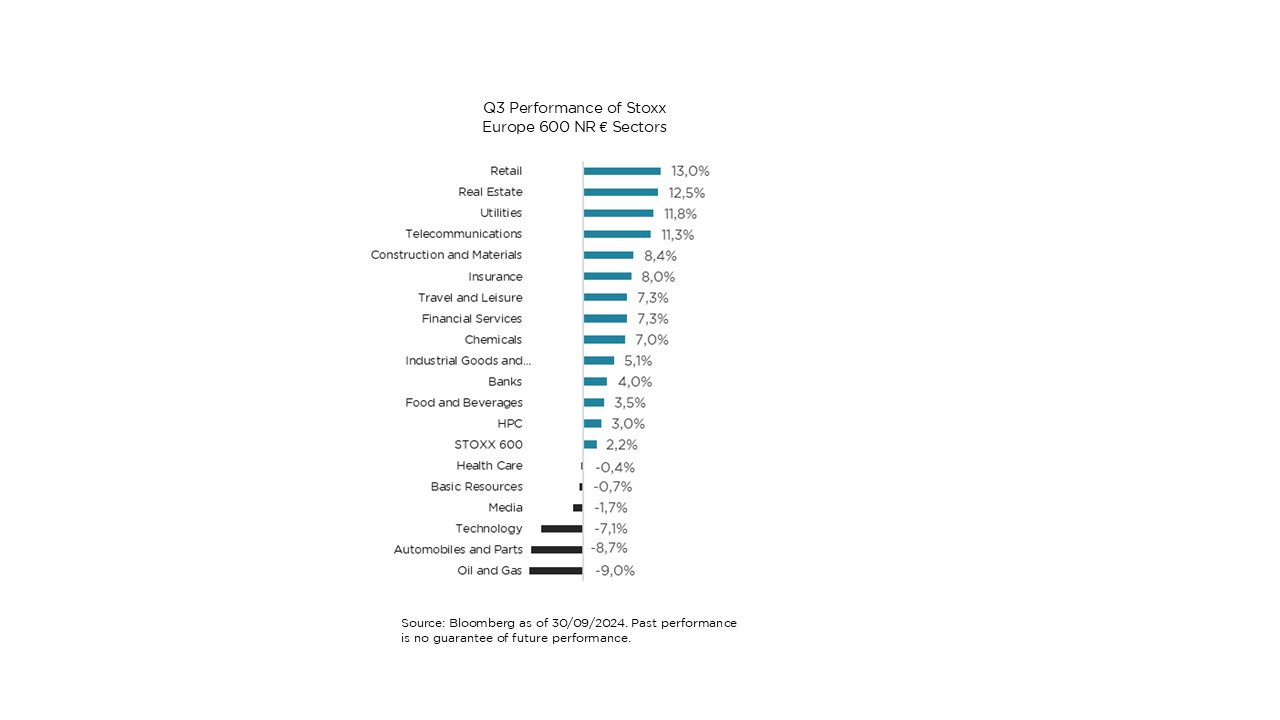
Q3 performance of Stoxx Europe 600 NR (Image: DNCA)
Macroeconomic outlook
The decisions of the major central banks continued to guide the markets. In September, the European Central Bank (ECB) cut its deposit facility rate by 0.25% for the second time this year, bringing it down to 3.5%, in response to the fall in inflation (from +2.2% in August to +1.8% in September) and downwardly revised growth forecasts for 2024. This decision, which was widely anticipated, reassured the markets and should breathe new life into the European economy in the months ahead.
In France, inflation fell to +1.2% year-on-year in September (vs. +2.3% in July), returning to its 2021 level. The purchasing managers' index (PMI) for the services sector stood at 55.0 in August, boosted by the Olympic Games (vs. 50.1 in July), recording its strongest rise for over three years and reaching its highest level since May 2022. INSEE lowered its growth forecast for the third quarter to +0.4% from +0.5%. In Germany, inflation stabilised at +1.6%, while the PMI for the manufacturing sector contracted to 40.3 compared with 42.4 expected by the market. Services held up better, with a PMI of 50.6 compared with 51.2 in August.
In the United States, the Federal Reserve (Fed) made its first rate cut of 0.50% at its September meeting, bringing rates down to between 4.75% and 5%, their lowest level since March 2023. However, Jerome Powell did not say whether further rate cuts would follow at the next Fed meetings in November and December. Some indicators show that the US economy remains resilient, with GDP growth of +3.0% over 12 months in the second quarter and a slight increase in the services sector.
For more information on our investement strategies : www.dnca-investments.com