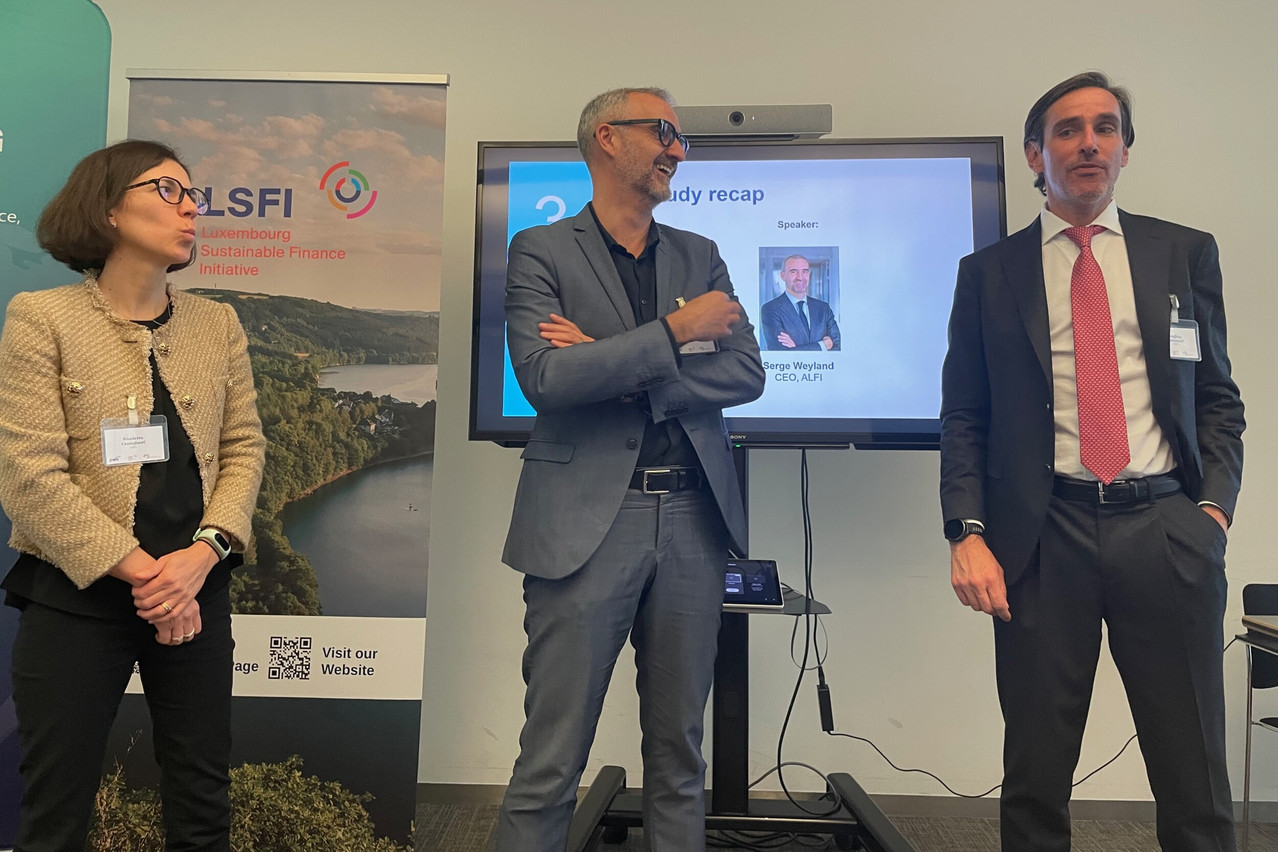
“Sustainable finance is entering a phase of recalibration,” said Nicoletta Centofanti, CEO of the Luxembourg Sustainable Finance Initiative, during a press conference organised by LSFI, ALFI and PWC. She added: “Of course, we have faced several headwinds, which are political tensions, macroeconomic volatility and shifting investment priorities.”
Yet Centofanti argued that “sustainable finance has successfully transitioned from a niche segment to a fundamental pillar of European financial decision-making.”
The joint study, covering data from 2020 to 2025, utilised a rigorous methodology involving the manual screening of approximately 8,500 Luxembourg-domiciled funds and relied on Morningstar classifications to ensure unbiased, evidence-based results.
In the public market domain, Geoffroy Marcassoli, partner at PWC noted that global sustainable hit €3.1trn, 6% of the total assets under management (AuM). Europe accounts for 85% of these assets, followed by North America at 11%, while the Asia-Pacific region remains relatively small despite recent growth. Luxembourg represents more than 31% of the AuM of sustainable public market funds in Europe (€815bn).
Luxembourg: Europe’s ESG fund powerhouse
Against this global backdrop, Luxembourg continues to play a central role. The country has solidified its status as a global hub, hosting over 2,000 sustainable public funds. By the end of 2025, Luxembourg sustainable public AuM reached €815bn, accounting for over 20% of the overall market.
Asset allocation in these funds is dominated by equity (65%) and fixed income (35%), reflecting a diversified market compared to competitors like Ireland, which is more skewed toward equity ETFs.
Sustainable funds record three-year slump in flows
Digging into the numbers reveals darker trends. Despite the efforts of the industry and a positive “performance effect” of €151.7bn, Luxembourg-domiciled sustainable public market funds recorded net outflows of €30.3bn over the three years (see chart 1).
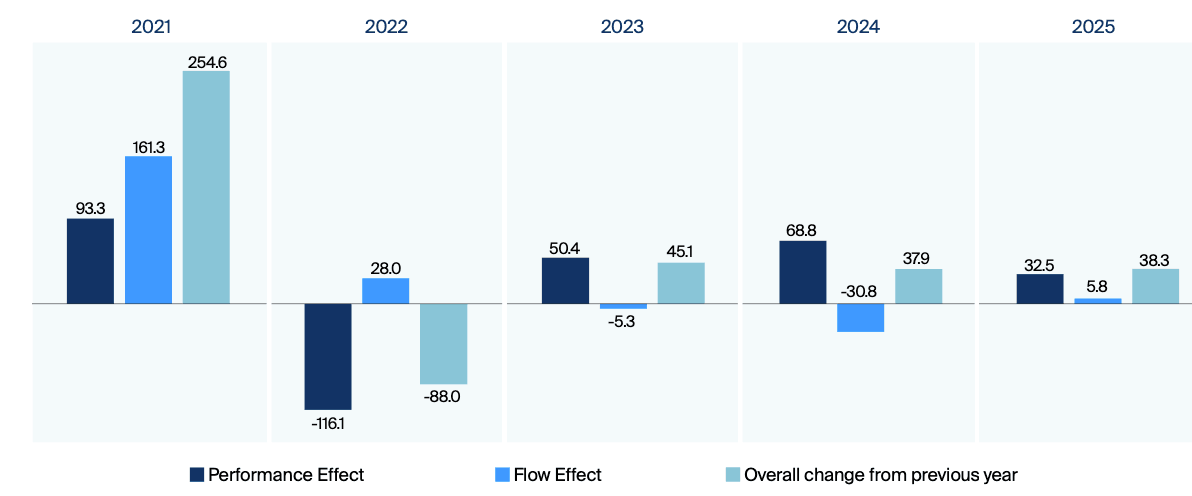
Chart 1: Breakdown of Luxembourg-domiciled sustainable public market funds: performance vs. flow effects (EUR bn) Source: Morningstar. Data excludes funds of funds, feeder funds and money market funds.
The picture worsens when looking at the net flows for the various asset classes (see chart 2). Indeed, equity and multi-asset classes recorded outflows of €76.2bn and €17.7bn, respectively in the last three years. The fixed income asset class partially offset these outflows by recording €66.4bn in inflows. It is worth noting that the former two asset classes are generally generating the highest performance fees for asset managers.
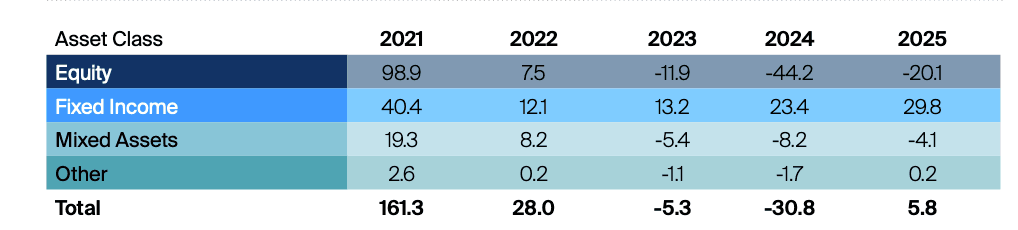
Chart 2: Net flows of Luxembourg-domiciled sustainable public market funds (EUR bn) Source: Morningstar. Data excludes funds of funds, feeder funds and money market funds. “Other” includes public market funds that do not fall within the above categories (such as absolute return strategies and commodity funds, amongst others).
Questioned on the reason for the poor flow performance, Marcassoli answered that “there are cycles where you have more inflows and more outflows. On a longer period [before 2020], you would have seen a lot of inflows in sustainable products.” He stressed that the last two years have been highly beneficial for the defence, and the oil and gas industries which contributed to the underperformance of sustainable products.
Marcassoli added: “There is a certain level of exclusion within the sustainable products for the defence sector… and also the regulatory uncertainty.” Serge Weyland, CEO at the Association of the Luxembourg Fund Industry (Alfi) suggested that “strong positive inflows” into passive ETFs may have also played a role. “There is a short-term play—big oil companies—it is also important to invest in renewables to achieve European sovereignty,” he said.
Investments with sustainability objectives cannot be pursued when you are paid only five basis points
In its recent report “ESG Funds: 2025 Closes with Continued Outflows Amid Persistent Headwinds,” Morningstar, the data provider, wrote a broader explanation for the outflows: “Factors affecting investor appetite for sustainable funds include geopolitical tensions, anti-ESG sentiment, regulatory uncertainty, and mixed performance.”
ESG Debate: performance vs purpose
During the press conference, a debate emerged around the drivers of these outflows. Participants also discussed the challenges faced by active managers in outperforming benchmarks, as well as the difficulty for sustainable funds and indices to beat traditional benchmarks such as the S&P 500 or the Euro Stoxx.
“True sustainability teams interact with the target companies and try to influence the way management approaches the future. Investments with sustainability objectives cannot be pursued when you are paid only five basis points on your AuM… you can’t afford the teams,” responded Weyland.
Companies have made meaningful progress, driven in part by the impact and influence of active managers who have pushed firms like TotalEnergies to evolve their strategies.
SFDR 2.0 could reshape ESG fund rules
The regulatory landscape is currently dominated by the Sustainable Finance Disclosure Regulation (SFDR). The market is split between Article 8 (promoting environmental or social characteristics) and Article 9 (targeting sustainable investment objectives), and the rest of the market (see chart 3) is what PWC referred to as Article 6 or the conventional market.
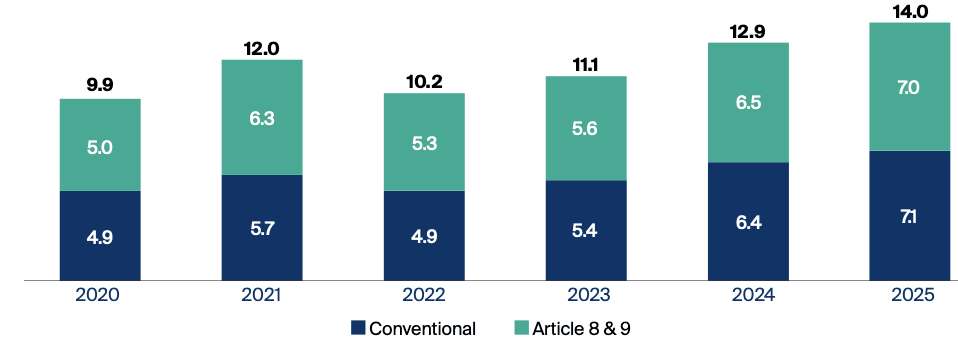
Chart 3: AuM of conventional public market funds in Europe vs. AuM of Article 8 and 9 public market funds (EUR tn) Source: Morningstar. Data excludes funds of funds, feeder funds and money market funds.
Within Article 8 and 9 funds, the former accounts for 95% of funds. The limited uptake of Article 9 (5%) is due to the perceived challenge of meeting the strict 100% sustainable investment threshold. Currently, Luxembourg holds a 44% share of all Article 8 and Article 9 funds in Europe.
Consequently, the industry is closely watching the development of SFDR 2.0, which may introduce a 70% threshold for sustainable categories and provide clearer definitions for “transition” and “impact” investing. “Let's hope that [SFDR 2.0] will not become overly prescriptive…but rather more principle-based than rule-based,” said Weyland.
Marcassoli noted that the new SFDR 2.0 framework is expected to allow passive products tracking PAB (Paris Agreement benchmarks) or CTB (climate transition benchmarks) to be automatically classified as sustainable or transition funds. This could lead to the emergence of more such products. “There is a promise to investors about sustainability outcomes. You can't do that with a machine,” Weyland stated.
Luxembourg captures 77% of ESG private funds
The private market sector has displayed even more dramatic momentum. “Penetration of sustainable products is now higher within the sustainable private market than it is in the public markets,” said Marcassoli.
Using Preqin data to assess ESG funds, PWC calculated that global sustainable private AuM reached $1.4trn, with an impressive 40% CAGR between 2020 and 2024. Europe holds 80% of this market (€1.1trn), where sustainable products now have a higher penetration rate (27%) than in public markets (see chart 4). No figures were provided on the flows. Therefore, it is not possible to break down inflows compared to performance effects.
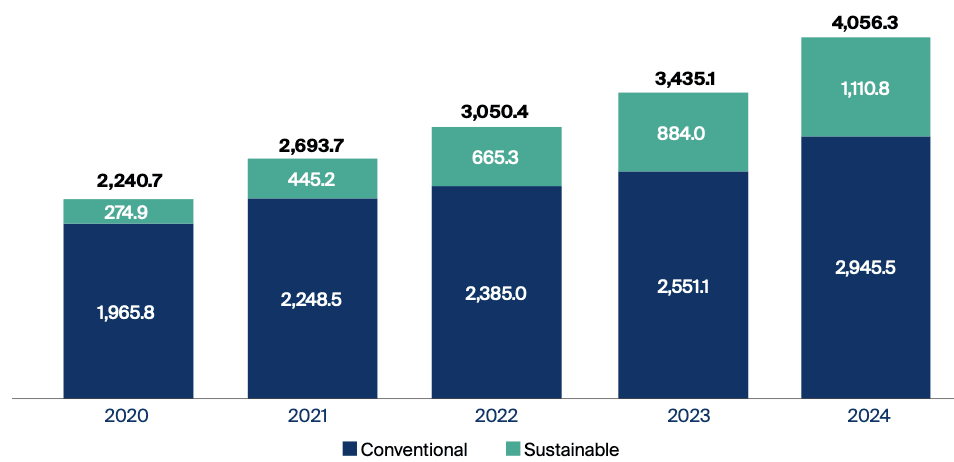
Chart 4: AuM of European private market funds, conventional vs. sustainable split (EUR bn) Sources: Preqin, Monterey Insight. Note: Data excludes funds of funds and funds that are in the fundraising process.
Within Europe, Luxembourg’s dominance is unparalleled, representing 77% of the continent’s sustainable private AuM. Private equity (50%) and infrastructure (30%) are the leading asset classes, with ESG integration and energy transition being the most popular strategies.
Despite short-term pressures on flows, the data underscores Luxembourg’s entrenched leadership in both public and private sustainable finance markets.