
After the publication of Morningstar’s “ESG Funds: 2025 Closes With Continued Outflows Amid Persistent Headwinds,” Paperjam approached Laetitia Hamon, head of operations and sustainable finance at the Luxembourg Stock Exchange, to gather her perspective and insights in writing.
Structural shift or cyclical setback?
Morningstar reported that 2025 marked the first year of annual net redemptions in global sustainable funds since tracking began in 2018, with $84bn in outflows (see chart 1), despite $1.7trn of inflows into the broader fund universe. Even worse, the negative trend has broadened out to include all three regions, two quarters in a row.
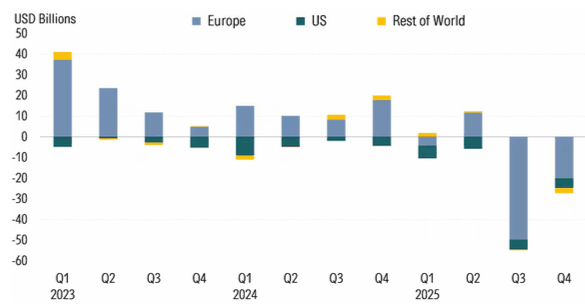
Chart 1: Quarterly global flows into sustainable funds (USD billions) Source: Morningstar Direct. Data as of December 2025. Excluding money market funds, funds of funds, and feeder funds
Sylvain Barrette: Do you see this as a cyclical correction driven by performance and politics or as a structural shift in investor behaviour?
Laetitia Hamon: I see the recent outflows as largely cyclical rather than structural. Investors ultimately allocate capital where they see financial value and long-term viability, and there is a very strong pipeline of sustainable assets, products, and projects that meet those criteria.
Sustainable energy, and sustainable infrastructure in particular, has never made more economic sense than now, from grid modernisation all the way to renewable generation and electrification technologies. These are fundamentally driven investments, and the need for capital in these sectors is only set to grow.
What we are observing in the fund space is a period of adjustment. Performance headwinds in certain segments, political noise around ESG, and perhaps most importantly, regulatory uncertainty have all contributed to temporary hesitation.
In Europe, the market is clearly waiting for the SFDR omnibus simplification to restore clarity. As long as the regulatory framework remains in flux, it is natural that a portion of investors will pause or reposition rather than commit new capital.
Exchange-level resilience
What evidence do you see in Luxembourg listings and admissions that supports your view?
It is also important not to conflate trends in sustainable funds with what we observe at the exchange level in Luxembourg. Funds and bonds are different instruments, driven by different dynamics.
While sustainable funds have experienced net redemptions, the sustainable bond market, where the Luxembourg Stock Exchange plays a global leadership role, continues to show resilience. Last year remained the second-best year after 2021 in terms of sustainable bond debt issuance in our markets.
Issuers across sectors and regions continue to tap the market to finance the energy transition and social development, demonstrating that demand for sustainable financing channels remains structurally intact.
In other words, the recent fund outflows reflect a cyclical correction and a moment of uncertainty, rather than a retreat from sustainability.
The underlying investment case for sustainable assets remains strong, and the financing needs of the transition are only growing. Once regulatory clarity improves, we expect investor flows to stabilise and resume their long-term upward trajectory.
Political backlash vs regulatory complexity
In its report, Morningstar pointed to anti-ESG sentiment, geopolitical tensions, and regulatory uncertainty (including SFDR review and the EU Omnibus Package) as headwinds weighing on investor appetite.
How can the Luxembourg Stock Exchange avoid being caught between over-regulation that stifles product innovation and under-regulation that fuels greenwashing concerns?
In my view, Morningstar’s assessment is correct. Anti-ESG political sentiment, geopolitical uncertainty, and ongoing regulatory reviews are all contributing to a more cautious investor environment. These factors inevitably influence the market’s short-term dynamics, but not necessarily the long-term trajectory.
However, it is important to clarify that the perceived “tension” between overregulation and underregulation does not directly apply to the Luxembourg Stock Exchange itself. Ultimately, it is issuers and investors who are directly impacted by the regulatory framework, whether it provides clarity and credibility or becomes overly complex and difficult to navigate.
It is also crucial to distinguish between different instruments. Bonds are not subject to SFDR or CSRD in the same way investment funds or corporates are, so the regulatory debates are not directly comparable across asset classes. Yet the broader question, 'How to strike the right balance in sustainable finance regulation?’ is absolutely valid.
Striking the right balance
Where should that balance be struck?
In my opinion, the way forward is to set high and credible standards while giving issuers access to a progressive pathway in order to reach them. Sustainability is a journey, and we should not discourage entities that are genuinely advancing, even if they are not yet at the “end state”.
If an issuer has a clear, ambitious, and verifiable transition trajectory, they should not be labelled as greenwashing, as this would only deter the very companies we need to engage with.
At the same time, the market needs strong guardrails and the ability to identify risks of mislabelled or misleading claims. Transparency, comparability, and meaningful disclosure are all essential. Part of the solution lies in continuing to educate the market, including investors, issuers, and intermediaries, so that sustainable finance can mature without becoming an overly burdensome compliance exercise or a diluted concept.
At the Luxembourg Stock Exchange, our role is to remain a trusted platform, setting rigorous yet achievable standards, ensuring transparency, and supporting issuers at different stages of their transition. This balanced approach helps maintain credibility without closing the door to innovation and progress.