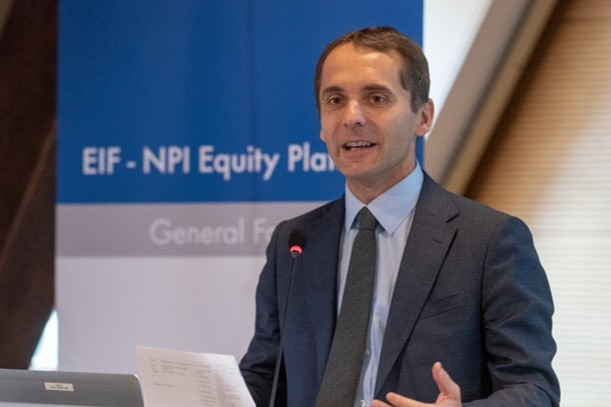
“Private capital investments are crucial to modernise but also sustain infrastructure to keep our societies competitive,” said Tobias Griesshaber, head of performance measurement and investment controlling at Energy Infrastructure Partners (EIP), an asset manager with €7.5bn in assets under management. Investment funds with private capital are deemed pivotal for financing the “real economy” and fostering socio-economic development, as public sector involvement has decreased due to rising public indebtedness.
Griesshaber explained that funds also play a decisive role in addressing the pension gap by identifying profitable opportunities in underserved markets, creating economic and societal value through investment in social infrastructure, for instance. Investment funds offer access to third-party managers with specialised expertise and provide diversification that individual investors typically cannot achieve on their own, explained Mara Topping, partner, investment management and funds at DLA Piper.
Sparking retail investment in funds despite a risk averse propensity in Europe
“If I were a retail investor in private markets, I would probably already be drawn away by the paperwork,” said Griesshaber. He explained that sparking European retail investor interest is challenging given the inherent opacity of private markets, which have historically been exclusive. “Part of the magic is this opaqueness… because [some of the managers] pride themselves on accessing such special capital for their beneficiaries.” Therefore, he thinks that the focus should be on targeting educated private investors who understand these risks.
Overcoming cultural and psychological factors (like historical preference for savings accounts) requires education and demonstrating “proof of concept through consistent returns over time,” stated Topping.
Griesshaber added that “private markets really need to prove that they earn more than their fees.”
He commented that private market investments offer decorrelated returns and lower volatility as “they react less dynamically than public markets” due to infrequent valuations and less dependence on market sentiment. He also stressed the inflation protection in infrastructure, a feature that may be attractive for some investors.
Tackling demographic shifts
An aging population means a slower growth of the capital stock and fewer working citizens contributing to pension systems, with the baby boomers likely to spend more than they invest to finance their cost of living. Griesshaber thinks that the democratisation of private markets is essential, allowing individuals to reinvest their accumulated capital into similar structures, thus sustaining the capital stock. “Societies won't stop demanding energy and social services, or having their electric vehicles charged on the roadside.”
Topping noted that the liquidity challenges in private funds are being addressed through bespoke products such as in the secondaries market and evergreen vehicles, allowing for rollover possibilities, exit options and long-hold options for patient capital (high-net-worths and some of the sovereign wealth funds).
We won't stop AI. We just have to fuel it in a clean way.
Private investments can be particularly adequate for young investors due to their “illiquidity premium,” which encourages a long-term strategy and discourages selling during market troughs, commented Griesshaber. Given their expertise in infrastructure, he thinks that it gives EIP access “to trophy assets returning [superior] return over time… you have to stay long in order to really harness the fruits of your early actions and get the reward of your strategies.”
Balancing sustainable investment and AI energy needs
There has been a “pendulum swing” in sustainability focus. “We are better off by investing in renewable energy, in decarbonising our societies and in unwinding from dependency on fossil fuels,” argued Griesshaber.
Specifically, on AI’s rapidly growing energy demand (currently 1% to 2% of global power, potentially 5% to 10% in 5-10 years), he admitted that there is a need for more clean energy. While some data centres resort to gas turbines, Griesshaber stressed that AI is also a huge productivity factor and can make energy infrastructure decisions smarter and more efficient.
“We won’t stop AI. We just have to fuel it in a clean way,” he said. He pointed out that large tech companies are significant commercial off-takers of renewable energy through power purchase agreements. Griesshaber and Topping both argued that storage and battery construction are nowadays an integral part of the energy supply architecture for AI data centres for stability and for supporting volatile renewable energy supply in the grid.