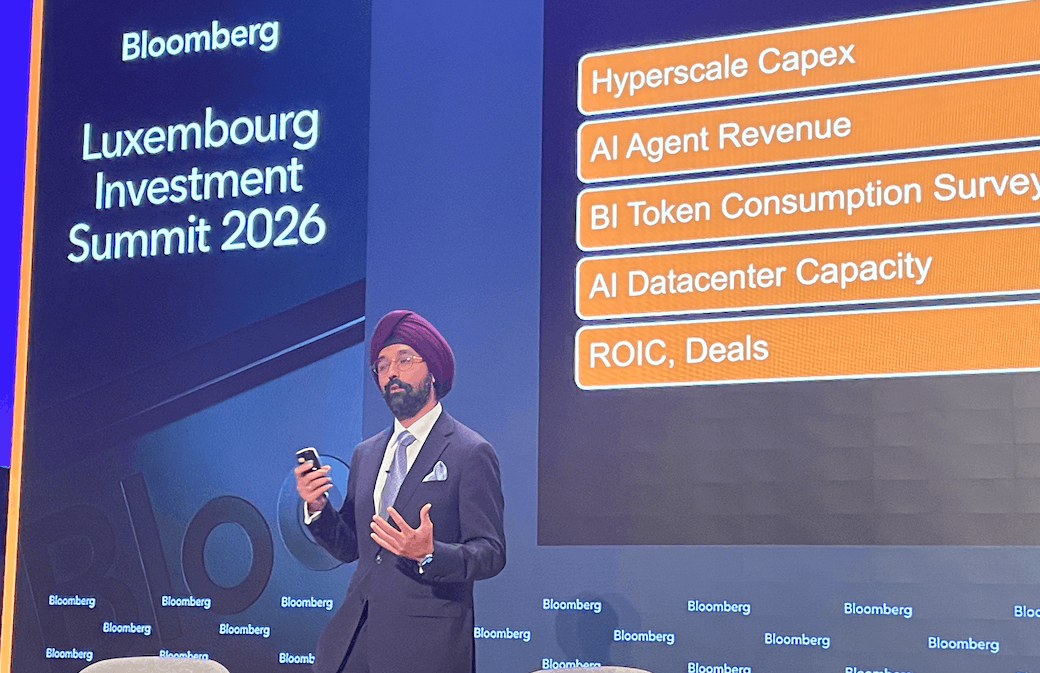
When Bloomberg Intelligence presented its global analysis, it laid bare a startling reality: the world is pouring hundreds of billions into data centres, yet the underlying economics remain constrained, said Mandeep Singh, global head of technology research of Bloomberg Intelligence at the Bloomberg Luxembourg Investment Summit at the Philharmonie on 1 October 2026.
What began as a $500bn capex expectation across the four big US hyperscalers has ballooned to $750bn within just nine months, noted Singh. In short supply, component pricing for memory, storage, and silicon has soared alongside intense demand from rising neoclouds that recently set up AI data centres.
SpaceX which had no cloud business, may generate $70bn just by renting AI infrastructure
Beneath this capex frenzy lies a shifting landscape where token consumption is skyrocketing, energy grids are straining, and a revenue gap separates model labs from application developers.
The $750bn compute crunch
The relentless capital expansion highlights an acute scarcity of physical compute capacity. Aggregate hyperscaler capex is projected to grow 47% next year, following three consecutive annual surges measuring 76%, 79%, and 95% in 2024, 2025, and 2026, respectively.
As component prices escalate, companies are scrambling for data centre allocations. On the infrastructure rental side, monetisation is surging; cloud giant AWS now generates $25bn of its $150bn business purely from renting AI infrastructure. “A company like SpaceX which had no cloud business, may generate $70bn just by renting AI infrastructure,” said Singh.
This boom has elevated cloud market growth rates from historical averages of 20% to an astonishing 50%.
The exponential surge in token consumption
Token usage serves as the clearest proxy for actual AI deployment. Over the past 12 months, token volume has surged 7x, driven by a structural shift from static chatbots toward reasoning agents.
While a standard chatbot prompt consumes roughly 10,000 tokens, a single coding agent query can consume up to 3 billion tokens, making tokens the core “units of intelligence.” An enterprise survey of 100 IT leaders revealed that token budgets represent under 10% of total IT budgets, signalling that adoption remains in its early stages.
Where the revenue actually lands
Despite massive capex investments, financial returns remain asymmetric. Pure-play agentic application revenue sits at around $10bn, with nearly half concentrated strictly in coding tools.
In contrast, frontier model providers like OpenAI and Anthropic have captured a $100bn combined run rate, monetising ten times more effectively than application layer firms. Enterprise respondents report that proving ROI remains a hurdle, with only 9% able to measure formal financial returns directly.
The power bottleneck and backlogs
A critical divergence is emerging between token growth and power capacity. While token usage expanded 7x, utility power capacity grew by merely 14%, creating a severe operational mismatch. In the US, grid moratoriums and community pushback are complicating data centre pipelines.
Furthermore, a $2.5trn industry backlog is heavily concentrated in two major model labs (OpenAI and Anthropic), introducing significant counterparty risk, argued Singh. In response, cash-rich semiconductor giants generating immense free cash flow are leading a wave of sector consolidation.