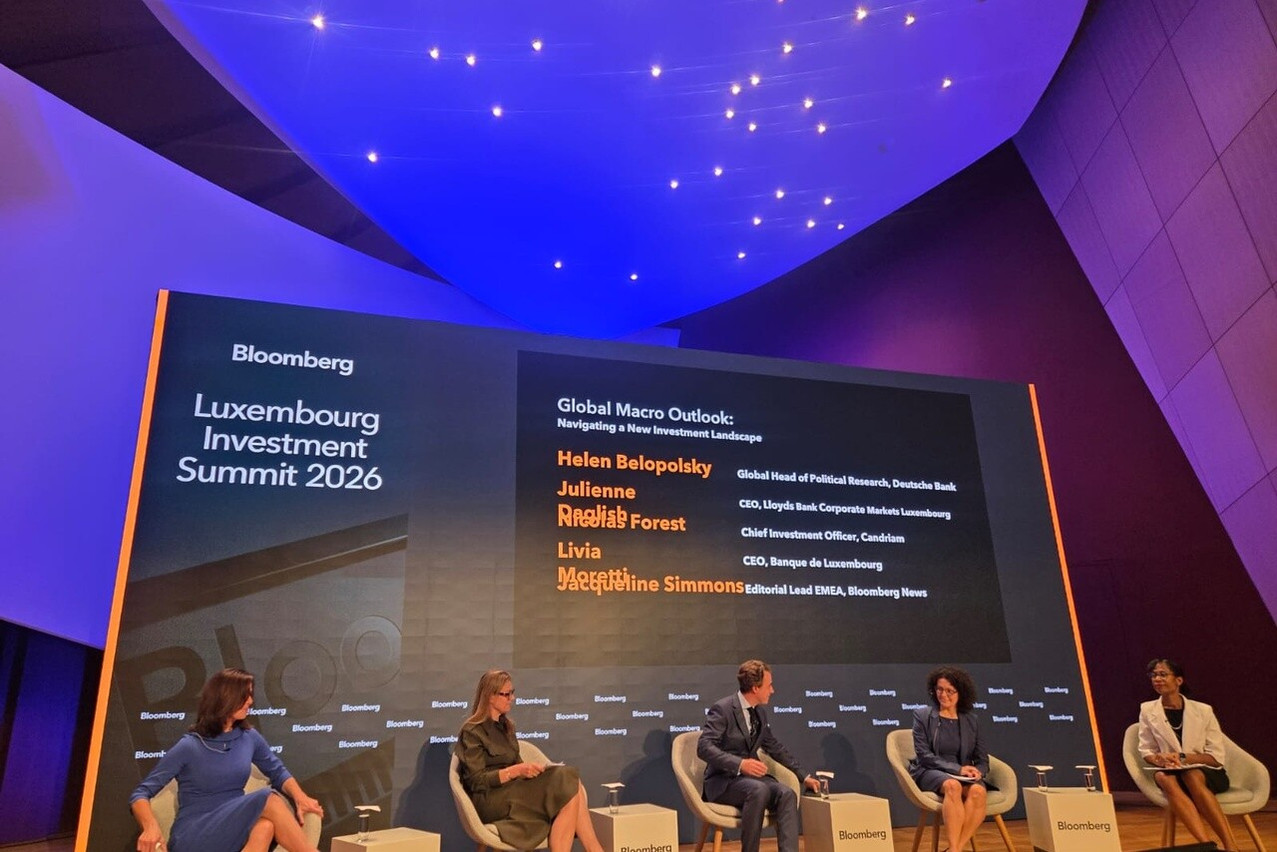
For investors hoping for a return to a more predictable geopolitical and economic environment, Helen Belopolsky had a warning: the biggest risk may be optimism itself. Speaking at the Bloomberg Luxembourg Investment Summit, Deutsche Bank’s Global Head of Geopolitical Research argued that investors and companies still too often assume that the disruptions of recent years will eventually give way to something resembling the previous global order.
“I think it’s optimism,” she said when asked which geopolitical risk markets might be underestimating for 2027. Instead, investors may have to prepare for several crises unfolding simultaneously. The consequences of the conflict in the Middle East could continue even after hostilities end, while the war between Russia and Ukraine, US-China tensions and political changes in Europe will remain important variables.
Rather than trying to identify the next single shock, Helen Belopolsky argued that investors should prepare for several possible scenarios at the same time.That idea of preparation rather than prediction became one of the central themes of the discussion.
Growth remains surprisingly resilient
The economic backdrop is nevertheless far from uniformly negative. Nicolas Forest, Chief Investment Officer at Candriam, pointed to stronger-than-expected global growth, particularly in the United States, where economic expansion could approach 3%. Despite geopolitical tensions and higher energy prices, US consumption has remained resilient while investment – particularly spending linked to artificial intelligence – continues to support activity. For Nicolas Forest, this helps explain why financial markets have remained strong despite concerns around valuations, inflation and geopolitics.
AI, he argued, should no longer be viewed simply as a technology story. The scale of investment involved has made it a macroeconomic factor in its own right. That investment boom is helping offset some of the negative forces currently affecting the global economy. But it also creates another risk investors need to monitor: whether the revenues generated by AI eventually justify the enormous capital expenditure being committed. The panel pointed to the extraordinary amounts being invested in data centres, computing infrastructure and technology. If earnings fail to catch up with that spending, the consequences could eventually feed through to markets.
Sovereign debt enters the equation
Another major change concerns government debt. For years, sovereign bonds from developed economies were treated as the safest part of portfolios. But rising public debt, higher interest costs and large issuance programmes are increasingly forcing investors to reconsider that assumption. Long-term interest rates cannot be explained by inflation expectations alone, the panel argued. Governments around the world are issuing large amounts of debt at the same time, putting additional pressure on bond markets.
That also creates competition for capital. States need investors to finance growing spending requirements, while companies – including technology groups funding the AI investment cycle – are also issuing debt. Nicolas Forest noted that the question is therefore no longer only about supply, but also about who will provide the demand, particularly as some traditional international buyers become less prominent in certain sovereign markets.
France under scrutiny
France emerged as one of the clearest examples of this new sovereign-risk environment. Nicolas Forest highlighted the deterioration in French public finances and the widening of sovereign spreads, arguing that investors increasingly need evidence of both the ability and the political willingness of governments to stabilise their debt trajectories. Credibility, he said, requires more than announcing a fiscal objective. Investors want to see a credible trajectory, concrete measures and evidence that governments are capable of implementing them.
The political calendar adds another layer of uncertainty. France's fiscal and political situation is therefore likely to remain closely watched by bond investors over the coming months, with potential implications extending beyond the country itself to European markets.
A more fragmented monetary landscape
Central banks are another source of divergence. After several years in which major monetary authorities broadly moved in the same direction, economies are increasingly entering different stages of their inflation and interest-rate cycles. For investors and businesses, that creates both complexity and opportunity.
Julienne Daglish, CEO of LBCM Luxembourg, stressed the importance of flexibility in funding and investment decisions as interest rates, currencies and economic conditions increasingly differ between markets. Nicolas Forest also pointed to opportunities emerging in fixed income, particularly in shorter maturities, as higher rates provide yields that investors had not seen for many years.
The new environment therefore does not necessarily mean avoiding risk. It means becoming more selective about where that risk is taken.
Can Europe mobilise its €11tn of savings?
Europe faces another challenge: turning more household savings into productive investment. Around €11tn is currently held in European household bank deposits, and policymakers increasingly want to channel a greater share of those savings towards capital markets to finance European companies, infrastructure and strategic investment. But the panel questioned how quickly that transformation can realistically happen.
One problem is structural. Moving substantial amounts of household deposits away from banks could have consequences for banks' own funding models. Another is cultural. 
European savers have traditionally held a much larger proportion of their wealth in deposits rather than securities. Changing that behaviour requires more than creating new investment products. Financial education, she argued, is therefore essential. But changing a savings culture takes time. The difficulty illustrates a broader European challenge repeatedly raised during the discussion: turning political ambitions into execution.
From prediction to preparation
Despite the list of risks, the panel was not uniformly pessimistic. Helen Belopolsky argued that the geopolitical transformation underway is also creating significant opportunities for companies and investors able to identify them. Changes in trade corridors, the growing strategic importance of sectors linked to security, technological transformation and the interaction between demographics, climate and geopolitics are reshaping where capital can be deployed.
The investment landscape is therefore not simply becoming more dangerous. It is becoming more complex. And complexity requires a different approach. Rather than trying to predict precisely which crisis will come next, investors may increasingly need to build portfolios and organisations capable of functioning across several possible outcomes. For Helen Belopolsky, the key word is resilience. For the other panellists, anticipation.
As the investment environment enters 2027, the common message was clear: the objective is no longer to wait for uncertainty to disappear, but to be prepared to invest through it.