
How does this type of financing work?
Interview with Pit Linster, Head of Companies & Entrepreneurs at Banque de Luxembourg, and Anne Goedert, Head of Family Practice at Banque de Luxembourg, who go over the main concepts behind this type of financing and the help and value it can bring to entrepreneurs and managers in their projects.
How does "private equity" work?
"Private equity" is the acquisition of a stake in the capital of a company that is not listed on the stock exchange, enabling it to finance its growth and carry out its transformation or transfer projects. This type of financing can be used at certain stages in the life of a company: at its creation, during a development project, in the event of a crisis, during the acquisition or transfer of the company...
This financial investment may be accompanied, depending on the investors, by a strategic contribution in the form of know-how, expertise, a network...
What are the added values of private equity for the company?
According to investors, private equity is characterised by its contribution of skills and networks, its ability to help transform companies and its capacity to promote sustainable practices. These equity investments enable companies to grow and innovate more effectively while creating value for investors and society.
Why is this type of financing still not widespread in Luxembourg?
Historically, private equity funds have been interested in larger companies than those that populate the Luxembourg economic landscape, which is characterised by small and medium-sized family businesses.
Furthermore, in our country there is a financing culture that is more focused on bank loans. Luxembourg companies are generally unfamiliar with this type of financing and there are very few players in Luxembourg promoting it.
Finally, opening up capital to third-party investors is not a natural move for a family business. And yet, the opportunities that such an opening can present are manifold.
Concretely, what can this bring to a family business?
Today's family businesses face a number of challenges and issues to ensure their growth and long-term survival. Involving an institutional investor in their capital can offer real strategic advantages, ranging from financial stability to opening up new markets, improving governance or supporting sustainability objectives.
A professional, external shareholder is also a reassuring presence for a manager who is often alone, and can play the role of a "sounding board".
In other words, it is a structuring and objective view that can help family businesses meet many challenges and take a step back.

Anne Goedert, Head of Family Practice Banque de Luxembourg
How can the financial participation of a third party facilitate a transfer?
Whether in the context of a sale of company shares to a director or key manager, for example, or with a view to passing the torch to the next generation, third-party investment makes it possible to breathe life into the capital and pass on a company in one or more stages. On this occasion, the investor mobilises the financial resources needed to buy out a block of shareholders, which can also make it possible to compensate (future) heirs who do not wish to join the family business.
How does Banque de Luxembourg promote this type of financing to its customers?
To help our customers better understand this model, we organise workshops featuring entrepreneurs who have opted for this financing model and experts from Crédit Mutuel Equity, our exclusive partner. At our latest workshop, Nicolas Ruggieri, head of the family business with an impressive track record, Batipart, spoke about his experience with this type of financing.
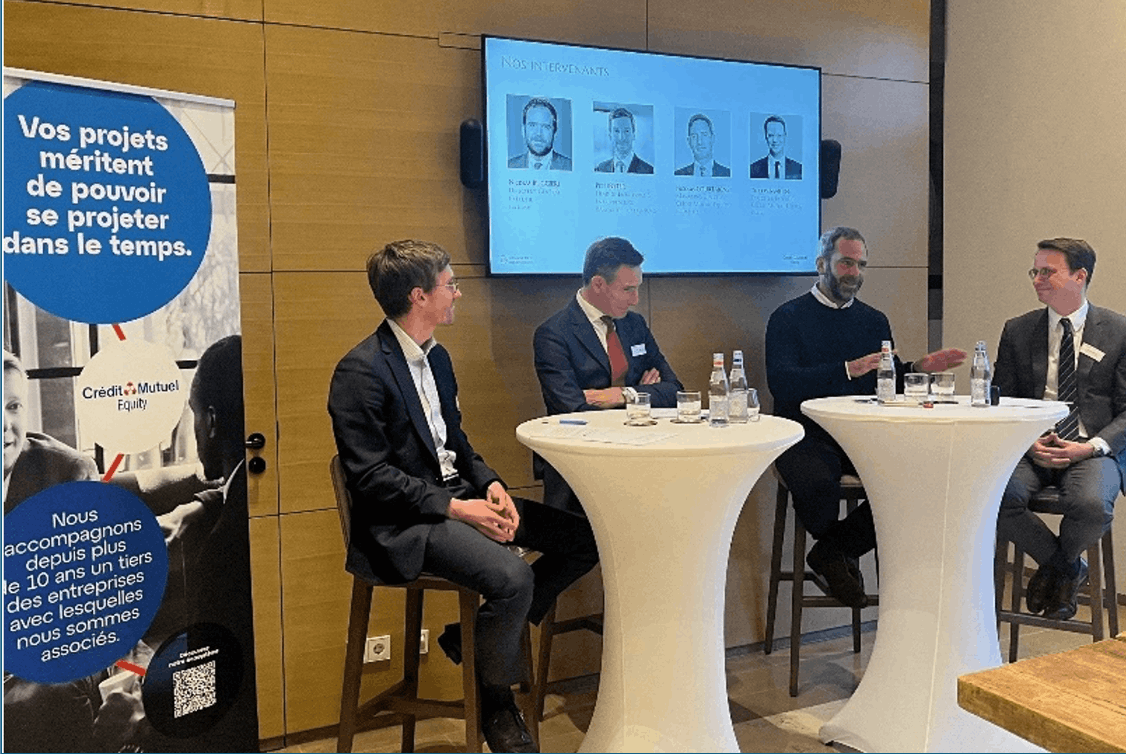
Experts from Crédit Mutuel Equity Banque de Luxembourg
At this event, Crédit Mutuel Equity, a subsidiary of our group Crédit Mutuel Alliance Fédérale, presented its approach based on minority shareholdings and long-term support, in equity, unlike many funds that invest the capital entrusted to them by third parties over shorter time horizons and seek a quick exit with high profitability.
Crédit Mutuel Equity, which is a shareholder in more than 300 companies, supports its portfolio companies throughout the duration of their transformation or growth projects with a genuine desire to preserve and strengthen the company's financial and extra-financial value over the long term. The entrepreneur and Crédit Mutuel Equity first and foremost choose each other and move forward on the basis of a roadmap defined together, an alignment of interests, while prioritising transparency in exchanges and mutual trust.
From our side, the combination of our knowledge of the local market for Luxembourg family businesses and this virtuous model enables us to benefit not only from additional capital, but also from a team of experts who put their know-how and their network of professionals to work for the benefit of the company's strategy, providing tailor-made support for development projects.
We offer our customers the benefit of this approach, which is clearly part of our support culture. As a strategic partner to Luxembourg entrepreneurs, the Bank wishes to provide practical answers to managers for whom opening up their capital to an institutional investor could be an opportunity.
---
Pit Linster, Head of Companies & Entrepreneurs at Banque de Luxembourg.
Anne Goedert, Head of Family Practice at Banque de Luxembourg.