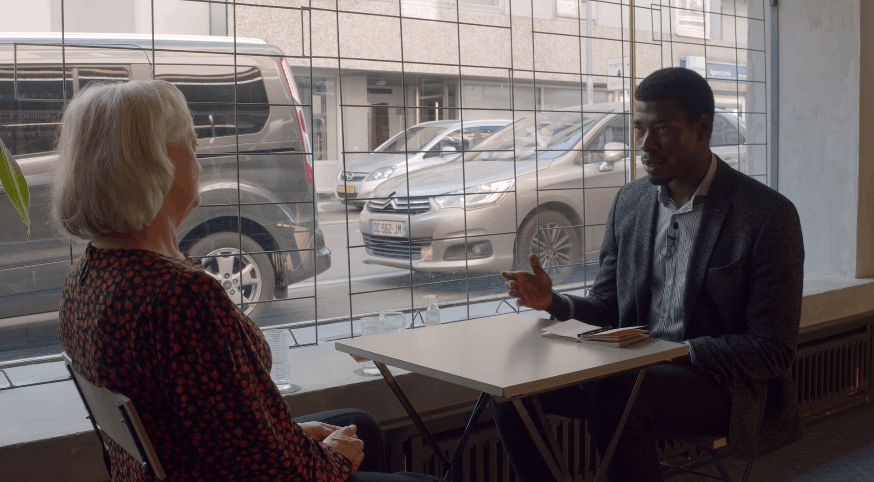
As part of the Sunday specials organised by the Dudelange-based Documentation Center on Human Migrations (CDMH) to promote intercultural exchange, Déterré pushes the unspoken boundaries of conversations and delves into several topics ranging from religion to the status of black women in Europe, integration challenges, as well as potential migration policies that could support the ever-growing demographic changes in Luxembourg.
No topic is off-limits in the conversations between the two strangers from different worlds, who meet for the first time on set and sit across each other to share their thoughts on several hot topics.
“I often hear people say they would love to meet Luxembourgers but they find it quite difficult to locate them and so I thought it would be interesting to create a platform for both parties to meet, and we developed the concept during the first exchanges,” says producer Akim El Ouardi.
“Déterré means to uproot and in a sense to search for things that were hidden,” he explains, adding that he has always been fascinated by the topic and was immediately interested when CDMH approached him.
“I’ve observed a sort of cultural divide in Luxembourg. We have so many diverse communities from different parts of the world, but I’ve always felt these communities were separated. Of course, it also depends on where you live. For example, this divide is less extreme in the south of the country. I’ve always wondered if this is really the real situation or if this was just my observations,” he explains.
The topic of cultural divides leads us to the question of language, which he explains is not necessarily a contributing factor to the split between the several large communities. “Most people here speak French or even English, and given that Luxembourgers learn several languages, this shouldn’t be a barrier,” he clarifies.
From a societal point of view, he poses the question of how and if colonial features that encouraged inter-cultural fragmentations still exist today? “That’s also the idea behind the documentary series, to ask these questions and try to find some responses,” he reiterates.
Some media, indirect effects of policies, family background, repeated stereotypes in films are all examples he cites as possible sources that could fuel existing stereotypes and build an even larger divide.
The main goal for the series--which he expects to be prolonged in the future--is “to start and facilitate a dialogue and encourage people to get to know each other. To build a bridge and remove xenophobic tendencies and the fear of the other by both parties,” he states.
The nationalities that feature in the series include two people from Guinea, two from Cameroon, one from Morocco, and Luxembourgers, who are all engaged in different professions and belong to different age groups and gender.
“The initial idea was to produce more episodes and include a more varied mix of backgrounds, but then we realised this wasn’t feasible due to time, budget and logistic constraints, but we had a lot of interested people from the onset.”
The project took about four months from pre-production to final editing. El Ouardi, a Luxembourger with a Moroccan heritage, studied motion design in Berlin with a focus on 3D animation and currently works as a videographer and has an interest in experimental films.
The documentary series is in French and will be subtitled in English. Send an e-mail to info@cdmh.lu to register for the presentation on 6 February. The series can also be viewed on Vimeo from 7 February.
The CDMH studies migration in Luxembourg and the greater region. It’s activities are financed by multi-annual agreements with the ministry of culture and the city of Dudelange.