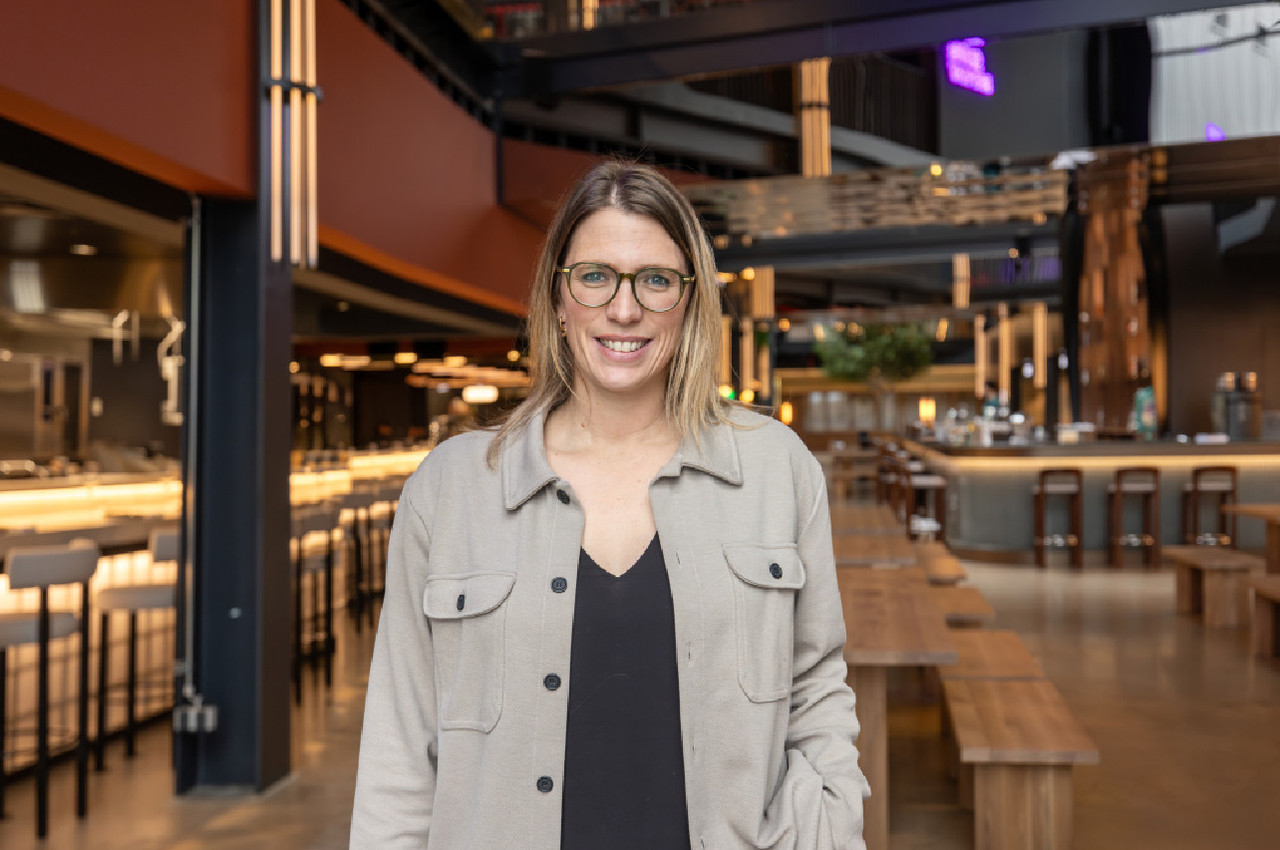
Arriving at Concept & Partners as HRD at the beginning of the year, Mélanie Odille boasts a career deeply rooted in operations. After working for Flunch in France and Compass Group in Luxembourg, she managed restaurants before moving on to HR and transformation functions. This dual culture, on the ground and strategic, is now shaping her vision: an HRD close to the teams, connected to the realities of the service and convinced that performance comes first and foremost through understanding the field.
How did you get to Concept & Partners?
Mélanie Odille. – "I was looking for a new position. When I looked at the market, Concept & Partners caught my eye. It’s a fast-growing company, and that’s precisely what interested me. But beyond the dynamics, it was above all the people I met that were decisive. I spoke to the two co-founders [Christophe Diederich and Marc Fusenig, editor’s note]. Their desire to professionalise the organisation without altering its culture spoke to me immediately.
I particularly liked their vision of human resources as a strategic, neutral function, positioned between management and the teams and focused on the collective interest. They explained to me that they had grown enormously and now needed to structure themselves further. They were looking for someone who could bring a more strategic dimension to human resources, while retaining a real operational connection. And that’s precisely the balance that structures my career path.
If you had to sum up those first few months in one word?
“Fun. I’ve discovered a Luxembourg company that’s entrepreneurial and has a real hands-on culture—an environment that suits me perfectly. It’s a far cry from the logic of a large group, with its more cumbersome processes. What impressed me most was the commitment of the teams. They’re young, dynamic and committed. This collective energy creates a particularly stimulating atmosphere.
If you had to name three qualities that make you a good HR director, what would they be?
“The first is listening. I often say that good ideas are already in the heads of our employees, in the field. If we really take the time to listen to what they have to say, we can implement a lot of things quickly. Then there’s empathy. This is the same as listening, of course, but with the ability to understand situations, constraints and individual realities. And finally, perhaps the most important quality: neutrality. An HR stance that is neither pro-employer nor pro-employee, but focused on the common good. I’m deeply convinced that we can combine performance with good human relations, while respecting everyone.
Does being HR director of a group of 2,300 people or an organisation with around 500 employees make any difference in terms of management?
“At Compass, there were three companies—food, cleaning and personal care—with a structured organisation and HR managers in charge of each entity. My role there was more strategic, very much focused on transformation and digitalisation. At Concept & Partners, we also have a form of triple organisation with catering, the food hall and the restaurants. The scope is smaller, but I’m now much closer to the ground, which creates a more direct connection with the teams.
In a demanding sector like yours, how do you attract and retain talent?
“You have to offer real prospects. Employees should not feel that they are in a fixed position. The diversity of our activities is an asset. Some people, often younger, start out in clubbing establishments, attracted by energy and rhythm. At another point in their lives, they may move on to restaurants that are more compatible with family life. It’s not yet totally structured, but it’s clearly the direction I want to take: giving greater visibility to career paths and developing internal mobility.
With teams spread over several sites, how do you build a real company culture?
“I want to reintroduce a tool that I’ve already tried out elsewhere: an internal application that’s a bit like a corporate social network. Employees can exchange and share information specific to their site—a new opening, an afterwork, a special initiative—but also access more formal content such as the collective agreement, internal regulations, benefits, pay slips or training courses. The idea is simple: to create links and maintain a shared culture, even when the teams don’t cross paths on a daily basis.
Beyond this application, what are your other priority projects?
“Redefine a transparent recruitment and remuneration policy. Without a structured framework, we lose consistency. Especially as the new European rules on pay transparency mean we have to think ahead. This also includes processes: simplifying the candidate experience, clarifying the role of managers, structuring onboarding and making the integration process more fluid. My aim is to rethink the entire employee journey—from recruitment to the first few months—to make it clearer, more consistent and more professional.
Does this involve more digitalisation?
“It’s still a bit early to go into detail. The tools already exist, and digitisation will involve the internal application in particular. I’ve already managed digital transformations. With hindsight, I know that you can go too fast. Change can be positive, but it can also be destabilising for teams. This time, I want to move forward more gradually. The challenge is to get everyone on board. The challenge this year is to analyse what’s working and to correct what’s not working so well.
The sector is changing fast: is training still the determining factor or do we first recruit personality and the ability to adapt?
“Experience is central to our recruitment policy. However, training remains a key criterion. A specialised course is a real guarantee of seriousness, particularly in terms of hygiene and food safety. We serve thousands of meals: when it comes to these issues, there’s no room for guesswork. For service-oriented professions, the approach is slightly different. Soft skills are essential: people skills, energy, the desire to please. Above all, we’re looking for committed people.
On the other hand, for certain positions, technical skills are essential. A chef needs to be trained: in the long run, the absence of a solid foundation always shows. There are incompressible minimum requirements, because they relate to our professionalism, our brand image and the premium environments in which we operate. As soon as you feed someone, the level of requirements is inevitably high.
How should the relationship be between an HR director and a CEO?
“The ideal relationship is to have a real impact on the decisions that are taken. Being an HRD is not just about providing support: it’s about contributing to, influencing and participating in the company’s important choices.
Is the HRD on the board at Concept & Partners?
“At this stage, I’m not formally part of the exco. The company is in the process of being restructured. It recently took on a managing director to run the catering business, and governance is gradually evolving. In practice, however, my role is fully integrated into the strategic thinking. I don’t see any discrepancy between the organisational chart and the reality on the ground. And I hope that in time, as has already been the case in the past, I will formally join the exco.”