
On the packed programme for the fiftieth anniversary of media pluralism in Luxembourg, Martin Senftleben, professor of intellectual property law at the University of Amsterdam, was not necessarily the most exciting speaker. Yet this expert brought the same ‘refreshing’ breeze into the National Library that had swept over the people of Luxembourg outside that Wednesday morning.
Just imagine. A levy – say, ten euros – on every prompt in an artificial intelligence window, for example in Google’s search engine, which captures the advertising revenue generated by news websites and channelled to the American tech giant. Then a fund responsible for collecting this money from that same giant and ensuring the distribution of revenue to media publishers. Admittedly, it would have taken more than the 24 minutes of his speech to explain the full extent of this mechanism designed to give the media back at least a larger share of the fruits of their labour (and their independence), but it is not certain that Cédric Manara, Google’s Director of Copyright, sitting in the second row after explaining why Google was more committed than the others, really ‘appreciated’ the value proposition.
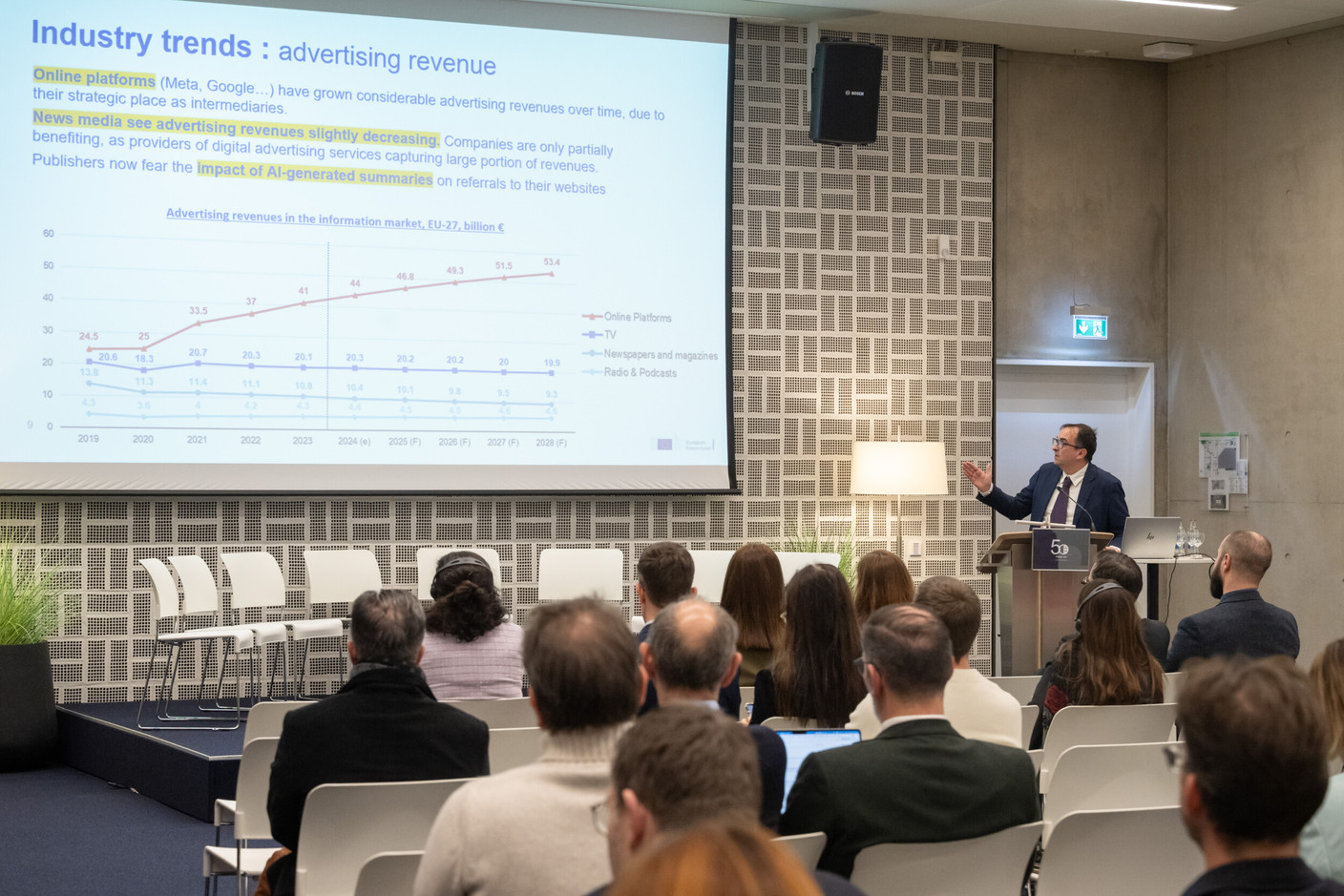
Together, they sum up very well the challenges facing the future of the media, at a time when – following an initial era in which Google became the hub for distributing visibility – the tech giant is seeking to maintain that position by offering news summaries that are enough for a generation less keen to pay, less keen to read ‘traditional’ media, and keen to save time… only to waste it on social media.
“An investment in democracy”
Two hours earlier, the Prime Minister, 
The decision taken in 1976 enabled several media outlets to survive in a market that was too small for them all to thrive on commercial principles alone. Technologies and practices have changed. But the fundamental role of a professional, independent and pluralistic press has not.
The Prime Minister pointed out that, as Budget Minister in 1998, he had already signed a law that no longer referred merely to ‘aid’, but to the ‘promotion of the print media’. The new law, passed in the summer of 2026, broadens the scope even further by linking access to information, professional journalism and democratic debate.
Artificial intelligence does not call this mission into question. It makes it all the more urgent. “Research, fact-checking and investigative work all come at a cost,” insisted Luc Frieden. He therefore refuses to choose between technological progress and the long-term viability of the media. In his view, Luxembourg must be among the countries that adopt AI most rapidly, but also among those that master it. “Democratic resilience requires professional journalism,” he summarised, referring to the external manipulation and disinformation campaigns that now accompany European elections.
Financial support is not enough, however. The aim is to preserve a press that is independent of political influence, comprising both large and small organisations, whilst enabling it to adapt to new tools.
Today’s news, tomorrow’s history
Claude D. Conter then explained why the venue chosen for the day was by no means a random choice. The National Library of Luxembourg is digitising the country’s press collections and gradually making them available to the public. “Today’s news is tomorrow’s history,” summarised its director. This history can only be preserved if newspapers, their archives and the data they contain remain accessible under transparent conditions.




The issue takes on a new dimension when European press content is used to train the artificial intelligence models of international groups without the producers of that content receiving adequate remuneration. In the face of these companies, Claude D. Conter presents the National Library as a trusted third party acting in the public interest, whilst respecting copyright.
He also raised concerns about requests to remove old articles held in digital archives. In his view, Luxembourg must strike a better balance between the protection of personal data and the freedom of expression and information provided for in Article 85 of the General Data Protection Regulation. Without a clear framework, the accumulation of individual deletion requests risks gradually undermining the integrity of the archives. Yet, enabling everyone to consult what has actually been published is not merely a technical task. It is a prerequisite for democratic debate.
In 1972, radio and television
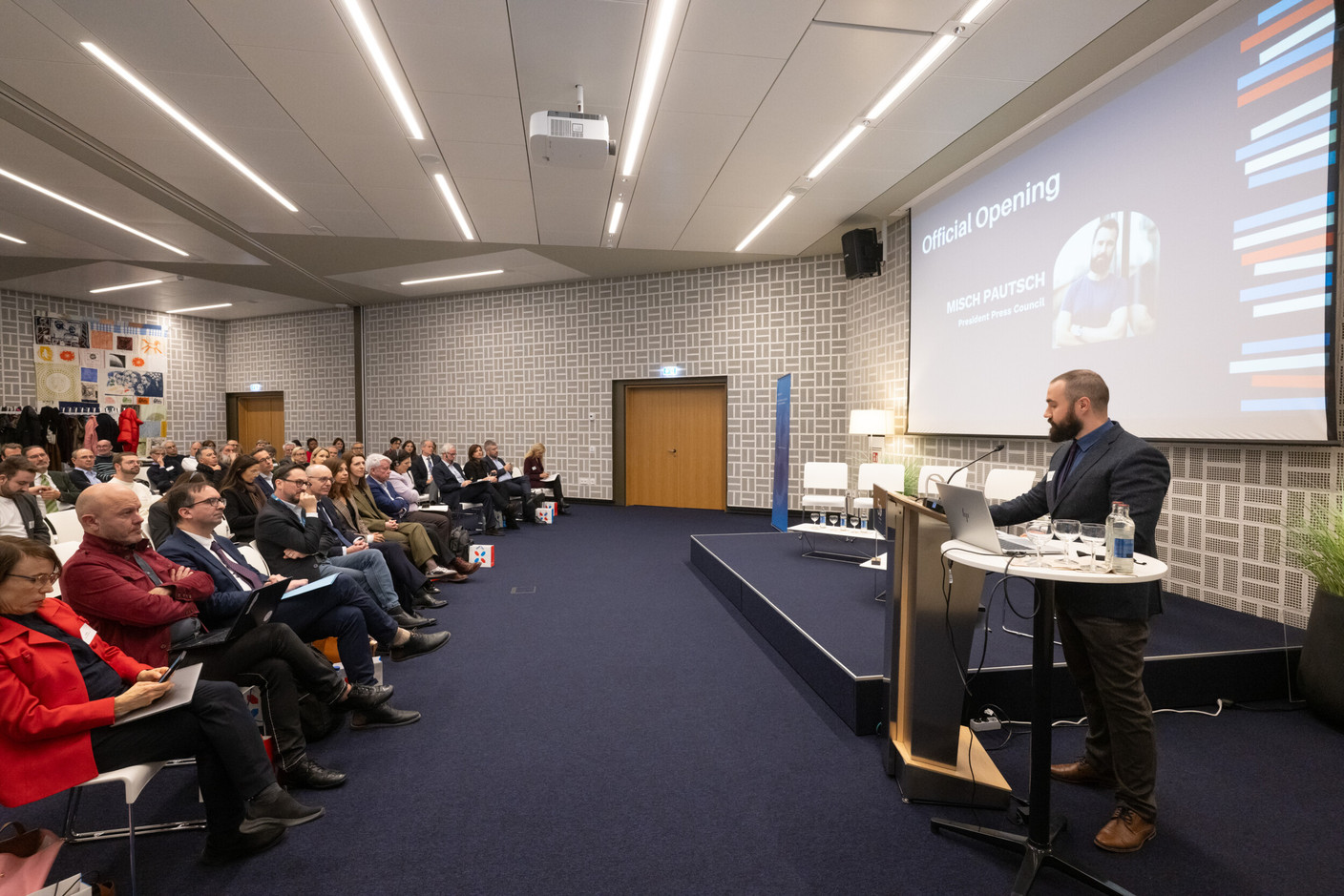
Misch Pautsch also delved into these archives. The chairman of the Press Council found a parliamentary debate from 1972 there. MPs were already concerned about rising costs, falling newspaper revenues and competition from new media: radio and television.
Half a century on, the scale of competition has changed. Platforms distribute content, capture advertising revenue and accustom users to what appears to be free news. Artificial intelligence is now generating text, images and synthetic voices that are becoming increasingly difficult to distinguish from genuine content.
This confusion threatens the common factual basis on which a democratic society rests. When it is no longer possible to tell whether a voice, an image or a piece of information is genuine, trust disappears. And with it, our ability to debate and make collective decisions is undermined.
For Misch Pautsch, journalism must remain a source the public can rely on when they have doubts about what they see or hear. But this trust does not exempt the media from questioning themselves. The sector has failed to find a sustainable model after establishing the idea that online news could be free.
In this context, the Luxembourg system embodies a democratic paradox: the government also funds those whose job it is to monitor and criticise it. This support does not guarantee the survival of the media. It gives them the means to continue seeking a solution.
No longer just making up for losses
Elda Brogi has placed this model within the European context. The deputy director of the Centre for Media Pluralism and Media Freedom at the European University Institute has observed a paradox: there has never been so much information available, yet the attention required to read it has become a scarce resource.
In this market, the democratic value of journalism no longer matches its economic value. Newsrooms are shrinking, local newspapers are closing down, and in-depth investigations or stories of public interest are becoming harder to fund. At the same time, platforms, influencers and new content producers are vying for the public’s attention.
Algorithms initially decided which information would be visible. Artificial intelligence systems go one step further: they re-frame the information and respond directly to users, often without referring them to the media outlets that produced the facts in question.
Public funding should therefore no longer merely compensate for the sector’s losses. It should also fund its adaptation: shared digital infrastructure, technological investment, collaboration between newsrooms, and new business models that are less reliant on the major platforms.
It remains to be seen who will benefit from this. Journalism is no longer produced exclusively by traditional newsrooms. Digital media outlets, investigative organisations, newsletters and freelance journalists also contribute to media pluralism.
Elda Brogi suggests focusing less on the platform itself and more on the guarantees it offers: transparency of ownership, professional standards, editorial independence, accountability and the production of original journalistic content. However, this shift requires that editorial freedom be protected against any politically motivated selection of beneficiaries.
National policies will not be enough. Decisions on the regulation of platforms, competition, copyright and AI systems are largely taken at European level. Public support must therefore form part of a broader strategy to redistribute value and limit the power of intermediaries.
“Will the editorial team still be able to say yes tomorrow?”

“Will the editorial team still be able to say ‘yes’ tomorrow?”, asked the Minister of State for Media and Connectivity. The Luxembourg system is designed precisely to enable this positive response: to allow time for further analysis, verification and investigation.
Advertising and subscriptions alone are no longer enough to fund this work. For Elisabeth Margue, the responsibility must be shared. Public authorities support pluralism. Citizens must understand that information comes at a price. Advertisers must assess the impact of their investment decisions. Journalists, for their part, must provide what other stakeholders cannot offer: “verified facts, investigations and, above all, context”.
They must also ‘reach out to readers where they are’. Artificial intelligence can assist them in research, data analysis, production, distribution and engagement with the public. It can even become a competitive advantage, provided that its suppliers respect editorial autonomy and media independence.
But the shift in the balance of power is already evident. “Search engines are becoming answer engines,” the minister warned. They are thus taking on a role previously fulfilled by the media, whilst enabling readers to access information without visiting the source that produced it.
The issue is not merely economic. Malicious actors can taint the data used by the models with false or biased content. According to Elisabeth Margue, ‘sound media literacy and high-quality professional journalism’ are the best remedies against disinformation and the misuse of artificial intelligence.
Charge for the response rather than for the copy
Martin Senftleben finally suggested shifting the focus of the debate. Copyright protects the way in which a journalist writes a news story. It does not protect the information itself. Artificial intelligence can therefore take in the findings of an investigation, rephrase them and reproduce them without copying the article.
The professor distinguishes between two uses that are often confused. The first is the general training of a model using a vast corpus of texts. The second involves searching for and consulting articles at the very moment the user asks their question, in order to construct an up-to-date response.
In the latter case, the substitution is direct. The search engine provides most of the information. Even when a link appears, the reader often no longer needs to click on it. The media outlet bears the production costs. The platform retains the user.
Hence the idea of a payment obligation based on the responses generated. The remuneration would be collected from providers or professional users of AI systems, and then distributed by a collective management organisation amongst publishers and journalists. A share could go directly to the authors rather than depending entirely on the distribution decided by their employer.
Large media groups that consider their catalogue to be sufficiently strong could opt out of the scheme and negotiate their licences independently. Above all, the collective system would give small publishers and freelance journalists bargaining power, provided they are not overlooked when determining who is eligible.
The mechanism could also be used to measure the diversity of sources featured in the results. For the next battle will not only be about the remuneration for articles consumed by machines. It will also determine which media outlets, opinions and journalists remain visible in the space where a growing proportion of the public now turns to for news.