Today, what is the main challenge large companies face when assessing their risks
Charlotte van Bouwel, Advisory Leader Marine, Cargo and Logistics Europe: Lack of visibility. Many companies have a good understanding of their tier-1 suppliers, but very few know what happens beyond that level. Yet major vulnerabilities are often found among subcontractors. A supply chain disruption rarely comes from the supplier everyone has identified, but more often from a tier-2 or tier-3 subcontractor.
We are a consulting and services firm specialised in complex risks.”

Are executives aware of this threat?
C.v.B.: Today, more than 60% of companies acknowledge that their supply chain represents a major risk for their activity. Recent crises have shown how a disruption — even at a remote supplier — can temporarily halt an entire production process. At the same time, nearly 90% of executives now consider geopolitical tensions to be one of the main threats affecting their supply chains.
How does Marsh support its clients in this context?
Luc Verbiest, Country Manager Luxembourg: We are a consulting and services firm specialised in complex risks. Our role is to analyse companies’ actual exposure. We do not work “against’’ insurers, but with them, for the benefit of our clients. Protecting our clients’ balance sheets is our mission.
What concrete solution have you implemented?
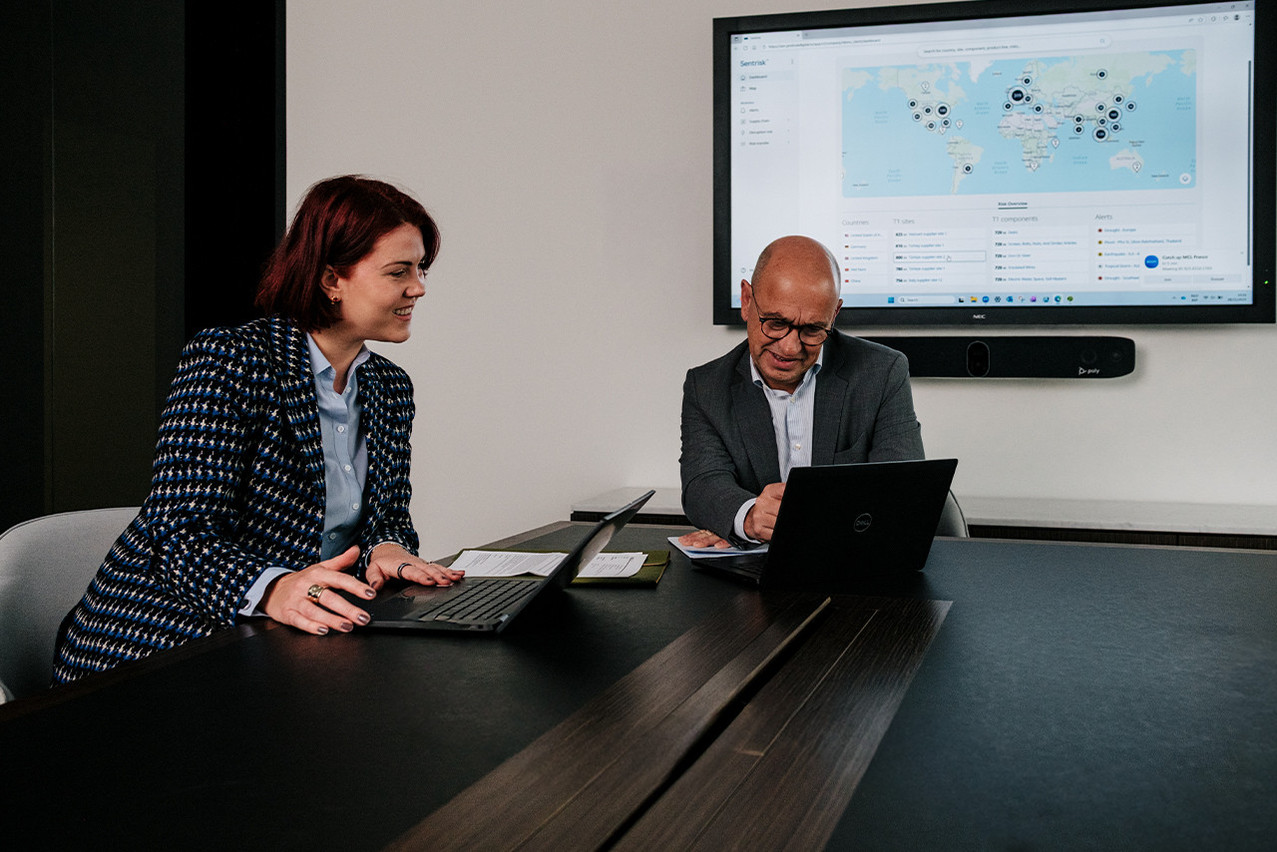
L.V.: We developed Sentrisk, a powerful tool that enables a precise analysis of supply chain risks.
C.v.B.: When clients log in, they see an overview of their entire supply chain, including ongoing alerts and notifications. We reveal the layers of dependency within the chain. A client may know their tier-1 site in Vietnam, but be unaware that it depends on 63 suppliers. Everything is recorded—from raw materials to finished products.
Sentrisk’s analyses rely on data. How do you collect it?
C.v.B.: The client provides information on their sites and direct suppliers. From there, we leverage our data lakes: vast databases containing information we hold on companies, their suppliers, shipments and claims, among others. AI is used to read and extract the information, but nothing is automated. Every element is validated by our team.
Isn’t AI likely to generate inaccurate results?
C.v.B.: This is precisely why everything is manually checked by our team. We apply a critical eye to the data. The goal is not to produce an automated mapping, but a reliable representation of reality.
How does this data translate into concrete analyses for your clients?
C.v.B.: Once the information is structured, we can map the client’s entire supply chain within Sentrisk. We highlight dependencies, regions with high supplier concentration, and critical sites exposed to natural or geopolitical risks. Most importantly, we can simulate the impact of an event and estimate its financial consequences. Sentrisk supported us during a recent assignment where a bank estimated a loss scenario at 10 million euros. After our simulations, the loss was closer to 50 million.
AI will accelerate risk analysis, but decision-making will remain human.

Do you have an example where this approach helped prevent a crisis?
C.v.B.: For an industrial company facing a tariff increase, Sentrisk enabled us to identify alternative transport routes. Thanks to this analysis, the company reduced its costs by several million euros during the launch of a product.
How do you view the future of risk management in the age of AI?
C.v.B.: AI will accelerate risk analysis, but decision-making will remain human.
L.V.: The key word, today and tomorrow, is resilience. Our mission is to help companies be better prepared before a disruption occurs.