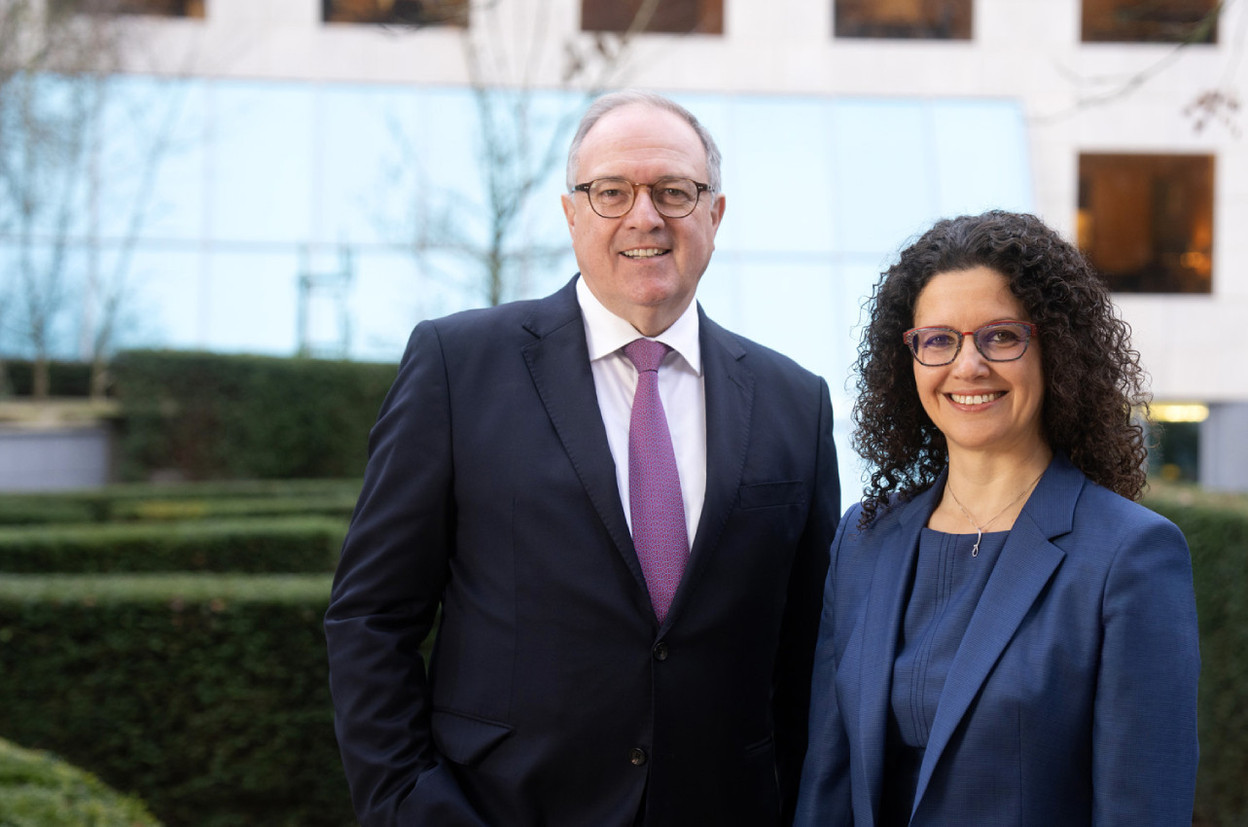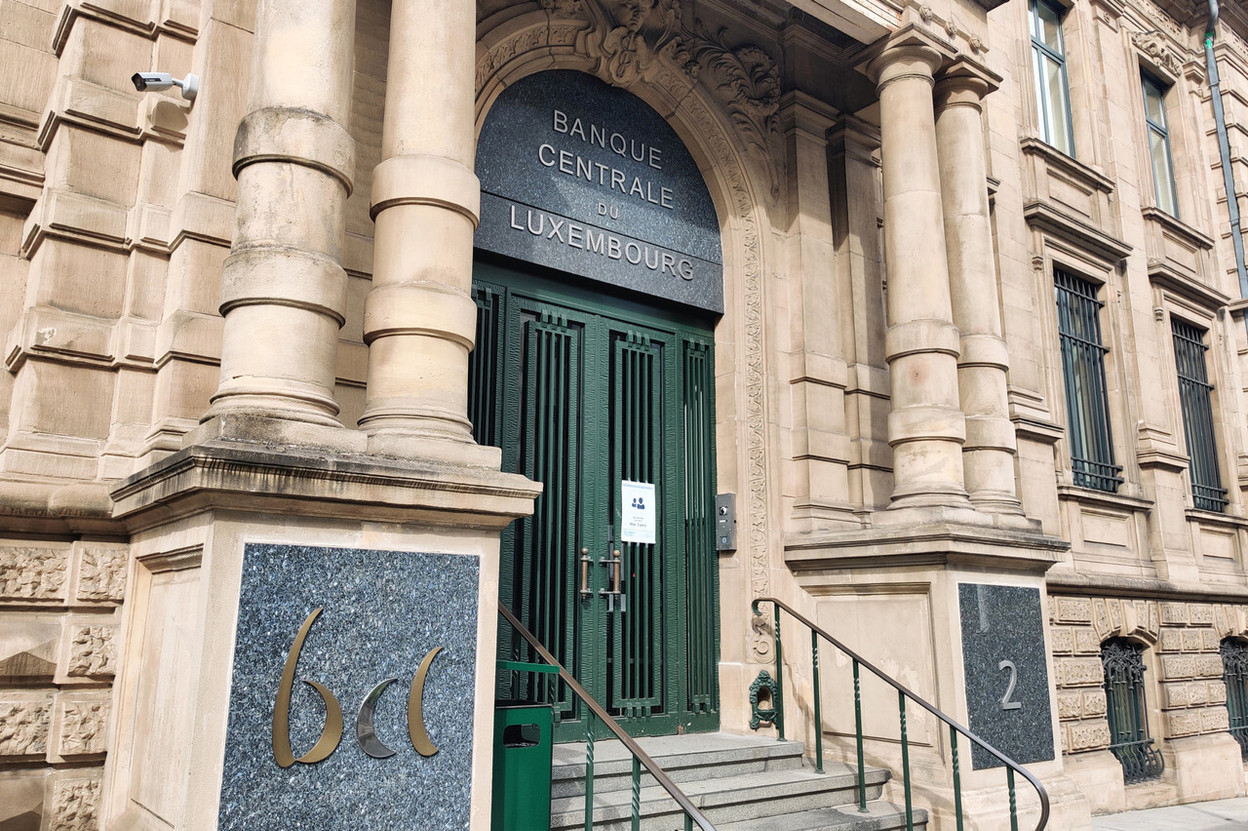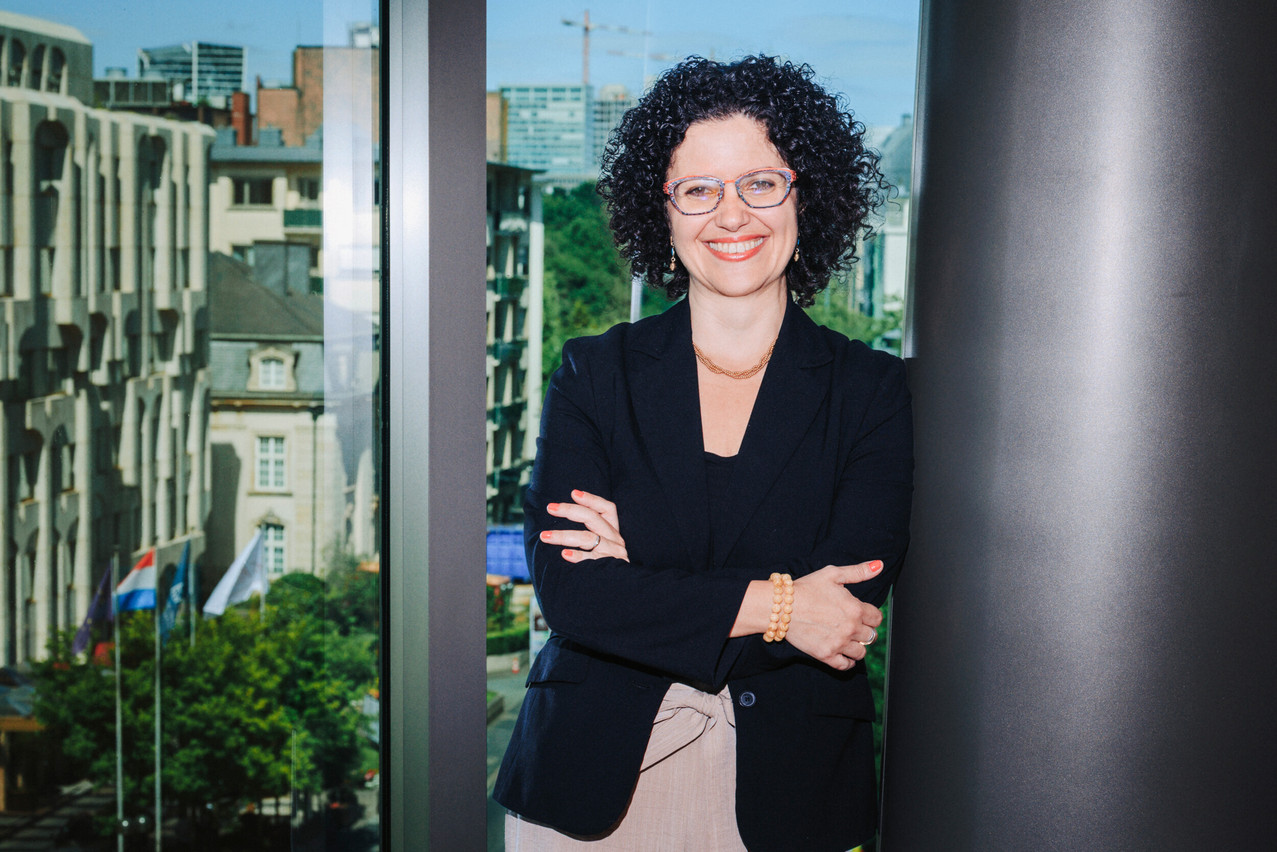
Did you start your career at KBL… which was already located on the other side of Boulevard Royal [opposite the Banque de Luxembourg]? Was it already there?
Livia Moretti. – “Yes, the KBL was already on the other side of the boulevard.
It must be quite a special feeling to come back to this very spot, mustn’t it?
“Yes. I told my colleagues that I remembered, when I started out in Luxembourg in the early 2000s, that there were some leading banks, and that the Banque de Luxembourg was one of them. Every morning, I’d look at that bank… but it was KBL that offered me my first contract. For someone coming from Italy, who hadn’t quite finished her studies at Bocconi University, that work placement was almost beyond my wildest dreams. When I was approached to take over from Pierre [Ahlborn, ed.], I felt that special connection. I accept this responsibility with a great sense of honour.
Tell me about the circumstances surrounding your arrival in Luxembourg!
“Just imagine: it’s the 2000s. You’re a young university student. You want to gain some international experience. You look at the leading financial centres: London and Luxembourg. When I arrived here, I was deeply impressed by how compact the country is, and by its very human feel. The welcome I received here was unique, and I still talk about it with my children. I didn’t feel homesick. At the same time, I’d always been told not to look abroad for things you couldn’t find abroad. Italy is Italy, and Rome is Rome. From a very young age, learning languages has been very important to me. And I could have returned to Italy very quickly and often, but that didn’t happen because I met the man who would become my husband. Not only did this little country give me so much and place its trust in me, but for my part, I put a great deal of effort into every role I took on, at KBL and afterwards.
What would the person you’ve become today say to the Bocconi student you once were? There are still plenty of students from Luxembourg at Bocconi today.
“It’s very simple! I’d say to them: ‘Go for it! Don’t be afraid!’ Moving to a new country can be worrying, but there’s no point in letting your fears get the better of you. You just have to go for it and believe in yourself.
At that time, in the early 2000s, Luxembourg was still enjoying the heyday of its financial sector before the crisis of 2008 and 2009. What are you learning about wealth management? What have you learnt from KBL? What new aspects of the industry have you discovered?
“I had a solid academic grounding that Bocconi University had given me. It was only once I was there that I discovered the rigour of real-world analysis. I started carrying out financial analyses. You have real companies asking you for lines of credit, with real clients, and you have to put proposals together for them. The fact that my managers at the time involved me directly in the day-to-day running of the business enabled me to learn the trade quite quickly.
Did you already love this job?
“The best proof is that I accepted the contract offer even though I was supposed to return three months later!
What did you want to do when you were at Bocconi?
“I wanted to pursue an international career. That’s part of my upbringing. That’s the purpose of my education. My father travelled abroad a great deal for work, and he realised very clearly that, without learning foreign languages, my prospects as a young woman would have been extremely limited. I remember those afternoons spent with a tutor doing lessons in French, German and English… At the time, I didn’t really understand why I had to learn these languages whilst my friends were off playing volleyball… But over time, it became a game. On holiday, I could chat with foreigners. By the age of 15, I was fluent in all three languages. That was quite rare in Italy at the time. I couldn’t see myself pursuing a career in Italy, and if I hadn’t had the opportunity in Luxembourg, I would have carried on looking. It’s a question of consistency, respect and ambition.
Is it your drive, your ambition, or is it simply a matter of seizing opportunities because you’re not afraid?
“I have been fortunate in my career, particularly during my time at the European Central Bank, to work alongside great statesmen and stateswomen, as well as senior civil servants who had a vision. I remember something the Governor of the Bank of England once said: that the ultimate aim of public administration must always be to move forward. I have always told myself that we must keep moving forward, keep making progress.
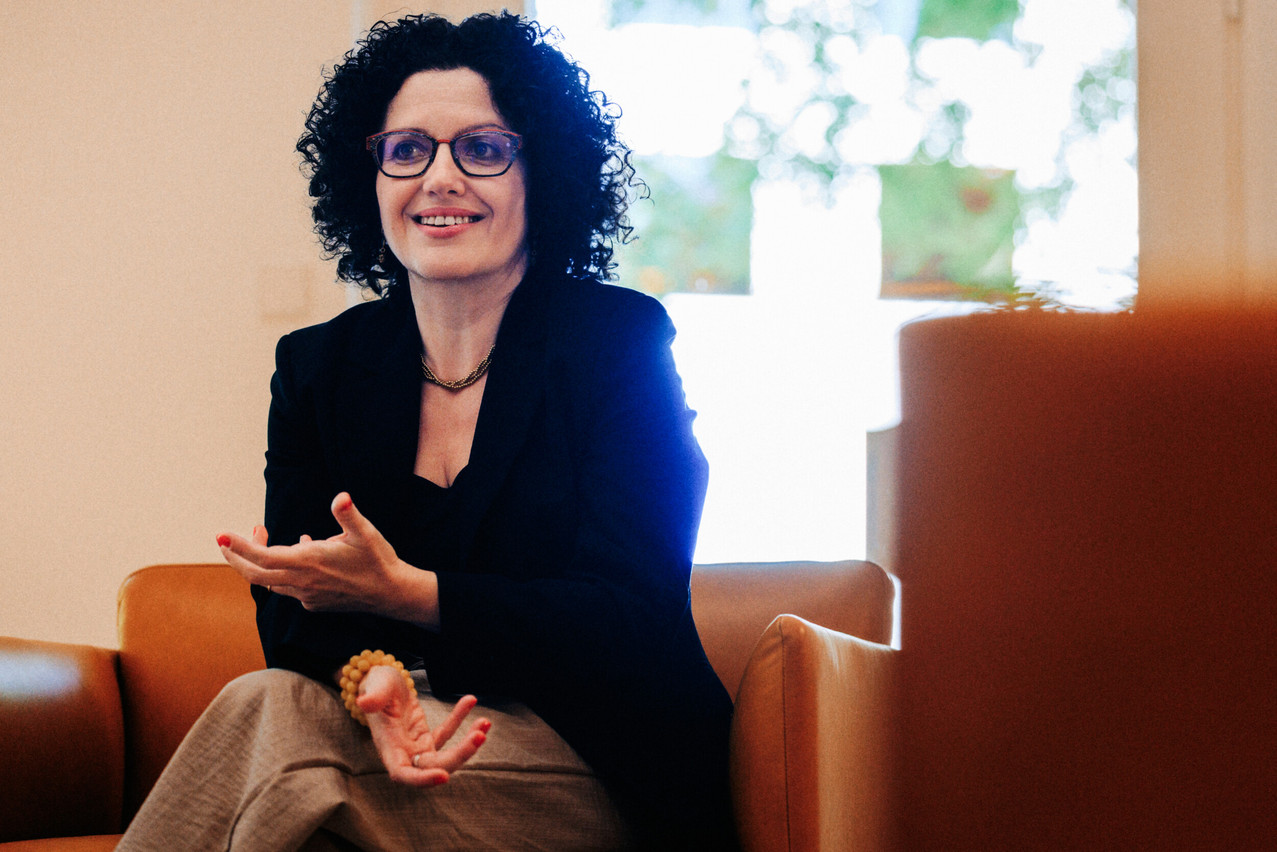
Livia Moretti is moving from the KBL to the CSSF. Faced with the crisis, “I couldn’t just stand by and watch”, she says. (Photo: Julian Pierrot/Paperjam)
Moving from the KBL to Luxembourg meant joining the regulator. To put it rather bluntly, it’s like stepping into a different world. The private sector on one side, and the public sector – which regulates and oversees the private sector – on the other. Did you have to do a bit of juggling?
“I have always applied the same standards to myself, whether at the KBL, the CSSF, the ECB or the CIC. My aim is to build! At the time of the financial crisis, in 2008–2009, I felt the need to join the regulator to make a positive contribution to finding solutions to minimise the problems banks might face. I remained consistent in my view that there were very serious challenges for Luxembourg, relating to risk monitoring, management and the strengthening of supervision. I couldn’t just stand by and watch.
It was a peculiar time during the crisis. Many experts had sensed trouble brewing for some time, and nobody was really prepared for it…
“We were clearly unprepared. The crisis hit us head-on just when we thought banks could never go bust. Today, the general consensus is quite the opposite: a bank can go bust, and this is even part of the normal life cycle of any business. The problem at the time was a lack of preparation. We weren’t sufficiently aware of the liquidity risk. For many, it was just another market risk like any other. It has become a major issue, and a range of initiatives have been launched not only to improve preparedness should the problem ever become a reality, but also to monitor the market and manage the various phases of a crisis, from recovery to resolution.
This crisis has arisen from the – shall we say – cavalier behaviour of certain parties. Does having to deal with the consequences of this lead us to reconsider our view of humanity?
‘People are what they are. They have their flaws and their strengths. You have to be realistic when facing a crisis. I think the system has, in fact, been significantly strengthened to be more vigilant against these personal excesses that nobody had really identified before, due to a lack of policy or governance. That said, no matter what measures you put in place, you’re never completely safe from the delusions of grandeur of a few individuals. If, at the helm of a company, you have someone who doesn’t follow the rules, you’re bound to run into trouble. Significant progress has been made on the ECB’s reviews and on the management of conflicts of interest within boards and executive committees. But there is no such thing as zero risk.
Abolishing banking secrecy: a sensible idea
This was also the period when Luxembourg began to consider abandoning its famous banking secrecy. How did you experience that?
“I’ve always thought it was a very clever move on the government’s part. Particularly the fact that it was done in line with Switzerland, which, within Europe, was aligned with Luxembourg. There was a great deal of criticism and uncertainty. Some feared a step backwards. But in the end, it proved to be as visionary as it was realistic. 
And then you left Luxembourg to move to Frankfurt and join the European Central Bank. How was your move from Italy to Luxembourg and from Luxembourg to the ECB received? Is there a tendency in Luxembourg to take great pride in its “local heroes”?
“Please forgive my somewhat provocative response, but it wasn’t really my problem. Everyone sees it as they wish, and you can’t change that. As for me, I was fortunate enough to represent this country, which has given me so much; I was extremely proud of that. I found myself at the ECB as a supervisory expert, part of a group of around fifty European experts in dedicated offices in the Japanese Tower. We had very long days spent building the European supervisory methodology from scratch. I had to defend the institutional reputation of the country I was representing there – me, the Italian whom Luxembourg had adopted. I was fighting hard. One day, the 
Quite a thankless task, isn’t it? Representing a country and being ‘drowned out’ by Europe’s collective needs.
“I loved every single year I spent at the ECB, from start to finish. It was extraordinary. I had to get my hands dirty. We had to set up the supervisory framework whilst taking into account the perspectives of all European countries. From day one right through to the point where I found myself in charge of a portfolio of very large European banks. There were many cross-cutting issues, which taught me a great deal. Hippocrates said that every part of the body is important. And you could find yourself having to reprimand the CEOs of major banks, the chair of the board of directors or shareholders… The repercussions were significant. I found that fascinating and motivating.
Build and build again – that’s his motto
Jean Asselborn, to whom I once provocatively remarked that he was the most useless of all foreign ministers, replied that the Germans and the French would have been unable to communicate with one another without the mediating role of Luxembourg’s diplomatic service. Is the ECB precisely the place where you capitalise on your language skills?
“Yes! Of course! Some countries are a bit too self-centred when it comes to their own country and language. Everyone thinks that English is enough. But it isn’t. There’s another aspect to it, apart from the ability to connect people: a German cannot supervise German banks and a French person cannot supervise French banks. But who speaks both languages well enough to do that in Europe? There weren’t that many of us. And the Luxembourgers have also developed a particular skill, given the size of their country: listening to their neighbours.
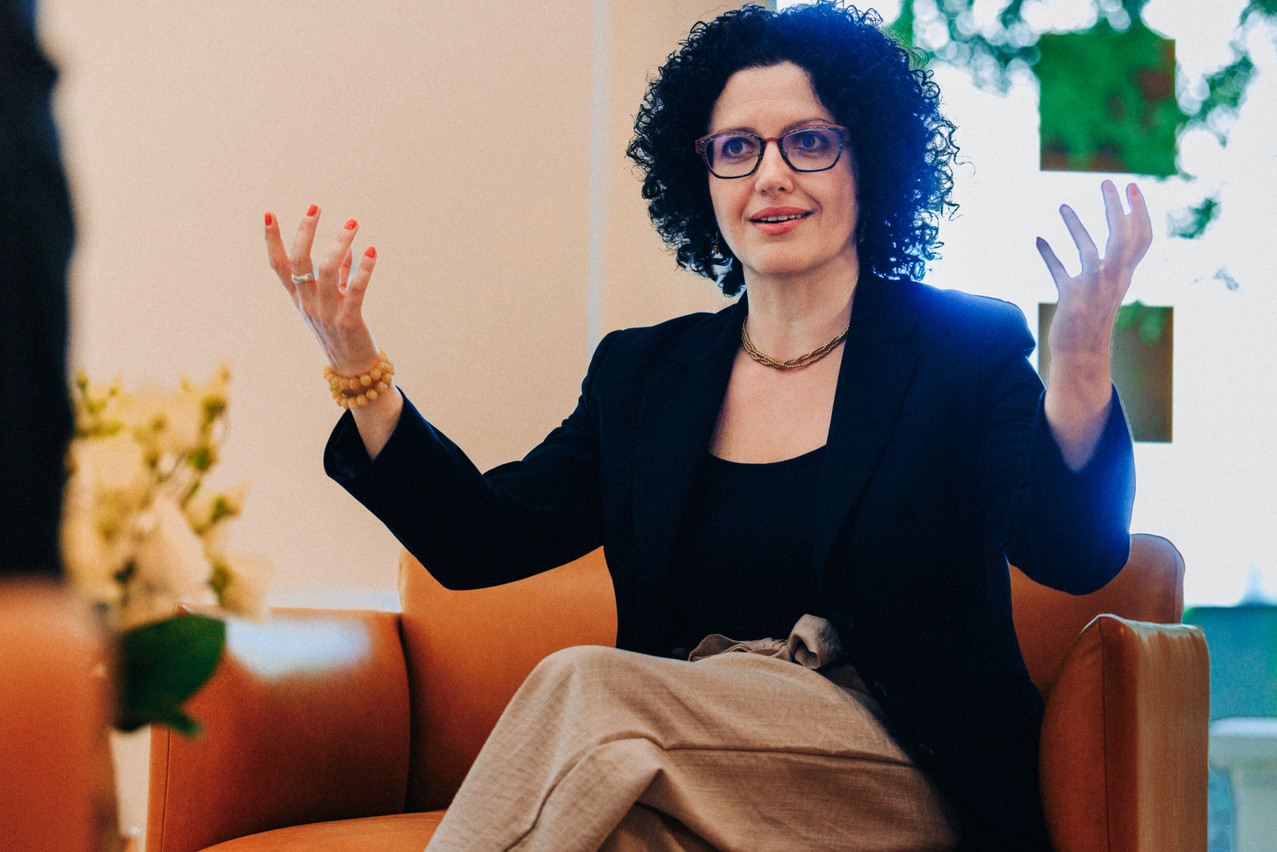
“If you fail to incorporate this positive aspect of the strategy and fail to set out a vision, you will lose the support of all those who only see people leaving.” (Photo: Julian Pierrot/Paperjam)
And yet another change: you left Frankfurt for Switzerland, to join CIC Switzerland, at a very tricky time for the bank. What on earth made you do it, if I may put it that way?
“It’s very simple. As in any business, you move from a start-up phase – where you have to build everything from scratch – to a more stable phase. I asked myself what I wanted. And that was to embark on a new phase of development. By chance, I was approached to join the CIC Group and completely overhaul the strategy of the group’s Swiss division.
By that point, you’d reached a certain level of expertise. What sort of due diligence did you carry out before taking the job?
“What convinced me was that the Crédit Mutuel group is an extremely solid organisation with reliable managers, and what I particularly liked was the opportunity to work for the long term. I’ve been through all sorts in my previous career, but in a group that isn’t listed on the stock exchange, managers aren’t pressured into taking risks that are sometimes excessive. You can maintain a measured appetite for risk even when working for a charitable cause. Working with a long-term perspective was very appealing. When I arrived in Switzerland, I initially worked as a consultant and adviser to the chairman of the board of directors.
Then you had to put a strategy in place to try to get out of the crisis…
“Let’s just say we were forced to let a number of people go. When I saw what was happening, I sought and obtained the board’s approval; I had also presented them with an action plan that very clearly positioned us in a crisis situation and set out our crisis management strategy. It focused primarily on governance, auditing and the strategy to be implemented. If you don’t put this positive aspect of the strategy in place and don’t provide a vision, you lose the support of all those who only see the departures. I worked on these areas not for six months, but for two years! The bank’s progress has proved my strategy right.
Looking back, what makes you most proud?
“Firstly, the bank has a distinct identity. The CIC Group is well positioned within the Swiss landscape, and there are commercial synergies. Secondly, we have a well-established management team. Starting from a challenging situation, we went on to achieve exceptional results for three consecutive years. I am also very proud to have surrounded myself with the right people to reshape the management, corporate culture, collaboration and transparency. Especially as, as you can imagine, when an organisation is going through a difficult period, the regulator keeps a very close eye on things…
The right decisions for the right ecosystems
You’re not afraid – never afraid – but you do have your doubts, don’t you?
“Yes, but generally speaking, doubt is a sign of managerial intelligence. Otherwise, you end up with amateurism or management by fear… The important thing is to be able to ask the right questions of the right team in a fully transparent manner. That’s always more effective than having to ask questions on an individual basis. The transformation plan I carried out over two years is really one that should have been planned over five years! I’ve always prioritised honesty and authenticity. There’s no point in sugar-coating things, nor in painting them in a negative light.
You’ve experienced the financial ecosystems of Luxembourg, Frankfurt and Switzerland – three of Europe’s largest financial centres. Tell me something positive and something negative about each of them…
“I’ve had some exceptional years in Luxembourg, Germany and Switzerland. And in all three cases, it’s because these countries have enjoyed favourable economic conditions as a result of making the right decisions, even though things are more complicated in Germany today. The common thread is not to become complacent just because everything is going well.
Looking at your skills and career history, one wonders whether you might have a future in politics?
“Why are you asking this question? I’m not involved in politics. I have a strong sense of institutional duty. The public interest is close to my heart. In Switzerland, I took part in the debates and work on the overhaul of banking regulations following the Credit Suisse debacle. But when I’m looking to make the greatest impact, being on the front line is what enables real progress to be made within the system.
You hardly ever talk about yourself.
“I’m a very down-to-earth person. I’m a woman of action. I think very quickly and you have to keep up with me… but did you know I play the piano? The Romantics. Chopin. Schubert. Piano transcriptions of opera arias. I feel at one with it. Sometimes I play with my son, who plays the violin, or with my daughter, who sings. They’re wonderful moments. For the time being, I’ve had to put that on hold, but as soon as I’ve settled into my new role, I’ll get back to it.
Speaking of which, even though this interview is only about your career, how are things going for you?
“To give you another personal anecdote. My son plays football and one day I heard one of his coaches shout to this merry band running all over the place, ‘stop, kucken und spill’ [which could be translated as ‘stop, look around, and play!’]. I’m in ‘watch’ mode. I’m not in a rush. Banque de Luxembourg is thriving. Everything is in place. The aim here is to enter a phase of strategic reflection on how to develop the bank in the face of major challenges.”