
Semi-liquid private-market funds are facing their most significant stress test to date, as investor redemption requests increasingly collide with the illiquid nature of the assets these vehicles hold. Also known as evergreen funds, they allow investors to subscribe and redeem periodically, unlike traditional closed-end private-market funds that lock capital up for a fixed investment period.
When liquidity promises meet illiquid assets
While the pressure is most measurable within non-listed Business Development Companies (BDCs) and private credit vehicles, the decision by Partners Group to limit redemptions from its $8.6bn evergreen private-equity fund on 3 June 2026 serves as a warning signal for the broader industry.
The core issue is that investors may have treated conditional liquidity as if it were reliable, while managers hold assets that cannot be sold quickly without imposing substantial costs on remaining shareholders, Roberto Steri, associate professor of empirical finance at the University of Luxembourg, argued in an opinion note sent to Paperjam on 5 June 2026.
BDC redemptions overtake fundraising
The stress in the BDC and private credit sector is currently the more advanced and observable problem. Q1 2026 marked the first quarter on record in which redemptions exceeded fundraising in the publicly registered non-listed BDC market (see Chart 1).
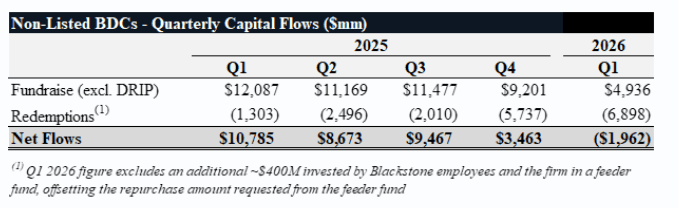
Chart 1: Quarterly outflows have surpassed quarterly inflows Source: Robert A. Stanger & Co
For example, the Blackstone Private Credit Fund capped withdrawals at its 5% quarterly limit after investors sought to redeem approximately 10% of outstanding shares. At a 5% quarterly redemption rate, a large investor could theoretically require several years to fully exit a position if redemption demand remains elevated. Across the US non−traded BDC sector, investors sought to withdraw roughly $13.2bn in Q1 2026, but sponsors only agreed to meet about half of that demand.
Industry proponents argue that redemption gates are functioning as designed, protecting long-term investors from forced asset sales during periods of market stress.
The evergreen PE warning signal
While redemption pressure first became visible in private credit, recent developments suggest the problem is no longer confined to that segment. Partners Group decided to cap redemptions from its $8.6bn Global Value SICAV after requests exceeded the fund’s 5% net asset value (NAV) limit.
Investors received only 62 per cent of their requested capital, while the remaining requests were cancelled rather than carried forward. Investors therefore had to submit new redemption requests in future windows rather than automatically retaining their place in the queue.
Investors interpreted the move as evidence that liquidity pressures were spreading beyond private credit into private equity; Partners Group’s share price plummeted 16.3%, and other European PE firms such as EQT, CVC Capital Partners, and Bridgepoint Group also saw significant declines.
Evergreen PE is considered more vulnerable because it holds residual equity claims rather than senior loans, explained Steri. Unlike credit, which generates contractual interest income, “equity depends heavily on volatile exit markets, M&A demand, IPO windows, leverage conditions, and valuation multiples.”
Furthermore, equity holders are last in line in the event of bankruptcies, which have been increasing since interest rates rose in 2022, wrote Pitchbook in a research note on 4 June 2026.
NAV credibility and academic perspectives
A key issue in both private credit and evergreen private equity funds is the reliability of reported net asset values (NAVs), which determine the price at which investors subscribe and redeem. Academic research suggests that funds holding illiquid assets are inherently vulnerable to “first-mover” dynamics: when redemptions create liquidation costs, investors have an incentive to exit early rather than bear the cost of those redeeming later at potentially stale valuations.
Steri argues that these concerns have now spread to evergreen private equity, where first-mover incentives are even stronger than in private credit.
In an interview on Citywire on 21 April 2026, Ludovic Phalippou, professor of financial economics at the University of Oxford Saïd Business School, argued that the very term “semi-liquid” is “abusive,” the term creates a false sense of security regarding how quickly one can access capital. He noted that a 5% quarterly redemption limit implies a five-year exit timeline even in a best-case scenario.
Phalippou contended that NAVs are “pretty obviously wrong,” citing three clear market signals: the fact that managers are implementing gates, the fact that secondary market transactions occur at a discount, and the fact that publicly listed closed-end private credit funds trade at massive discounts to their reported values. He compared the current drive to package illiquid assets into open-end structures—driven by a desire for high fees—to the real estate fund crisis of 2008.
Future outlook and proposed solutions
Despite these systemic challenges, evergreen PE is forecast to grow significantly, potentially topping $1trn in total NAV by the end of the decade, according to Pitchbook.
To restore confidence, Steri suggested that funds must adopt stricter valuation governance, including more frequent independent valuations, conservative marks in weak exit markets, secondary-market evidence, explicit illiquidity discounts, and stress-tested NAV ranges.
However, Phalippou remains highly sceptical, predicting that nearly all open-end private credit funds will disappear within two to three years, as the structure was “wrong to begin with.”
Ultimately, Steri suggested that these products should be marketed as “managed-liquidity” vehicles rather than liquid substitutes for public-market funds. The fundamental trade-off remains: the more liquidity a fund promises, the more cash or liquid assets it must hold, which may ultimately reduce the very returns that attracted investors to private markets in the first place.
A liquidity shock in these vehicles often evolves into a valuation-confidence shock, revealing that the promised liquidity was always conditional rather than guaranteed.