At a time when remote working has become commonplace in many sectors, employees and employers share their sometimes differing views on this practice. Testimonials.
“I’m quite a sociable person, and I work in an open-plan office; luckily, I often work from home, otherwise I’d chat too much with my colleagues and be much less productive,” confides Véronique, 51, who works in the communication field.
“In my company, the rule is clear: as long as the work gets done, my manager doesn’t care whether I’m in the office or not,” explains Andrew, 39, graphic designer. “I actually work better from home because my setup is far more ergonomic than at work. As a graphic designer, I mostly work on my own anyway, even when I’m in the office. But for some jobs, working remotely is definitely more complicated!”
“It should be based on trust”
Ludivine, 44, sales representative, paints a bleaker picture: “Since he can’t monitor us, my department head has found a way around it. Urgent emails at 9:05 a.m., pointless meetings at the end of the day just to check that we’re still there... He also asks us for detailed reports on what we’ve done during the day, which he never asks for when we’re in the office. That's the game you have to play to be able to work, but it's a shame; it should be based on trust.”
“Unfortunately, in my company, residents and cross-border workers are subject to the same teleworking quotas. Sometimes you wonder what’s the point of paying such high rent if you don’t get any of the advantages of being a resident,” relates Carla, 29, working in the marketing field. “I enjoy coming to the office to see some of my colleagues, but I also appreciate being able to focus away from the open space when I have longer or more complex tasks to handle.”
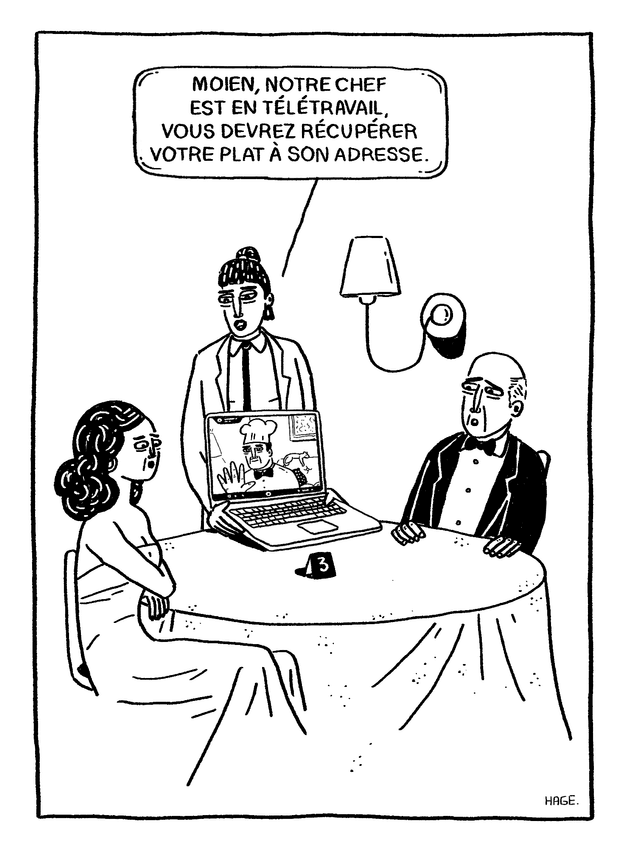
Widely adopted since Covid, remote working both appeals and annoys. (Cartoon: Bernard Hage)
For Damian, 29 and working in the communication field: “Working from home is a reality in my company, but they don't like it at all. In my case, I prefer working from home than in the office. I feel more focused, there are less distractions and I don't have to tolerate my boss's mood swings. I am as efficient, or more, because I work in a healthy environment where I don't have to deal with other people.”
Why not a fixed day for collective teleworking?
Simon, 48, who works in real estate, prefers to go to the office: “I am a partner in my company and I almost turned down the job because remote working is very limited. Ultimately, I find that going to the office is so much better than working from home, and I love it. It may be related to my role, but the camaraderie in the office is positive, and people are more committed.”
“Working from home forced me to rethink my entire organisation and I had to learn to plan my days better and, above all, to switch off in the evening; otherwise, I tended to never stop. Today, I feel more efficient, but also more disciplined,” confides Marc, 33, IT project manager.
“We have introduced a fixed day for collective teleworking in my department. We maintain team cohesion while enjoying real time for concentration. It’s a good compromise”, relates Inès, 35, HR.
Share your stories with us at temoignage@paperjam.lu before the deadlines. In our upcoming issues, we’ll be exploring new themes such as lunch break (testimonies to be sent before the 20 December).
This article was written for the December 2025 issue of Paperjam magazine, published on 19 November. The content is produced exclusively for the magazine. It is published on the site to contribute to the full Paperjam archive. Click this link to subscribe to the magazine.
Is your company a member of Paperjam Club? You can request a subscription in your name. Let us know via club@paperjam.lu.