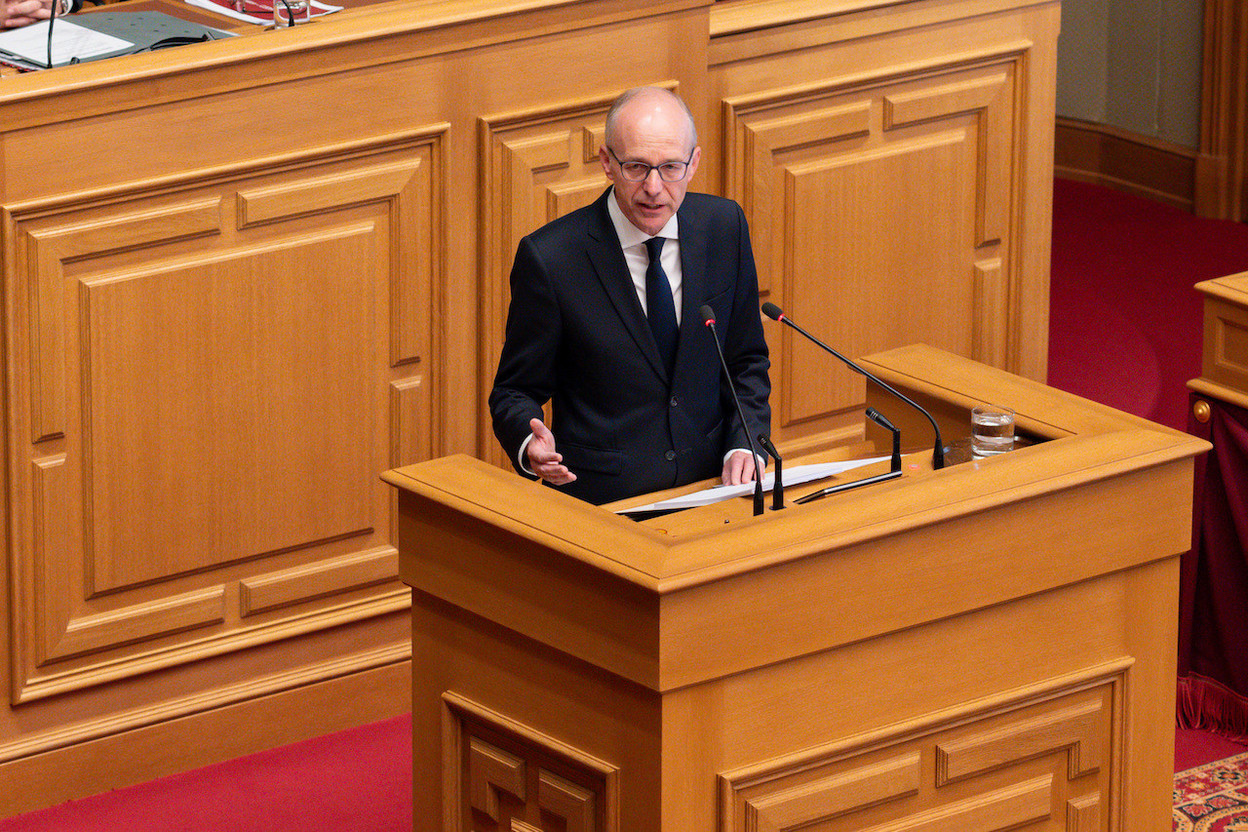
Marc Fassone: As minister of home affairs, you are responsible for overseeing the municipalities. Earlier this year, you told MPs that you see your ministry as a service provider for the municipalities. What does that mean in practical terms?

When I took up my post, the local authorities didn’t have a telephone list with the extensions of the agents who work here. One of my first decisions was to make this list available to them. It’s not a major political decision, but it does demonstrate a state of mind. Agents have been instructed to systematically answer questions. And if they don’t have an answer immediately, to get back to them as quickly as possible.
This back-office action goes well beyond a simple question-and-answer game. For example, in terms of town planning, we are in the process of developing a physical platform--which already exists in embryonic form--where, for example, developers can contact the town planning division to discuss a project in advance and how it can fit into a given area with its own constraints, particularly environmental. The aim is to guide people before a project is launched, so that no time is wasted.
This would enable an additional 8,600 homes to be built across the country, 4,900 of which would be affordable

An important tool in our relations with local authorities is the E-Mint platform, a communication platform under the authority of the ministry and launched in June 2020, which offers local authorities the possibility of secure electronic transmission of resolutions subject to compulsory transmission. This platform is also used by local authorities to put questions directly to the ministry, and in return allows us to communicate with the local authorities about the processing of the procedures transmitted. We’re going to extend the range of uses. The ultimate aim is for everything to pass through this network.
With the ‘once only’ principle, digitisation is the cornerstone of the policy of administrative simplification, a subject that is really important to the prime minister [
Precisely what are your main projects in terms of municipal policy?
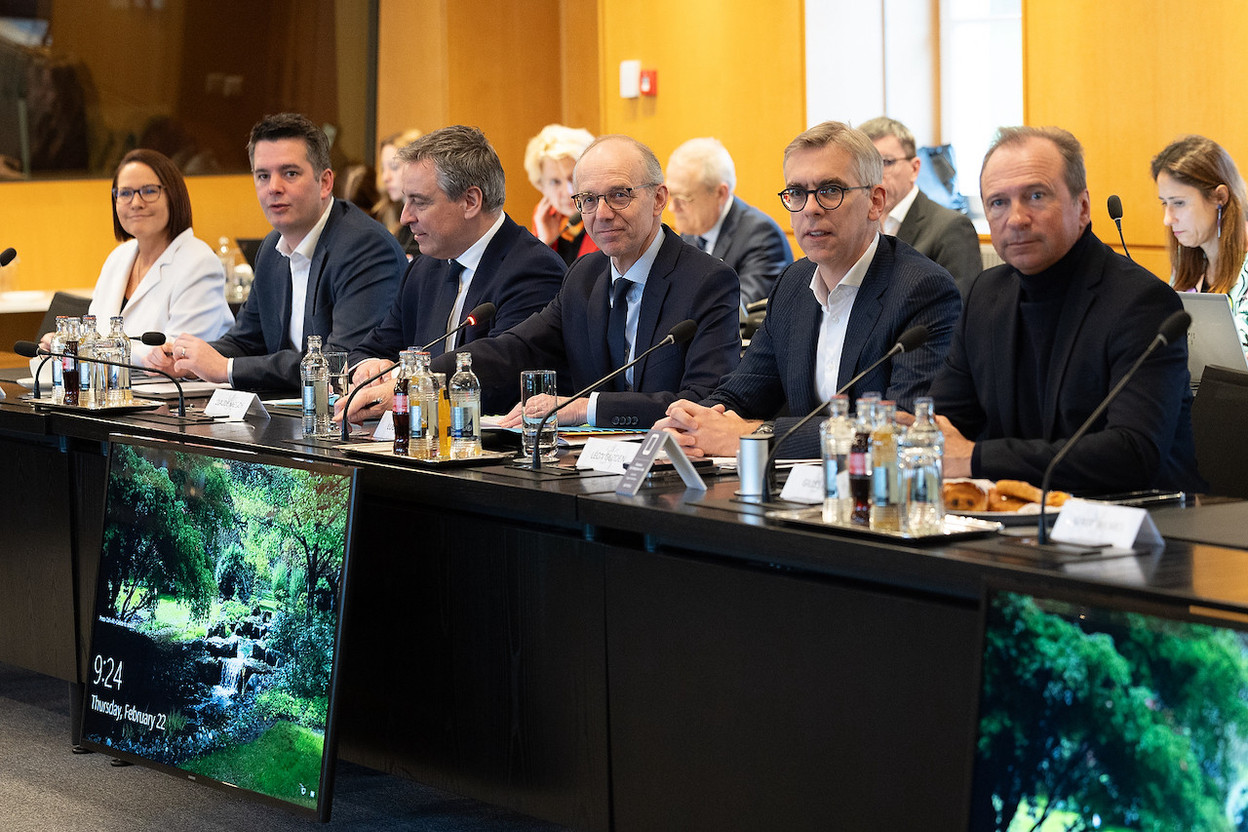
The first project was completed on Thursday 10 October 2024 with the vote by MPs on bill 8369, which extends the initial period of validity of planning permission from one year to two years, renewable once for a further year. This proposal was put forward at the national housing meeting on 22 February 2024, with the aim of simplifying and speeding up administrative planning procedures.
Housing is a priority for the government, and a number of commitments were made following the round table. Will all these commitments give rise to a comprehensive law, or will you be proceeding on a piecemeal basis?
There will be several bills covering the whole issue.
We are currently working on simplifying the procedures for general development plans [plan d’aménagement général, PAG] and specific development plans [plan d’aménagement particulier, PAP]. We unveiled the broad outlines of this reform on 19 June when we presented the ‘Méi, a méi séier bauen’ (build faster and more quickly) plan. It will be a major piece of legislation covering a wide range of issues.
Firstly, the issue of the famous article 29 bis which, in the Housing Pact 2.0, which came into force in the summer of 2021, aimed to support local authorities as central partners of the government in the development of affordable housing. It was a good idea that did not achieve the desired objectives. We are going to amend it between now and the end of the year. If the reform is adopted, social housing will no longer be taken into account in the calculation of housing density, which will make it possible both to increase the number of social housing units and to increase the number of normal housing units in a development. On the basis of the current PAGs, this would enable an additional 8,600 homes to be built across the country, 4,900 of which would be affordable.
Read also
In this bill, we are also going to change the enforcement agreement system. At the end of any PAP procedure, the local authority negotiates with the developer or builder over a number of details, such as the shape of the paving stones on the pavement or the quality of the lampposts. These negotiations can drag on and on. From now on, an agreement will have to be reached within six months.
We are also working on the issue of departmental reparcelling. I have taken up bill 7139--a bill tabled on 18 May 2017 by Dan Kersch (LSAP)--which has been split to speed up its passage. The aim is to be able to offer owners of building land blocking a project an exchange rather than being forced to initiate expropriation proceedings. A number of amendments were adopted by the MPs on 17 July to clarify the procedure. These are always delicate matters for mayors to deal with. The fact that the decision is taken by the minister could unblock conflictual situations. It will no longer be the mayor’s fault, but the minister’s... I can live with that!
When it comes to construction, there is one principle that is eagerly awaited--or feared--and that is the principle of silence being tantamount to agreement. How do you intend to go about getting it adopted?
The principle of silence being equivalent to agreement will be adopted gradually.
To begin with, we are going to introduce what I call bagatelle limits. For certain constructions, there will no longer be any need to notify or obtain permission. This applies to fences, garden sheds, terraces, pergolas, play areas, interior works and photovoltaic installations of less than 50 square metres on the roof. These provisions will be the subject of a bill to be tabled before the end of the year.
We are then going to introduce the principle of an order period, on two levels. Firstly, when an application is submitted, the authorities will have a limited time--between one and two months, as we are discussing with Syvicol, the Luxembourg association of towns and municipalities--to request additional documents following the submission of an application. If they don’t, the application is deemed to be complete and the procedure for obtaining authorisation can be triggered.
Personally, I’ve never heard a mayor say that he didn’t want his municipality to see its population increase.
Then, if the applicant does not receive authorisation within the legal timeframe, this may be considered as a refusal and may be appealed before the competent courts. The final phase--the real novelty, which will require a great deal of work between the ministries--will be the introduction of the principle of silence means agreement stricto sensu. My aim is to have all these bills tabled by the end of the year, so that they can come into force in 2026.
All these measures represent a real paradigm shift. Aren’t you afraid of opposition from local authorities and administrations? Are you preparing for this?
We are aware that there may be resistance. And we are preparing for it. Syvicol was invited to the roundtable on housing and took an active part in it. But it’s all very well to pass a law, but then you have to apply it on the ground. And municipal officers will be on the front line. I’m relying heavily on the mayors. They have to understand that we are acting in the interests of the country and the population: we need more housing.
But do the mayors have the same interests as the minister when it comes to these issues? For a long time, building issues were synonymous with political stakes and local interests…
I think it’s a completely different issue. I’ve never heard a mayor say that he didn’t want the population of his municipality to increase. Of course, the political, strategic and economic considerations are different for a rural municipality than for one that is part of an urban fabric. But every mayor wants his community to be vibrant. And for a community to be vibrant, it needs to have a population. The problem is not so much increasing the population as knowing whether the infrastructure will keep up. That’s where we want to take action, by proposing a reform of the municipal subsidy system.
We are working on reforming property tax and introducing a tax on land mobilisation. It is with this in mind that I have reformed the mechanism for determining municipal contributions to the Employment Fund. A mechanism that led to inequalities between municipalities: in 2023, only 27 municipalities were required to contribute, and half of them received less than they gave. Bill 8409, designed to rectify the situation, was tabled on 3 July.
It will introduce a direct and proportional method of calculating the individual contributions of the municipalities. The City of Luxembourg, which has paid nothing since the 2017 reform, will now contribute €11m. It is always in this spirit that I have decided to liquidate the communal cyclical equalisation fund. This was a mechanism put in place at the time of the steel crisis, but had not been funded by the state or the communes for years. Bill 8408 was also tabled in the Chamber of Deputies on 3 July. It will enable the communes to recover and share €52.191m from the fund.
Finally, on a more general note, we need to look at the subsidy system. It’s a system that hasn’t changed for decades. Syvicol and I are currently working on possible changes. It’s an important and long-term project. But already, in the new budget, we will have more resources to grant more subsidies to the communes.
Quick biography
Léon Gloden, the current minister for home affairs, was born on 9 December 1972 in Ettelbruck.
Lawyer: He holds a master’s degree in European and international law from the Faculty of Law and Political Science in Aix-en-Provence. He was admitted to the Luxembourg Bar in 1999 and practised law with Elvinger Hoss Prussen, where he became a partner in 2007.
Politician: A member of the CSV since 1999, he became an MP for the East constituency in 1999 and mayor of Grevenmacher in 2011. He held the post until his appointment as home affairs minister in November 2023.
Municipal finances and government agreement
With the aim of “giving local authorities the financial resources to offer quality services and infrastructure in line with the needs of their citizens and the objectives of territorial planning,” the government has set out three areas for action.
A review of the reform of municipal finances prior to any possible reform in order to offer municipalities, whether urban or rural, greater financial flexibility. A reform of property tax--“the revenue from which will remain communal revenue.” This will include a national tax on unoccupied dwellings and the mobilisation of land, as well as the introduction of a register of unoccupied dwellings.
A regular financial audit of municipal finances, the results of which will be accessible and published.
Gloden plans to announce more resources for local authorities in the coming months. His aim is to position himself as a partner and service provider to local authorities, in addition to his supervisory role.
This article was written in French for the November 2024 issue of Paperjam magazine, published on 23 October. The content is produced exclusively for the magazine. It is published on the website as a contribution to the complete Paperjam archive. Click here to subscribe to the magazine.
Is your company a member of the Paperjam Business Club? You can request a subscription in your name. Let us know via club@paperjam.lu