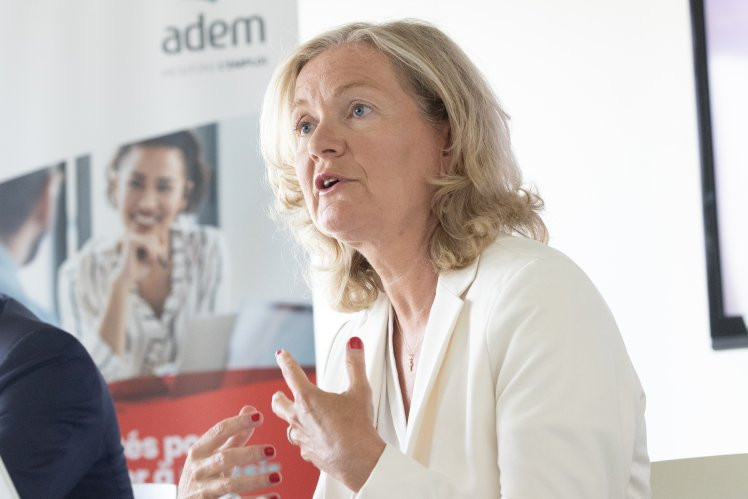
If you had to choose just one emblematic figure this autumn, which one would you choose?

Next, the unemployment rate, which has remained stable over the past two months at 5.9%, after rising steadily since the summer of 2022 to 6% (this interview was conducted on 16 September, editor’s note). We’re not yet talking about a pronounced fall, but at least the rise has stopped.
With this context set, what are the’Adem’s priorities for 2025–2026?
“We are entering a new strategic period: Adem 2025 is coming to an end and will give way to Adem 2030. There are three main areas of work.
The first, in November, is the launch of the first stage of our digital strategy. Jobseekers will be able to claim their benefits directly online and access a MyAdem portal via MyGuichet. This project is the fruit of two to three years’ work. For users who are not very comfortable with digital technology or who do not have the necessary equipment, e-Adem areas will be set up in our three main branches, with human support maintained. The idea is to digitise administrative processes to speed up procedures, without replacing direct contact for job-search advice and support. Appointments with an advisor will still be required.
Second priority: a programme to label companies as partners in employment. The first ten companies will receive this label at the end of September, as part of the 10-year anniversary of our partnership with UEL. These are companies that are actively recruiting young people, senior citizens or people with disabilities. The aim is to promote these practices.
Finally, the third project is the “skills-plang”, a law now passed, which enables companies to better identify and plan their resources. Adem will finance the support of consultants, followed by training and salary compensation based on identified needs. This is an initial preventive approach: training before unemployment, avoiding redundancy plans and anticipating labour shortages. The official launch will take place in October.
Automated filters are increasingly used by recruiters, and a poorly calibrated CV can be eliminated out of hand. That’s why we insist on digital training.

Adem’s latest activity report showed a marked downturn in recruitment in the’IT and construction sectors. Will the trend be the same in 2025?
“In IT, the situation remains difficult: between 2022 and 2024, reported vacancies fell by 36%. This is the sharpest fall of any sector. This does not mean that there is no longer any recruitment, but that there is less dynamism. The trend remains negative.
In construction, the signs are more positive: according to Statec, confidence is returning and order books are filling up. We recently had 408 vacancies, the same level as a year earlier. It’s not a huge number, but at least the decline has stopped. We have therefore relaunched training courses, particularly in “green construction”.
Health, finance, hotels and catering… How can we better support these sectors, which are also under pressure?
“Every sector is different. The hotel and restaurant industry, for example, is suffering throughout Europe, including in Luxembourg. The big groups are doing better because they can offer better conditions, such as contracts with no breaks during the day. Overall, it’s not a problem of qualifications, but of attractiveness and sometimes a lack of understanding. We explain to jobseekers that you can still progress in this sector during your career even without a diploma, which is becoming rare.
We also organise concrete actions, like for the opening of Gridx: “Jobdays” on site, to discover the environment and meet recruiters. In the catering industry, CVs aren’t everything: motivation and interpersonal skills count. This approach has led to many new hires.
About Jobdays, in fact, this same d’activities 2025 report mentioned a record number of appointments set up last year. What is their impact?
“We counted 52 last year, or more than one a week outside the summer period. The formats are very varied: some are targeted at two or three companies, others are much larger, such as Jobday Horeca, which brings together more than 2,000 people. Applicants meet recruiters directly, which is more effective than simply sending CVs. For employers, the time saved is considerable: in one morning, they see 50 candidates. For low-skilled jobs, it’s often a question of motivation, which is quicker than the traditional process.
We’re also assessing the practical impact. Large Jobdays produce results, but mobilise a huge amount of resources. Targeted formats are often more effective. With certain hospitals, we are now organising regular recruitment workshops for healthcare professions. This scheme works well and is becoming a flagship product that we will continue, even with digitalisation.
On this point, how is the Adem s’adapting to new recruitment methods, such as the’IA?
“We are already experimenting internally with data science and artificial intelligence tools, but have not yet integrated them into our operational processes. We are also raising awareness among jobseekers: automated filters are being used more and more by recruiters, and a poorly calibrated CV can be eliminated out of hand. That’s why we insist on digital training.
Two avenues are being explored. The first is to better identify the profile of applicants, in order to detect the risk of long-term unemployment and adapt the support provided. The second is to offer vacancies that neither jobseekers nor our advisers would have thought of, by matching skills rather than jobs. AI makes it possible to bring together different career paths but with transferable skills.
This is a key dimension for the future: showing applicants, especially young people or those undergoing retraining, that they can consider other professions than those they were initially thinking of.
More and more companies are accepting profiles that are not “ideal” but are ready to evolve.

Speaking of training, the proportion of jobseekers involved has risen from 13% to 17% in one year. What next?
“This is a very significant increase, because it comes against a backdrop of rising jobseeker numbers. This already represents 14,000 participations. And we’ll be going even further.
Employers are asking for this training, and it’s working. The profiles registered with us don’t always match the needs, so we encourage candidates to take training to get closer to the vacancies. More and more companies are accepting profiles that are not 'ideal' but are ready to evolve.
The training courses are very varied: from simple basic digital skills modules to advanced certifications to become a project manager in a particular sector.
How can we better help young graduates enter the job market?
“From 24 September we will be launching enhanced support. The idea is to broaden their horizons: they shouldn’t be stuck on a single path. With a master’s degree in French, for example, you can become a teacher, of course, but you can also do other jobs. The idea is to open up the field of possibilities. It’s all about teaching. From now on, all young people will attend workshops to find out about the market and its opportunities. The jobinsights.lu website, which presents job vacancies, skills and experience requirements on a job-by-job basis, is a valuable tool.
We are also working more with temporary employment agencies. At a recent Jobday, nine agencies offered assignments directly to candidates. Temporary work is not a universal solution, but it can be a gateway into a wait-and-see market. And, often, a successful assignment leads to recruitment. In Luxembourg, temporary work remains unknown to residents, unlike cross-border commuters. We therefore want to open up this avenue to young people.
8,000 registered jobseekers are over 45. That’s a lot of people, and they are the most likely to be long-term unemployed.

What about senior citizens? How can we encourage them to stay in work or return to it? Here too, we need to educate both them and employers?
“Nearly 8,000 registered jobseekers are over 45. That’s a lot, and they’re the ones most likely to be long-term unemployed. This makes no sense in a context where people are being asked to work longer.
We are focusing on recruiting them via the label. There are many obstacles: salary, especially for those from well-paid sectors; fears about mastering technology, which are often unfounded; and the transformation of professions, which requires new skills. The “skills-plang” should make it possible to make the most of what has been acquired and to add certifications.
There is also a psychological aspect: some recruiters, often young people, doubt the ability of older people to fit in. And on the candidate side, there’s the shock of job loss and the fear of not being able to bounce back. Transforming this frustration into a positive dynamic is a challenge.
Only a minority of recruitments are preceded by’a job declaration to the Adem. Why aren’t companies playing the game? How can we improve transparency?
“Many companies don’t declare all their vacancies, believing that we don’t have the candidates they need. We explain to them that vacancies are not only used to recruit, but also to produce reliable statistics. Without a declaration, these needs do not officially exist. This sometimes concerns entire sectors. In the hotel and catering industry, some people are surprised that their jobs are not on the list of shortages, but when they check, few positions are declared. Sometimes there is also a misunderstanding: a company declares a position when it is actually recruiting 400 people a year.
Mind-sets are changing with the list of shortage occupations. Today, on average, if we compare the recruitment declared to the Social Security and the job offers we have, we are at around one third. But this figure needs to be qualified: there are technical reasons why every recruitment is not always preceded by a real job offer. But whatever the case, there’s still a long way to go.
As far as attractiveness is concerned, I’m not sure that salary transparency makes much of a difference.

We are working on simplifying the declaration, with automatic imports from HR software or via sector-specific sites such as the Horesca site. Large, well-organised groups already declare all their jobs. The challenge mainly concerns small businesses, which are sometimes unaware of the obligation. It’s a long-term task, but it’s essential if we are to better describe the labour market.
From next June, companies will begin to get their act together on the issue of pay transparency. Some say that the implementation of this European directive will shake up the dynamics of the employment market. What do you expect from your side?
“This is a subject that is not yet on Adem’s radar. If we look at international comparisons, particularly on equal pay for men and women, I’m not claiming that everything is perfect - we’re far from it - but, on paper, progress has already been made in Luxembourg. Luxembourg’s good figures in this area are, however, at least partly due to the fact that many women work in the public sector.
In some sectors covered by collective agreements, pay transparency also exists… But that doesn’t mean there won’t be problems: there’s always unemployment or labour shortages. As far as attractiveness is concerned, I’m not sure that transparency in itself makes much difference. Salary remains a key factor of attractiveness and Luxembourg is well positioned compared with its neighbours, even if some, like Germany, are starting to catch up in certain professions. But it’s not the only factor that makes a job or a country attractive.
Let’s take healthcare as an example. Hospital pay scales are perfectly transparent: anyone can see what a nurse earns, and it’s considerably more than elsewhere in the Grande Région. Yet we are still short of dozens, if not hundreds, of nurses and doctors. So transparency alone does not resolve the issue.
Conclusion? Wait and see?
“In my view, pay transparency will undoubtedly have an impact, but probably a limited one. For small businesses, the rules are particular and the reality may still depend on "the customer’s head". And for jobs that are in high demand - cybersecurity, data analysts and so on - salaries are already excellent everywhere. -salaries are already excellent everywhere. What makes the difference, then, are other factors: the working environment, the lifestyle, the meaning given to the job. Wait and see, yes.”
This article was originally published in French.