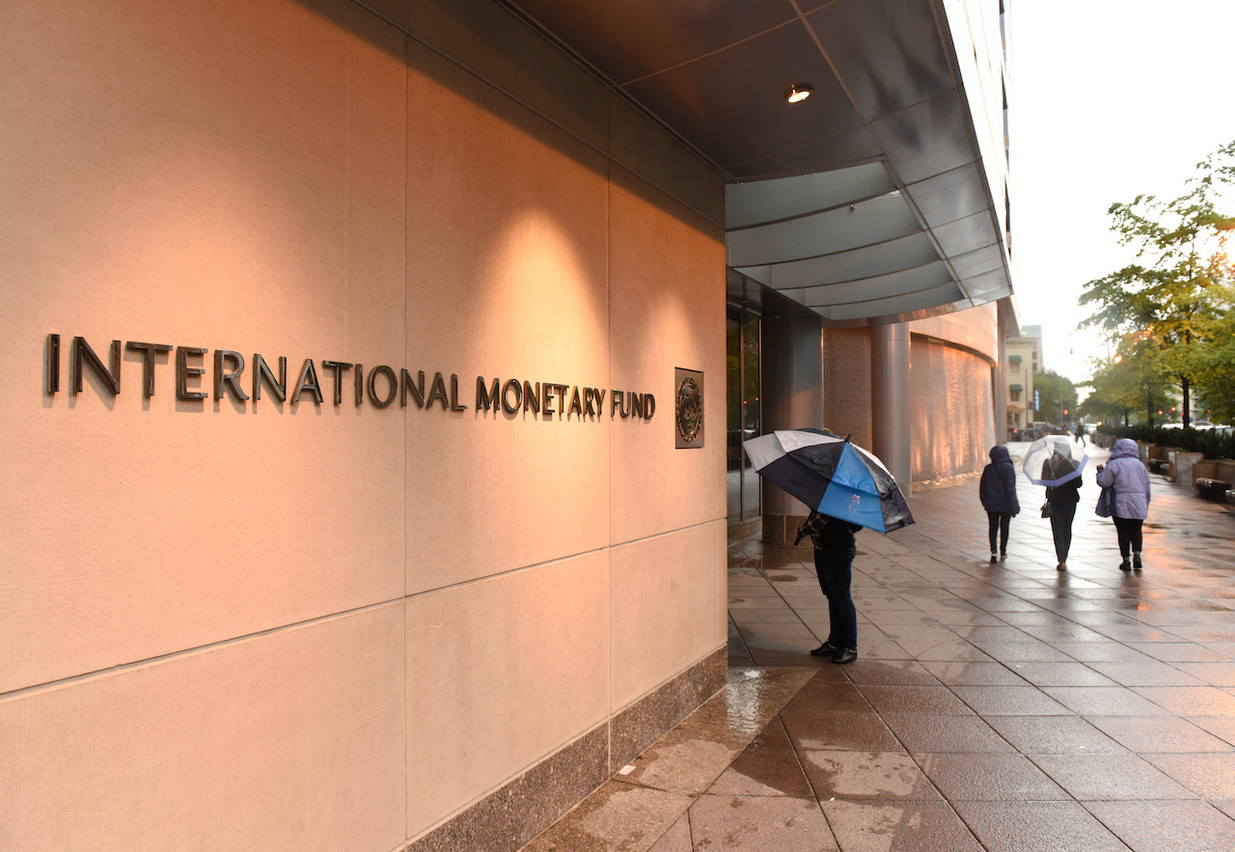
While the International Monetary Fund (IMF) is careful to point out that its forecasts are subject to much more uncertainty than usual -- the fault of a war in Ukraine that is set to last and a Covid pandemic "that is not under control" - the latest issue of its Global Financial Stability Report, published on 11 October, does not give cause for optimism.
According to the Washington-based institution, "a contraction in real GDP lasting at least two quarters in a row" will occur at some point in 2022-23 in about 43% of the economies accounting for nearly one-third of global GDP.
Developed countries struggle
Growth in developed countries will suffer greatly. It will fall to 2.4% in 2022-23 and 1% in 2023. In the United States, sluggish consumption - with purchasing power eroded by inflation - has slowed GDP growth from 5.7% in 2021 to 1.6% in 2022 and, according to projections, to 1% in 2023. While the euro zone will be more resilient in 2022 with growth of 3.1%, it will collapse in 2023 to +0.5%, hit hard by the energy crisis which, according to the IMF, "is not a temporary shock". The two most affected economies in the euro zone will be Germany and Italy, which in 2023 will post GDP contractions of -0.3% and -0.2% respectively.
In Luxembourg, growth will also be strongly impacted: it will only reach +1.6% in 2022 and 1.1% in 2023.
India ahead of China
The emerging countries are limiting the damage with growth of 3.7% in 2022 and 2023. The change is that the economic engine of this bloc is now the indicator, for which the IMF forecasts growth of 6.8% and 6.1% in 2022 and 2023. China, whose 2022 growth is at 3.2% - its lowest in 40 years - and well below the government's plans, could rebound in 2023 with GDP growth of 4.4%. Analysts will be watching closely to see what happens at the 20th Congress of the Chinese Communist Party, which opens on 16 October.
The rise in the dollar - a rise that traditionally affects emerging countries suffering from capital flight - could cause financial turbulence that could upset the growth trajectory of emerging countries, the IMF warns.
Inflation set to last
Inflation, which will reach 8.8% in 2020, should remain "high" for longer than expected and slow to 6.5% in 2023 and then to 4.1% in 2024 worldwide, notes Pierre-Olivier Gourinchas, chief economist at the IMF. This is due to the war in Ukraine, factory closures in China imposed by the zero-covid policy and the opening of the credit floodgates to revive the world economy after the pandemic.
In Luxembourg, it will reach 8.4% in 2022 and 3.7% in 2023.
The economist believes that monetary tightening policies will continue. And he calls on policymakers to use fiscal policy to "ease cost-of-living pressures while maintaining a sufficiently restrictive stance aligned with monetary policy". "Structural reforms can further support the fight against inflation by improving productivity and easing supply constraints, while multilateral cooperation is needed to accelerate the transition to green energy and prevent fragmentation," it says.
The IMF does report one piece of good news: food prices, although still at very high levels, are on a downward trend due to the gradual recovery of Ukrainian grain exports via the Black Sea.
This story was first published in French on Paperjam. It has been translated and edited for Delano.