Catherine Kurzawa: Friday 23 June is Luxembourg’s national day. What does this day evoke for you: celebration, work or a bit of both?
HRH Crown Prince Guillaume: In any case, 23 June marks the 
Last May you chaired an economic mission to California. How would you sum up the experience?
It was very positive because California is bubbling over with ideas and innovation, and it’s also important for Luxembourg to be present in this place with such an impressive creative force. Naturally, one of the major topics was AI: what does it represent, what opportunities does it hold for companies and for the country? These were the questions we were able to ask during this mission, which--on a personal level--was very interesting.
How long does it take to prepare for a mission like this, and how do you assess the tangible benefits?
We have the consulate general in San Francisco, where one of the Luxembourg trade and investment offices is based. It provides us with regular reports on the economic spin-offs and is one of the linchpins on the ground for preparing the missions. We also have our part to play: we need to be well-informed about the various meetings, speeches and visits that are going to take place. When it comes to setting priorities, the ministry of the economy has a sort of ‘lead’ role in relation to companies, events and seminars. All this is done in close collaboration with our chamber of commerce.
Does that mean that the ministry of economic affairs suggests companies that you could visit?
It’s the ministry of the economy that sets the framework for the programme, and we follow the direction of the ministry or minister.
Which points does that include?
There are two different types of trade mission: in California it was a prospecting mission, where we went out to other companies in the field that were interesting or with which we had partnerships in Luxembourg. Then there are the more ‘traditional’ trade missions, where we take a delegation of Luxembourg companies out into the field to enable them to meet players they would not otherwise have the opportunity to meet. Seminars are more traditional examples of missions: we present Luxembourg to companies with which we can create a potential partnership. Then the chambers of commerce create a kind of matchmaking between companies.
The monarchy can open a lot of doors.

What exactly is your role in these missions? From the outside, you seem to be a sort of ambassador for the Luxembourg economy...
I like that term [laughs] because that’s how I experience it too. Of course, the monarchy can open a lot of doors. In some parts of the world even more so. Asia is typically a continent where the monarchy is extremely appreciated, it appeals, it impresses, and it enables us--with my presence or that of my wife--to arrange meetings at a very high level, with the minister of the economy too. I think the added value of the monarchy in these visits is that it opens a lot of doors and gives these different missions a very special profile.
You’ve been chairing economic missions since the turn of the century. Have you noticed any change in the way Luxembourg’s image is perceived abroad?
That’s a good question... [he reflects] I can’t answer it. We’ve always been welcomed in such a way that we’ve always felt that the welcome wasn’t proportional to the size of the country: people have always had great admiration and respect for what Luxembourg has managed to achieve over the years. I think that’s still the case today, just as it was then.
Luxembourg invests a lot in promoting its image abroad, but the image of a tax haven still sometimes sticks in the eyes of some observers. Do you understand this?
It’s a complicated and sensitive issue. I note that in terms of promotional efforts, Luxembourg has succeeded in diversifying and is beginning to be recognised in relation to other innovative segments of our economy, such as space. And in finance, Luxembourg stands out in the world rankings for fintech, which benefits our image and testifies to Luxembourg’s determination to be innovative. Your duties take you to many companies, both in Luxembourg and abroad. Do you have any idea how many companies you have visited so far?
[Laughs]. It’s impossible for me to tell you. I know that I’ve been on 55 economic missions and that we have a minimum of three company visits per mission. But in reality, it’s a lot more. In short, I’ve probably visited hundreds of companies. You should know that we try to meet the companies before the assignment, for example if they are already established in Luxembourg. This allows us to become familiar with them and then meet them abroad with a good understanding of their challenges on the ground.
More than a sector that appeals to me, it’s the entrepreneurial spirit that I take away with me.

Over the course of your visits, have you developed a greater affinity with a particular sector of economic activity? If so, which one?
[He reflects]. In the economic missions, there are many players who are often the same. It’s true that there’s something that characterises them: they’re companies that want to develop internationally and therefore have this creative and innovative force that I admire enormously. Coming back to Luxembourg, I immediately jumped at the chance to take on the patronage of the Fédération des Jeunes dirigeants d'entreprise and the Jonk Entrepreneuren because I admire this entrepreneurial spirit. During these economic missions, it’s this atmosphere that you find. More than a sector that appeals to me, it’s the entrepreneurial spirit that I remember.
What attracts you to entrepreneurship?
It’s the courage that these young (or not so young) people have to set up a business, because there’s a huge risk involved, because it means a lot of hard work. I don’t think anyone who starts a business takes much holiday in the first few years. Then, it is they who are an innovative force in meeting the challenges of our time. The private sector has the great task of finding an answer to many of our challenges, whether it’s global warming, the energy transition or the use of AI. I admire a young person who dares to take the plunge.
Your status as crown prince naturally imposes duties on you, but if that hadn’t been the case, would you have imagined yourself as an entrepreneur, and if so, in what sector?
That’s a good question. It’s never been asked [laughs]. But I’ve often asked myself. I haven’t found the answer yet. But going into entrepreneurship is actually something I could very well have considered.
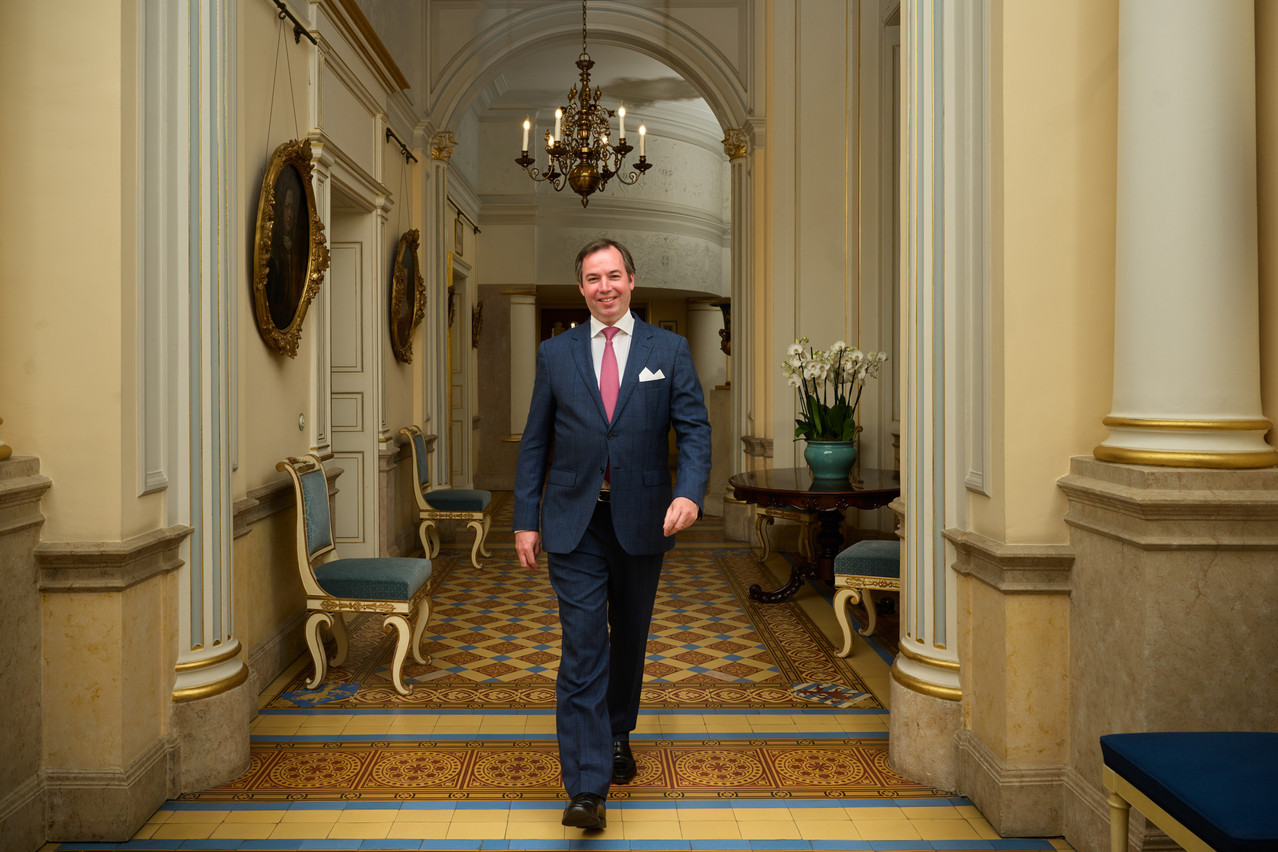
“I’ve probably visited hundreds of companies,” admits the crown prince, who has been going on economic missions since the beginning of this century. Photo: Nader Ghavami/Maison Moderne
Your brother Prince Félix is an entrepreneur himself, managing the Château les Crostes wine estate in the south of France with his wife, and has created a brand of children’s clothing, furniture and decorations, Young Empire, with friends and family. Do you ever talk to each other about the nuts and bolts of running a business?
Absolutely, and I’d go so far as to say a lot! He often asks me what I think of his various adventures, and it’s fascinating to listen to him and to understand what his journey has been like and what difficulties and challenges he faces. With my brother Félix, we can see that he’s someone who’s been ‘bitten’, you could say, because he has a desire to undertake and continue to create, and I think that’s remarkable.
In the early 2000s, you did internships with multinationals such as UCB (2003), Deutsche Bank (2004) and ArcelorMittal (2005). What do you take away from these behind-the-scenes experiences with these economic heavyweights, which you may later be asked to visit in the formal context of your duties?
It allowed me to discover what lies behind a company: the work, the history. During my internship at UCB, the CEO asked me to draw up a fairly exhaustive summary of the company’s history, to give me an idea of the different stages and challenges it had gone through. I think that was a very good lesson for me. At Deutsche Bank in London, I was able to see the diversity of the business. At ArcelorMittal, I did my internship in Spain, where I realised how complicated it was to pull off a merger and then establish a giant in the sector.
Let’s come back to you and your involvement in promoting Luxembourg abroad. Have you already considered who might take over from you the day you become grand duke?
It’s too early to say. But in any case I think the monarchy has a very important role to play in these missions and that role must continue.
In 2011 in Paperjam, on your 30th birthday, you answered “no, I’m not ready yet” when asked if you felt ready to take on the role of grand duke the next day. Twelve years later, what’s your answer?
[Laughs]. I think it’s an illusion to think that one day you’re really ready, but you have to take the time and prepare yourself as well as possible. I’m still learning today, which I’m enjoying, and the day it happens, I’ll be ready [smiles].
This story was first published in French on Paperjam. It has been translated and edited for Delano.