
The JIF platform hosts an annual women’s strike on 8 March. What is the aim of this protest?
Jessica Lopes: The aim goes beyond us. The international aim is to use the symbolic date of 8 March to make the inequalities that still exist visible. Even in a country like Luxembourg--that’s not a typical country where you would think of female oppression--there are still a lot of things to work on. We want to use 8 March as a platform to really make these problems visible with our demands but also to celebrate the advancements that already exist and all the women who fought before us.
How have your demands changed over the last years, and what are you aiming for this year?
This year, we decided to maintain the demands of last year when we sat together and thought about what the main issues are affecting our lives as women. We agreed on four big demands, which are fighting the wage gap, reducing working hours, giving access to housing for all and equal parental leave. We thought that these affect us all, no matter the class, ethnicity, gender. We decided that these are our demands, and we will keep them until there is a substantial transformation. Those aren’t things that are going to change in a year or even in years. But if we really want them to change, we need to keep on discussing them. We added one demand this year about fighting violence against women.
Do you feel that the government is listening?
I do think they are listening. We have the possibility to discuss the demands with them. It’s also important to recall that JIF is composed of different organisations, and these organisations do this lobby work already. It’s not like we have this demand of, for example, working time reduction within JIF once a year and then we forget about it. The [OGBL] union is an active member that continues all year long to try to negotiate this in collective bargaining agreements. The impact happens with different actors on the ground. It’s a process.
We try to think of a transformation of society overall.

Every year around International Women’s Day, there’s a discussion whether it has become superfluous. Why do you think we still need this day?
In an ideal situation, I would say we don’t need it anymore because it would become obsolete. But it’s not yet at all. If we look at the numbers, we realise we need it. More women are killed by their partners than the opposite. There is a huge wage gap in Luxembourg, the pension gap is very scary. These are very concrete things. We have numbers, we have facts, we have laws that actively discriminate.
For example, the law says that the mother is obliged to stay at home for the first three months, when the father has 10 days. This is the law telling me, as a woman, that I have to stay at home and take care of my child and that my partner--who is a man, because the law is framed as if the partner can only be a man--needs to provide for us and therefore go to work. As long as we don’t have a more gender-neutral and inclusive way of thinking about families and society, it’s necessary.
Speaking of inclusion, there has been criticism of feminist movements, especially in Europe and North America, of being too white, straight, able-bodied. How is the JIF platform addressing this?
JIF is a platform where you have organisations but also private people who come together and sit around the table once a month to address the different forms in which the patriarchy and capitalism impact our lives as women, but not only as women. The myth of male superiority that is still the foundation of our social, political, religious, economic order oppresses women, but also what are considered feminine men, migrant men, racialised men, the gender non-conforming. It also impacts some women more than others, and that’s where intersectionality comes into place.
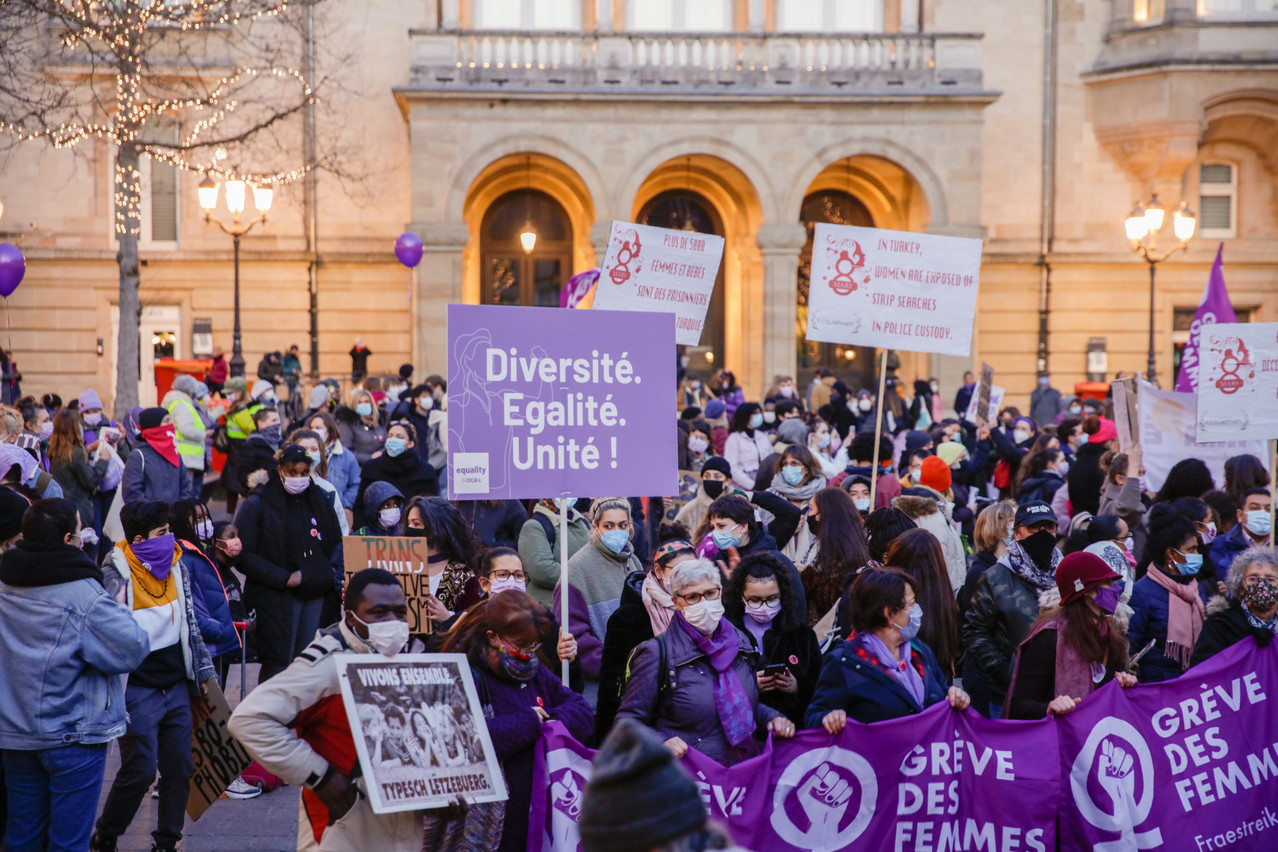
The women’s strike in Place d’Armes in 2021 Library photo: Romain Gamba/Maison Moderne
The platform is open for everyone. But I would look at intersectionality as a process, something we need to work towards. The best way to look at how JIF, as a platform, is different from the liberal white feminism that is criticised, and rightfully so, is to look at the demands. The demands focus on housing for all, on wages that allow people to come out of poverty, on inadequate parental laws. These demands are very broad and don’t aim to drive some of the women to the top. We try to think of a transformation of society overall.
But then, if you look at the active members: how do we include not-abled people in the platform? This is an open question that we don’t really have an answer to yet. It’s a process. It’s not a final state.
There is always a risk of social movements operating in an echo chamber. Who do you think you need to reach out to the most?
We know that the people who come to our open meetings and to our events usually are people who are interested in those kinds of topics anyway. But I don’t think that there is any specific group we need to reach out to more than another. We need to reach out to everyone, and we do it through the fact that we are organisations that also work outside of JIF. For example, I work in a migrant organisation. I bring these topics to the users of the organisation that I work in, and so does the union, and so does Femmes en détresse. The organisations within JIF are multipliers, and they bring it to the public they work with. I don’t personally identify one group that needs to be more addressed than others. I really think this is something that concerns everyone.
Do you still face this image of the bra-burning, man-hating feminist, or has the perception of feminism changed?
It has become a lot more mainstream. There’s feminist washing, like greenwashing. Feminism has been appropriated by the capitalist system. We consume feminist things. We call ourselves feminists with our clothes and stuff. On the one side, being feminist is not particularly radical anymore. On the other side, there are a lot of people who still look at us like that, but I would say we don’t care. When we discuss or plan anything, we are not thinking, how can we look less angry and man-hating.
Rules of masculinity are not automatic or inevitable.

Men face their own issues, from stereotypical portrayals in the media to racism and homophobia. More men die by suicide than women, boys are more likely to underperform at school. How is feminism helping men?
Patriarchy not only confines women to their place but also creates norms of masculine behaviour. Men face pressures to conform to this image. And it really shows that rules of masculinity are not automatic or inevitable. Feminism wants to break away from these norms that have been created by the patriarchy and liberate everyone who is suffocating under this gender construct. Feminism is a fight that includes men. Some don’t feel that it’s their topic, others might feel it is, but they are scared because they don’t want to say something wrong. There’s this whole thing of cancel culture and needing to be careful what you say. But we’ve been trying to overcome this challenge to include men in the conversation, make them feel welcome. Among younger men, maybe there’s already a consciousness that feminism would benefit them as well.
There’s this idea that younger people are woke and much more conscious and aware of alternative lifestyles. What is your experience working with a younger generation in Luxembourg?
The experience, to be honest, is pretty good. We really see that we have a lot of young people contacting JIF and participating in our plenary. A big part of youngsters today is completely open to these topics and way earlier. I can see a big shift between the way I was thinking when I was maybe 15 and how a 15-year-old now thinks and the freedoms they have, for example, with sexual orientation. It’s way more normal, which is a good thing.
But it’s also an illusion to think that youngsters now are woke and feminist. You still have very misogynistic patterns. You can see violence in relationships when people are very young. It’s a topic that, in Luxembourg, is not really talked about that much, violence in adolescent relationships. For example, your partner looks into your phone to control with whom you’re talking. That’s a form of violence. Those kinds of things still exist among youngsters.
If there is one thing that people who are unconvinced that we need International Women’s Day should do this coming 8 March, what would it be?
Sit down, read our demands and think about them. Criticism often comes from people who have not really looked into what we are asking. There is this stereotyped vision of, as you said, bra-burning, hysterical feminists who are totally exaggerating. But if you really sit down and look at what we are asking and why we are asking those things, I find it very difficult to disagree.
I don’t think you can disagree with the fact that it is very important to give everyone access to housing, for example, women in single-parent households who earn less than men and who are predominantly working part-time. There need to be ways to ensure that they don’t fall into precarious housing situations. I don’t know how you could argue against that. Those are demands that really make sense. And when we say housing for all, we mean it. It’s housing for all and that also includes the less favoured men in the system. We are not misandrist.
The 2022 women’s strike for equality starts at 5pm on 8 March at Place de la Gare in Luxembourg City.
This article first appeared in the March 2022 edition of Delano magazine.