The adoption of artificial intelligence (AI) in business generates as much curiosity as it does questions, offering both enticing prospects and legitimate concerns. A recent survey conducted by Luxinnovation and FEDIL – the first of its kind on this scale in Luxembourg – reveals that companies (particularly in the industrial sector, though the trend is similar elsewhere) expect AI to significantly enhance process optimisation and control while delivering financial benefits.
The shift is already underway. According to data published by Eurostat in May 2024, 14.4% of Luxembourg companies with 10 or more employees are using AI technologies. This places the country third in Europe, behind Denmark (15.2%) and Finland (15.1%), and well above the European average of 8%. In manufacturing, the anticipated benefits are especially strong: eight in ten companies expect clear improvements in cost reduction and efficiency.
Reinventing to stay ahead
AI now sits at the heart of the digital transformation facing companies of all sizes and sectors. More than any other technology, it illustrates the importance of an organisation’s ability to adapt and reinvent itself in an ever-changing environment.
The first edition of the Luxembourg AI Awards, initiated by FEDIL in partnership with Luxinnovation and supported by the Chamber of Commerce, showcased tangible success stories. The 55 applications received testify to the growing integration of AI solutions across multiple industries.
One example comes from bakery chain Fischer, which partnered with Resultance to create an order recommendation tool based on artificial intelligence. The system predicts daily demand and suggests optimal order quantities for each product at each point of sale, resulting in a 4% increase in sales, a 1.5% reduction in waste, and a return on investment in just three months.
Similarly, Cebi International, a producer of electromechanical components for the automotive and home appliance sectors, developed "Predictive", its own operational AI-based digital twin, in collaboration with DataThings and the University of Luxembourg’s SnT. The system integrates real-time production, energy, maintenance and quality data to anticipate anomalies and optimise operations – reducing scrap by 60% in under six months, improving equipment efficiency by 20% in one year, and cutting production costs significantly.
A technological, human and organisational challengeAt the core of any AI initiative, no matter its scale, is data. Companies are generating and using ever-larger volumes of information that can be transformed into value through products, services and business models… but only if processed and used effectively. This is where AI comes into play.
According to the Chamber of Commerce’s “Economic Barometer” for the second half of 2024, 48% of Luxembourg companies believe AI will have the greatest impact on their business model in the medium term, and 63% plan to actively invest in it.
“Used wisely, AI offers many advantages: productivity gains, better decision-making, improved production and more efficient energy and resource management,” says Philippe Mayer, Deputy CEO of Luxinnovation.
“For example, a recent study of 1,200 craft business leaders in France estimated time savings of 1.7 to 4.3 hours per week, depending on the level of AI adoption – equivalent to productivity gains of 4% to 9%.” He stresses that implementing AI is not just a technological challenge. It also involves human and organisational change.
Despite becoming more widespread, AI requires expertise more than ever to identify use cases and turn them into concrete projects. Philippe Mayer, Luxinnovation

This is why Luxinnovation offers companies the Fit 4 AI programme, which begins with an initial assessment carried out by an experienced consultant. In close consultation with the company, the consultant will define issues, objectives and priority development areas. This assessment is financially supported through state aid, granted in the form of a capital subsidy by the Ministry of the Economy.
"Despite becoming more widespread, AI more than ever requires expertise to identify use cases and turn them into concrete projects, to estimate potential benefits for a company, and to carry out cost–benefit analyses. It is crucial to choose the right technologies and to take legal and regulatory implications into account," says Mr Mayer.
This qualitative and quantitative analysis of the company’s available internal data enables it to clearly determine its current position, define its goals and assess its level of digital maturity. It can then more easily identify relevant potential use cases based on technology recommendations, budget considerations, risk assessments and/or ROI forecasts.
A roadmap for implementing the project is then drawn up, including a timeline and action plan, as well as quantified requirements for internal and external staff and equipment. This assessment phase may also lead directly to referrals for relevant training courses, support programmes or strategic partners.
Moving from strategy to action
The House of Entrepreneurship, established nine years ago at the initiative of the Chamber of Commerce and the Ministry of the Economy, works closely with Luxinnovation to develop digital strategies. In particular, it offers tailor-made support for implementing digital solutions through the SME Packages-Digital. “These packages help companies quickly implement digital tools with the support of an expert, while being guided by an advisor in the execution of their digital strategy,” says Stéphanie Damgé, Director of the House of Entrepreneurship and Entrepreneurship at the Chamber of Commerce.
At the start of 2025, a new service was added to this system: the SME Packages-AI, specifically designed to help companies adopt artificial intelligence solutions in a practical way. These packages provide operational support to SMEs looking to implement the roadmap defined under the Fit 4 AI programme, coordinated by Luxinnovation. A simple and effective way to move from strategy to action. “This can be done through straightforward initiatives and tools that already exist on the market,” adds Ms Damgé.
It is essential that companies can take up AI without being held back by complexity: our role is precisely to make this technology more accessible.

Companies benefiting from the SME Packages-AI receive financial aid from the Ministry of the Economy, covering 70% of eligible costs for implementing an artificial intelligence solution. This applies to projects ranging from €3,000 to €25,000 (excluding VAT) carried out with an external service provider.
Once this support is completed, an evaluation phase measures the company’s satisfaction level and the savings achieved. “It is essential that companies can adopt AI without being held back by complexity: our role is to make this technology more accessible. The SME Packages allow them to take a step forward – gaining autonomy, efficiency, and confidence – while working with quality partners,” concludes Ms Damgé.
For every need, there is a solution: a company wishing to assess its maturity in artificial intelligence and explore the wide range of solutions available can rely on Luxinnovation’s expertise. Together, they can identify the right service or provider to respond precisely to the initial request.
Fit 4 AI/SME Packages decision tree
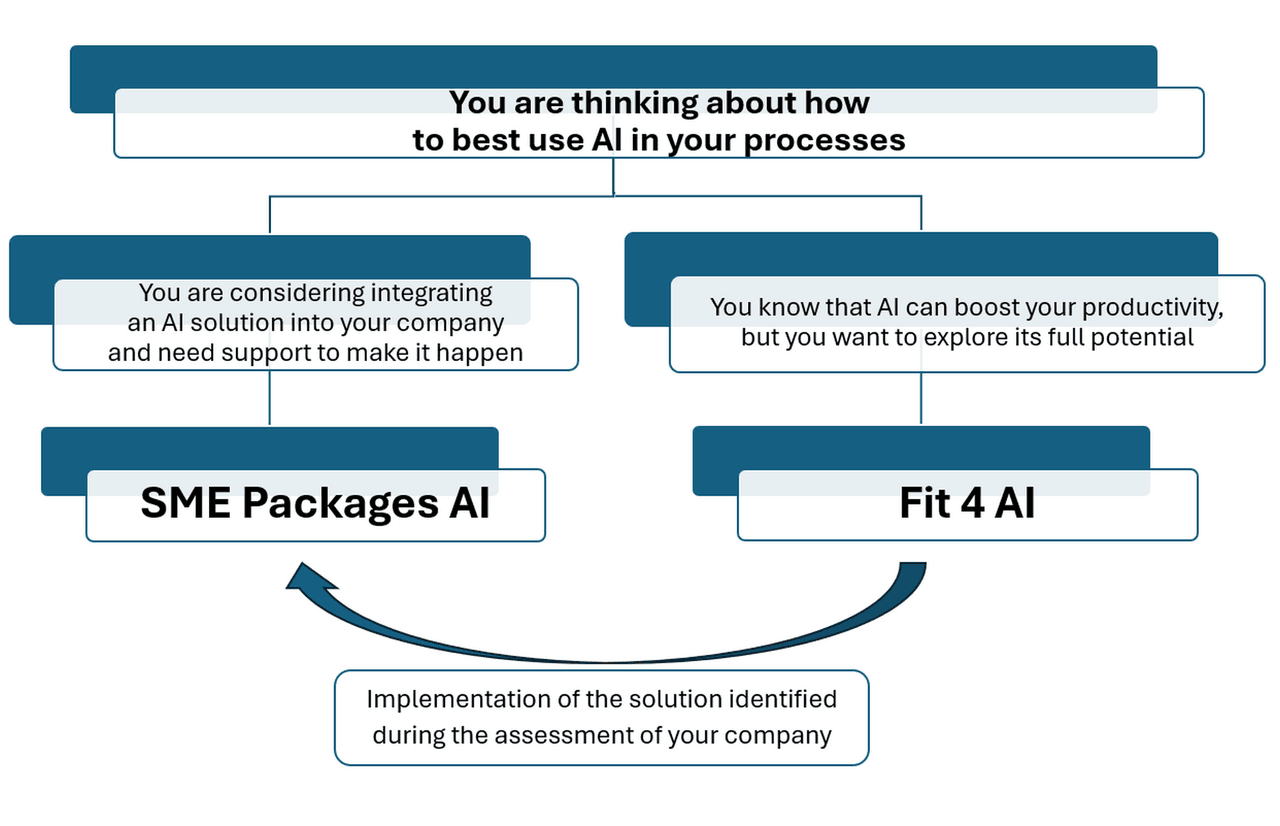
Fit 4 AI/SME Packages decision tree (Illustration: Luxinnovation)
Learn more about the Fit 4 AI programme
Learn more about the SME Packages-AI