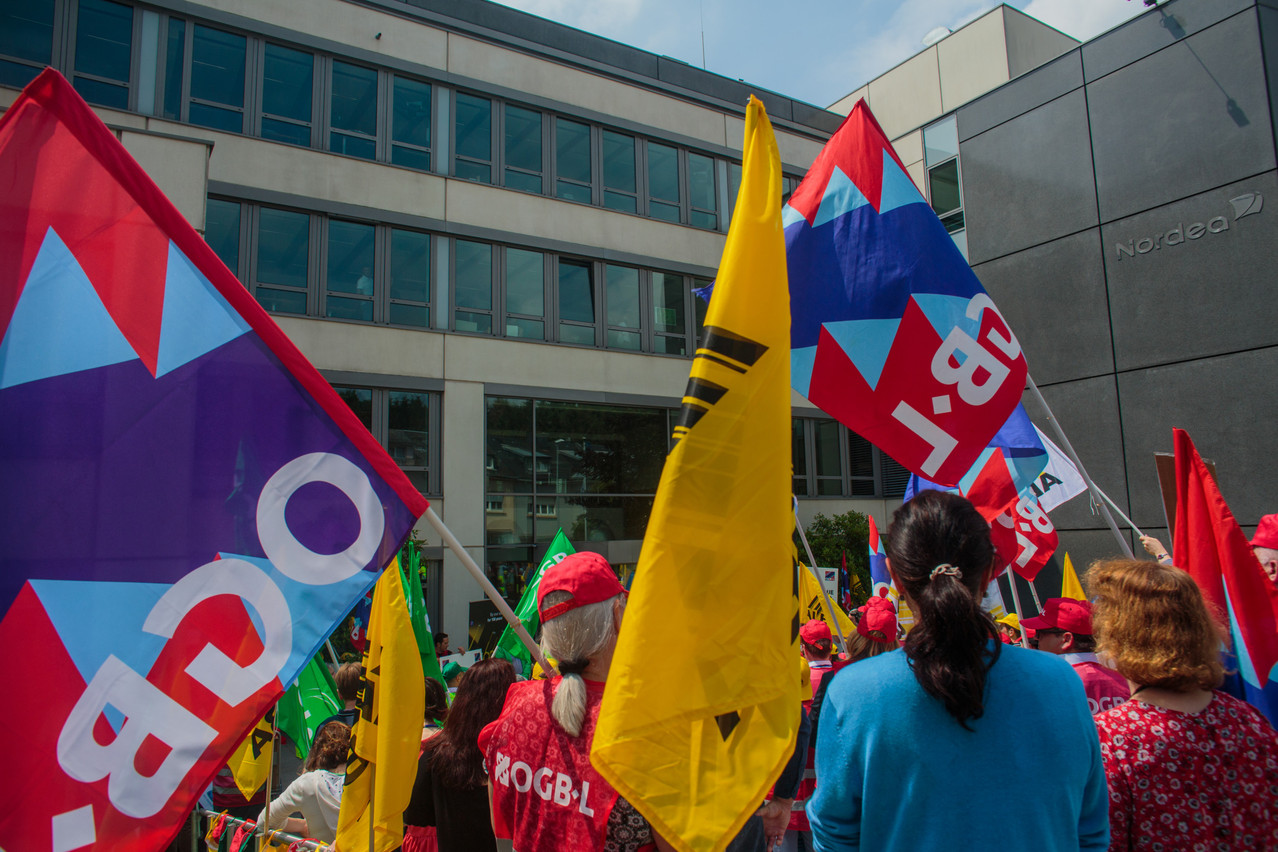
In 2019, an estimated 154,000 people were members of a trade union organisation in Luxembourg, Statec said in the latest data available. While in absolute terms this represents an increase of 1.3% compared to 2010, Statec said numbers dropped by 5.4% between 2017 and 2019 amid a growing workforce.
The trade union landscape was dominated by the OGBL with 45.4% of the country’s union members, including cross-border workers and pensioners. In second place was the LCGB with 25.9% of union members. In third place was public sector union CGFP with 19.5%, followed by financial sector union Aleba (6.5%). Only 2.7% were members of the FEP/FITC (Federation of Private Employees/Independent Federation of Workers and Professionals).
Between 2017 and 2019, the top three unions saw their membership numbers fall. Over a decade, the average union density based on OECD figures, including cross-border workers, fell from 36% in 2010 to 28% in 2019.
“This phenomenon of de-unionisation is even more significant among residents, where the unionisation rate has fallen from 40% in 2010 to 25% in 2019. In 2019, only 1 in 4 resident workers were affiliated to a trade union organisation according to self-reports. Union density has fallen sharply, by a third, over the past decade,” the Statec publication said, adding that “the decline in union density is greater than in the rest of the OECD.”
Heterogenous workforce
This decline in trade union density can be explained by several factors, including a lack of interest in trade union issues among younger workers. Having a collective work agreement at national or sectoral level can also result in reduced union activity as employees are protected, whether or not they are union members.
Another phenomenon that may explain the decline in trade union membership are changes in the world of work linked to economic restructuring, such as technological change, deindustrialisation and digitalisation. All of these factors have diversified jobs and created a more heterogeneous workforce.
It should be noted that the fall in union membership was greater among men than among women, slightly reducing gender inequalities in union membership.
On the other hand, nationality is a factor where the degree of unionisation diverges. Trade unions are much better represented among Luxembourgers (39%) than among employees with another nationality. The high level of unionisation among Luxembourg workers could partly be explained historically by the fact that these workers have been at the centre of the more protectionist approach of Luxembourg unions in the past.
Nearly two-thirds of non-unionised workers were foreign nationals, the 2019 data said.
This article was first published in French on Paperjam. It has been translated and edited for Delano.