Like Luxembourg with its tramway, Metz is upgrading its transport network. At the beginning of September, the Moselle capital will be inaugurating the extension of its Mettis line A, the high service level bus that already crosses the city from one end to the other. At the same time, another worksite is making headway: that of the future C line, set to strengthen the backbone of Metz’s mobility by 2027.
Reinforced service to the hospital and Stellantis
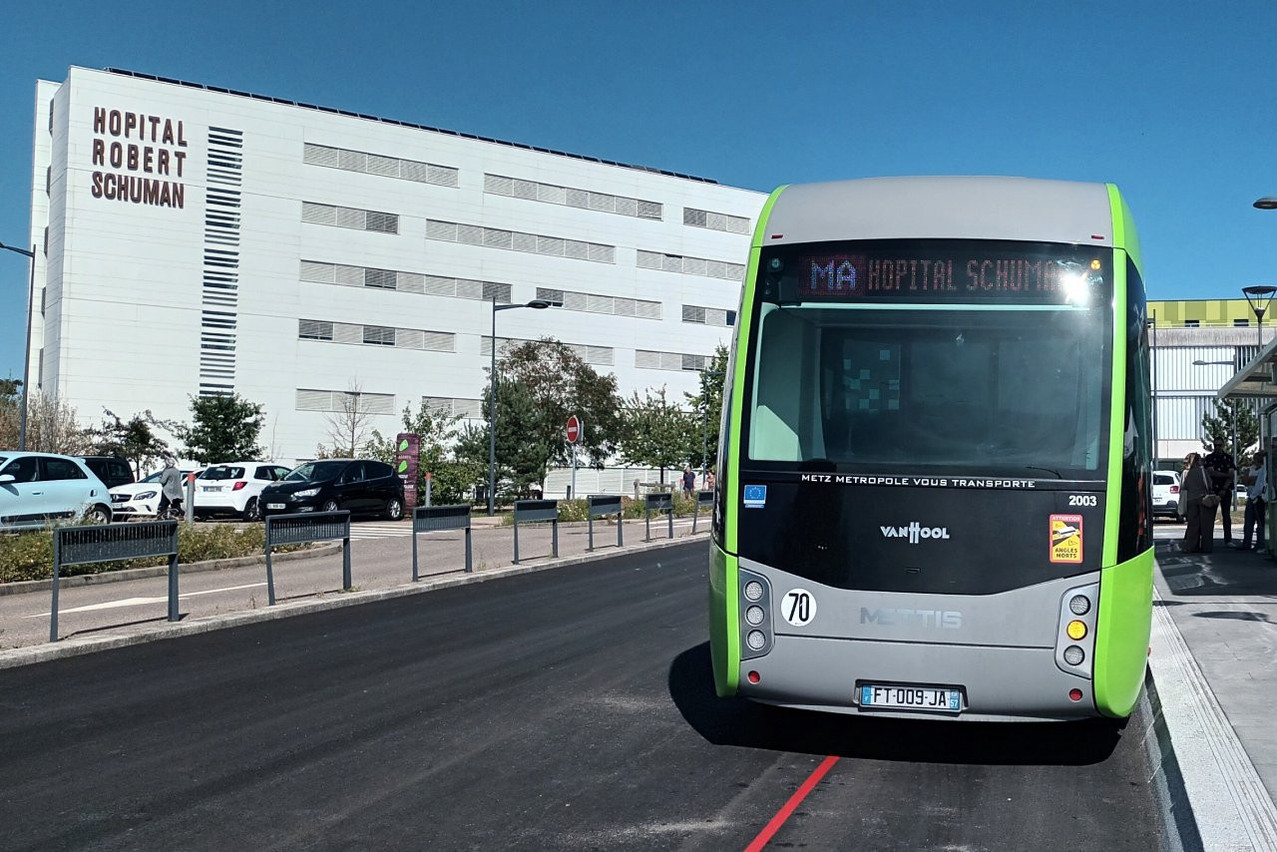
From 1 September, line A will run to the Robert Schuman hospital and the Stellantis site, two major service and employment centres. The hospital, inaugurated in 2013, employs 800 people, while the Stellantis factory employs around 900. This 2.2 km extension should improve accessibility for the thousands of employees and users who visit these sites every day.
The frequency will also be increased at peak times, with a service every seven to eight minutes on the network’s common trunk (compared with ten minutes at present), and every 20 minutes during the rest of the day. This service is designed to absorb the flow of commuters, particularly to the hospital and the car plant.
A new structural route in 2027
But the real revolution is yet to come. Metz is working on the creation of a third Mettis line, line C, which by 2027 will link the city centre to Marly via Montigny-lès-Metz. The aim is to connect new neighbourhoods, ease traffic congestion and offer a credible alternative to the private car.
Complicating the lives of shopkeepers and local residents, the work began in the hypercentre last spring, with the transformation of several key roads and squares. The idea, the public authorities have explained, is not just to lay out a new rapid bus route, but also to rethink urban space, giving more space to pedestrians, cyclists and vegetation.
€10m invested in 2025
For 2025, the cost of the work committed to the two routes reaches the sum of €9.9m (excluding tax), i.e. €5.3m for the extension of line A and €4.6m for the creation of Mettis C.
The Mettis was inaugurated in Metz in October 2013, after four years of work. This Bus Rapid Transit (BRT), presented at the time as an alternative to the tramway, is based on two main lines (A and B) that cross the city from the north for around 17km. The project, launched in 2009, had necessitated a major urban redevelopment: the creation of dedicated lanes, the redesign of junctions, the introduction of hybrid articulated vehicles and the construction of a new depot.
In 2024, the “Le Met” public transport network, to which the Mettis belongs, recorded around 23.5m journeys, an increase of 500,000 over one year.
This article was originally published in French.