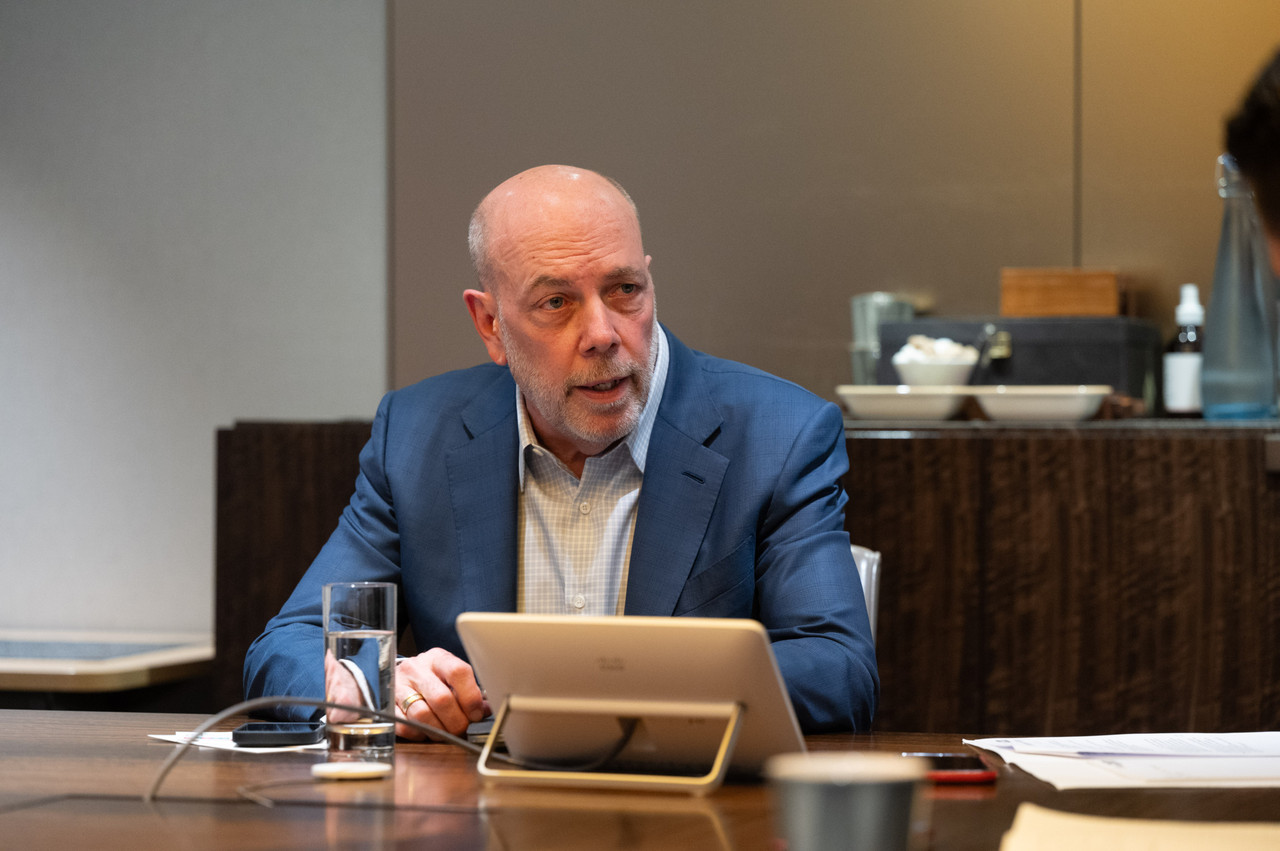
“We're exclusively focused on active management, adding value to our clients,” said George Gatch, global CEO at J.P. Morgan Asset Management. He added: “one priority for us is helping and advising clients how to navigate an uncertain world” by sorting through the mass of information and noise.
Sorting out the noise through technology
“We spend $500m a year on technology. We employ 1,500 engineers/technologists dedicated purely for the asset management business,” stated Gatch during a presentation at the firm’s International Media Summit on 13 March 2024 in London. The first focus of his team is to ensure “cutting edge, state of the art capabilities….to synthesise a large amount of information using AI big data” for the portfolio managers, research analysts and traders.
Education: giving some access to the firm’s knowhow
Gatch explained that JPMAM has a “guide to markets” programme with daily updates on their website to help investment professionals work with clients to identify opportunities, risks and challenges. It is offered in 25 countries and 11 languages and is subscribed to by over 250,000 investment professionals.
Through their “digital portfolio insights” tool, he claimed that his clients can use the same tool as the multi-asset portfolio managers are using to manage their portfolios.
Active exchange-traded funds (ETF): A major growth engine
Gatch commented that JPMAM manages $160bn in about 100 ETFs while aiming for $1trn within five years. He observed that $800bn went out of mutual funds last year while the same amount went into ETFs.
While the flows went historically into passive ETFs, he thinks that its active capabilities will contribute to change the face of the industry as 20% of inflows went into active ETFs which currently account for only 6% of the total ETFs.
“The more investors move towards passive management the greater opportunity it provides us to take advantage of valuation anomalies that happen in the market,” said Gatch. He provided several statistics on the extraordinary performance of few stocks in the US (the so-called Magnificent 7) but it is unclear whether his teams had the cleverness to overweight them.
With the Mag 7 trading at a price-earnings (PE) ratio above 30, Gatch thinks his firm is well placed to exploit inefficiencies as the rest of the S&P trades, on average, at PE ratios with “slight discount relative due to historical evaluations.”
Gatch claimed that JPMAM has the largest ETFs in the industry (JPM Morgan equity premium income ETF with $33.1bn in fund assets as of 18 March 2024). Yet he thinks that the largest growth opportunity is in active fixed-income ETFs as the “average fixed income manager outperforms indices.”
JPMAM believes in the democratisation of private assets
“Average institutions today have exposure to private markets of 15%-20%. If you look at foundations, some of them are up to 50% or more in alternative strategies,” stated Gatch. He thinks that the next wave will be in the wealth management industry where the “average individual investor has usually less than 5% allocated to alternative strategies.”
Gatch commented that JPMAM has leveraged their institutional alternative capabilities in investment structures, which he thinks are suitable for wealth management in the US and in Europe.
Committed to sustainable investing despite withdrawing from the Climate Action 100+ group
“We believe climate has a significant impact on the earnings, potential risks and opportunities for companies… and we continue to be a signatory to the net zero asset management initiative,” said Gatch. He commented that they invested “heavily” in the past five years in ESG and built up a team of over 40 dedicated professionals while their 300 equity and credit analysts are accounting for ESG factors that contribute to “over 30 sustainable strategies.”
JPMAM claimed having engaged with companies “more than 1,200 times last year, 500 of which were on the topic of climate change.” Gatch considers their engagement strategy to be fundamental “to preserving and protecting the interests of our clients.”
Regulatory challenges ahead
“There's greater fragmentation of regulation than there ever has been,” observed Gatch. Despite the standardisation drive in the European Union, he noted that “you see countries taking very different approaches on some key regulatory issues, that makes it harder for clients to invest across markets.”
No ventures into digital currencies
Given previous statements from JPM Chase CEO’s, Jamie Dimon, on the intrinsic value of digital currencies, it will come as no surprise that Gatch stated that they currently do not see how to add value to “the construct of a long-term investment portfolio.”
Greater potential in tokenisation and blockchain
Yet he thinks that that tokenization of private assets will provide greater liquidity and may be transformative for the industry. The same is also true for blockchain technologies to improve settlements, custodies, and fund accounting and to “digitally transfer the value across security markets between asset managers and market makers.”
Delano was invited to attend J.P. Morgan Asset Management’s International Media Summit in London. The latter paid for accommodation and transportation.
This article was published for the Delano Finance newsletter, the weekly source for financial news in Luxembourg. Subscribe using this link.