It had started with visiting students. Three years later, ESSCA in Kirchberg has its first permanent cohorts, a bachelor’s degree programme launched at the start of the academic year, and a specialisation in finance designed to supply the Luxembourg labour market.
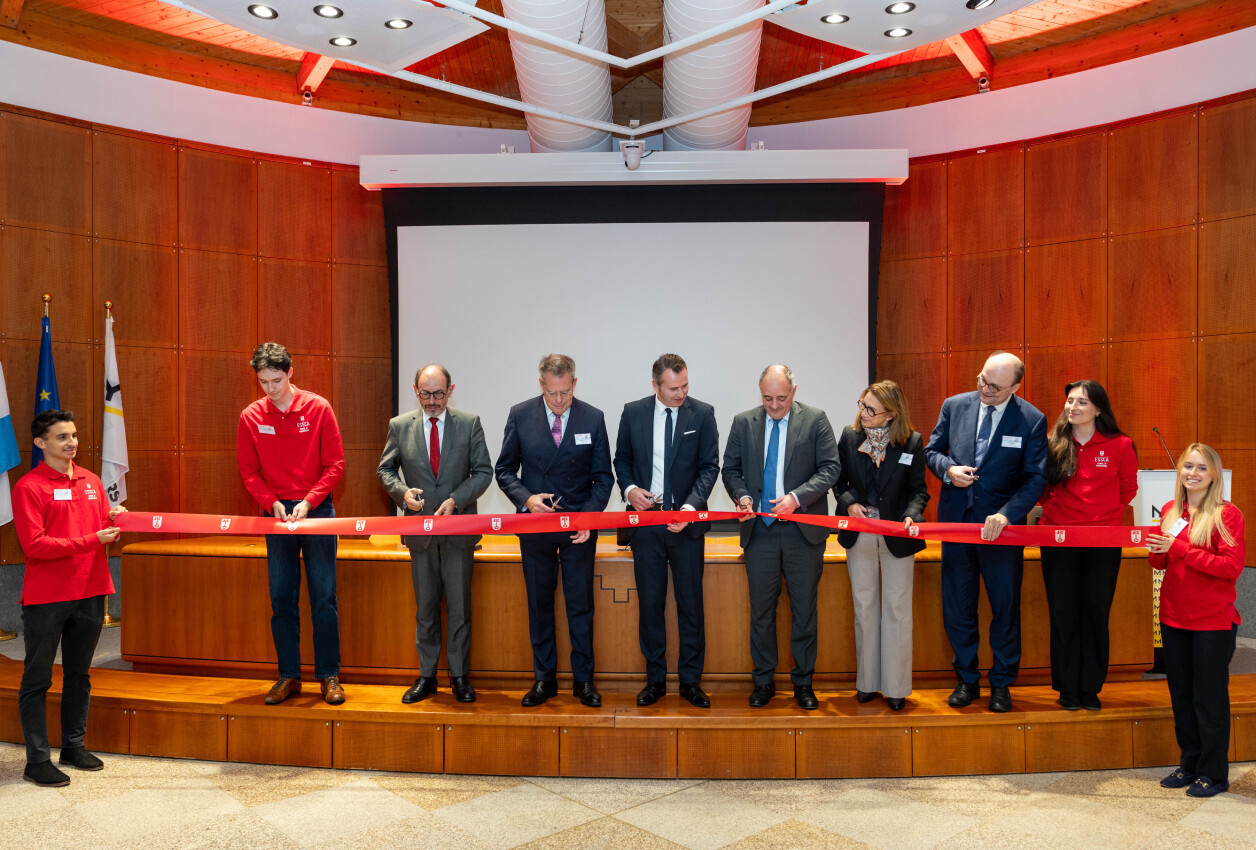
The French business school officially opened its campus on Wednesday 28 October, on the premises of the Chamber of Trades. It had begun operating in the Grand Duchy in February 2023. Its first students arrived there in September of the same year, as part of an international exchange programme under the Grande École Programme.
“We currently have around 50 students; we’ll have 75 from January onwards as we’re also welcoming exchange students,” said Antoine Rech, director of the Luxembourg campus, at a press conference held ahead of the opening ceremony. The student body currently comprises 23 students on the Bachelor’s degree in International Management and around 15 on Master’s programmes. The rest are on exchange programmes. Half of the students on the Bachelor’s programme are from France and half are Luxembourg residents representing a range of nationalities.
The school’s tenth campus
The Chambre des métiers site can accommodate “just over a hundred students”. This capacity could be reached quickly if the school manages to attract some of the students enrolled at its nine other campuses. “The aim is, of course, to expand significantly in the coming years,” explained Jean Charroin, Managing Director of ESSCA. “The market will tell us whether it works or not.” The school has more than 7,500 students worldwide. A transfer of just 2 per cent of them to Luxembourg would already amount to 150 people, its chief executive calculated. However, ESSCA has not yet set a specific target for the next five or ten years.
The Luxembourg campus is the school’s tenth site. Six are in France, in Angers, Paris, Bordeaux, Aix-en-Provence, Lyon and Strasbourg. The four international sites are located in Budapest, Shanghai, Málaga and Luxembourg. Founded in 1909 in Angers, ESSCA is a non-profit organisation. It holds French status as a private higher education institution serving the public interest. Any surpluses must be reinvested in teaching and research. The school boasts a network of around 24,000 graduates, more than 200 of whom work in Luxembourg. This network was a key factor in the Grand Duchy’s decision. It should also make it easier for students to gain access to businesses and secure their first jobs.
The Bachelor’s degree in International Management welcomed its first cohort of Luxembourgish students in September 2026. All teaching is conducted entirely in English. The programme allows students to spread their three years of study across several countries and campuses. The Grande École Programme, for its part, offers a Master’s-level course specialising in finance. Its Luxembourg specialisation covers, in particular, asset management, investment funds, auditing, compliance, risk management and corporate finance. The institution plans to launch the first full year of the Master’s programme in Luxembourg at the start of the next academic year. At the same time, a module focusing on artificial intelligence and agent creation is to be incorporated into the curriculum across all campuses.
Links with businesses and a multicultural ecosystem
The link with employers is one of the main selling points put forward by the school. Students recently visited UBS. Further meetings have been announced with Société Générale and Crédit Agricole. PwC is also amongst the partners cited by the campus. Its membership of the Chamber of Trades should enable the institution to broaden its network beyond banks and major firms. ESSCA also aims to expose its students to small and medium-sized enterprises, entrepreneurship and business takeovers.
Bachelor’s students will undertake a work placement at the end of their degree programme. In the second year of the Master’s programme, teaching takes place between September and December. This is followed by a six-month work placement starting in January.
The school does not yet have any data on the proportion of its students who will find their first job in the Grand Duchy. Its first cohorts to have completed a full course of study in Luxembourg will not graduate for another two years. ESSCA has therefore pledged to carry out graduate surveys to gauge the number of graduates who have remained in Luxembourg, moved to another country or returned at a later date. Talent retention was also discussed during a meeting with the Minister for the Economy, 
This adaptation presents a challenge. Recognised and accredited degree programmes cannot be updated at the same pace as the technologies used in finance. Jean Charroin acknowledges this: changes to the core curriculum must go through validation procedures. “We are a management school, not a technical college,” he also pointed out. Nevertheless, the institution aims to train managers capable of understanding artificial intelligence, tokenisation, crypto-assets and cyber security. To become more responsive, the school intends to use optional courses, known as ‘elective modules’. These can be developed more quickly and offered remotely to students across different campuses. Lecturers also have scope for innovation covering 10 per cent of their courses.
Triple accreditation
In Luxembourg, a regional council comprising businesses, institutions and qualified experts is tasked with identifying the skills required over the next three years. Its members include 
Green finance is one of the areas mentioned. The school is also considering combining the expertise of its various campuses. A seminar on cyber security could, for example, begin in Luxembourg and continue in Málaga, where ESSCA is expanding its technology programme.
The campus is covered by the school’s international AACSB, AMBA and EQUIS accreditations. Its Bachelor’s programme leads to a French licence degree. Its Grande École programme leads to a French master’s degree. Graduates may apply for recognition of their qualifications in Luxembourg, particularly if they wish to enter the civil service or continue their studies.
Accommodation remains one of the obstacles to international recruitment. The school provides students with a list of estate agents, but does not offer any accommodation itself. Some opt for co-living in Kirchberg. Others live in neighbouring areas and commute to campus every day.
ESSCA is also developing its continuing professional development programmes. It is working with the Paperjam Business Club on several programmes and provides leadership training to the Chamber of Trades.
The opening ceremony was attended by 


The tenth campus now has its own address, its first courses and an initial capacity of around 100 places. Its success, however, will be measured by the number of students it helps to graduate, and subsequently by the number of young professionals it enables Luxembourg to retain.