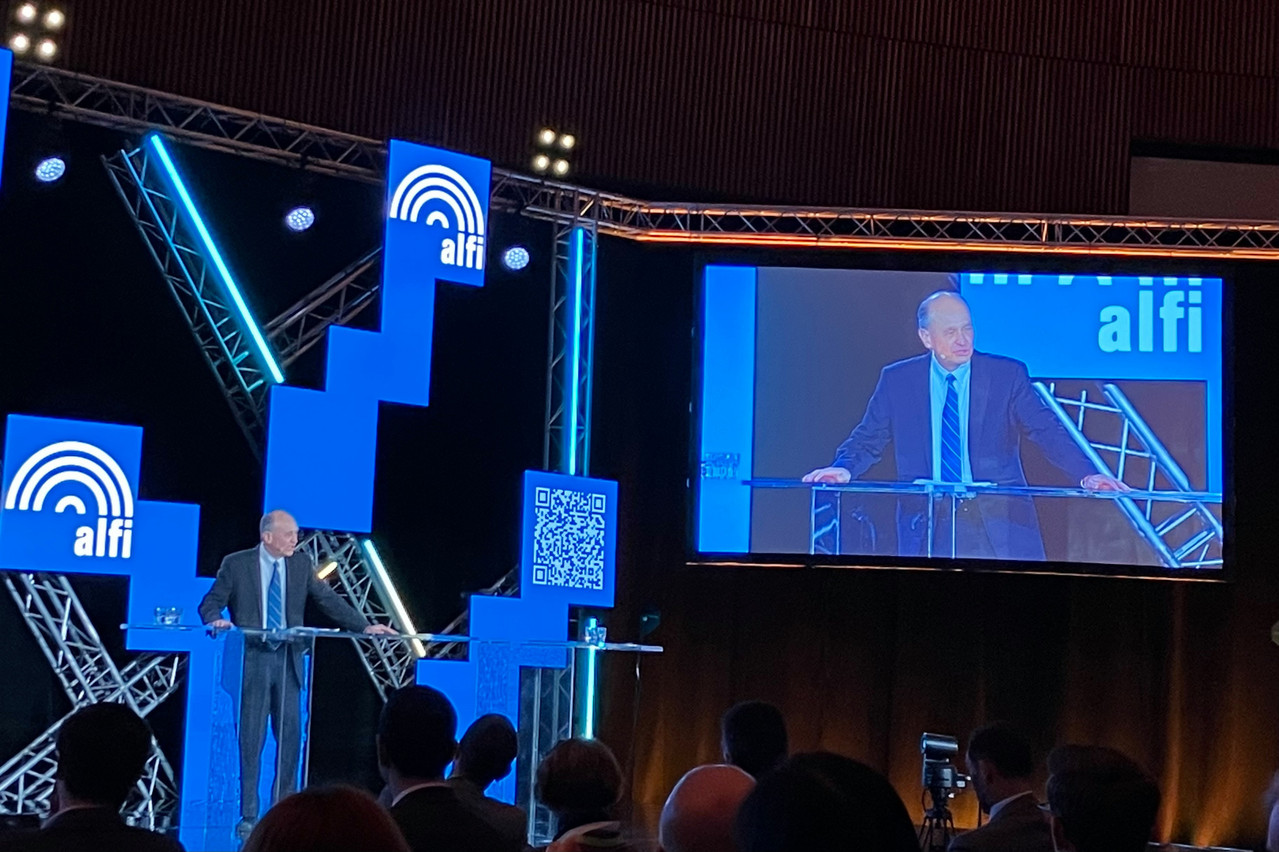
“The very important framing thought for us to bear in mind is that over the last four years, we’ve seen a very resilient global economy,” said Citi’s global chief economist Nathan Sheets during his keynote speech at the Association of the Luxembourg Fund Industry’s Global Asset Management conference in Kirchberg on 19 March 2024. Despite the covid-19 pandemic, lockdowns, Russia’s full-scale invasion of Ukraine, disruptions in commodity markets, a rapid rate-hiking cycle by central banks, the collapse of major global banks and the emergence of conflict in the Middle East, the global economy has been resilient.
Yes, there are challenges, risks and difficulties. But we’re not in a “severe recession” or “outright depression;” instead, we’re a “stone’s throw away” from normal. “We have seen a flexibility in the global system--I don’t know what word to describe it, other than--it’s extraordinary,” said Sheets.
“Economists for a generation will be studying this episode, and trying to better understand the roots of this flexibility and resilience. I personally think it has something to do with the technologies that are being deployed that make firms and production--particularly the production side of the economy--much more flexible than they were before, and hence better able to respond to various shocks.”
Strong consumer key to resilience
One of the key dynamics in this resilience has been the “interaction between a strong consumer and labour market, and specifically, coming out of a pandemic,” said Sheets. “Consumers had substantial, pent-up demand for services experiences.” Because of the pandemic, they hadn’t travelled or engaged in leisure, hospitality, entertainment, restaurants and other services activities; coming out of the pandemic, they wanted to do all of these activities, leading to a “surge of consumer spending on services.”
“That spending supported the economy. But importantly, services are also labour-intensive,” he argued. Wage growth has been pushed up, which means two things. One, people have more money in their pockets, which means they’re able to continue to spend it now. It’s an illustration of the “self-reinforcing dynamic between the services and labour market,” said Sheets. “Each reinforces the other.”
“But by the same token, this tighter labour market and faster wage growth has also passed through into higher services inflation,” he added, which is at the core of what central banks are still fighting.
On the horizon: continued resilience, but also a slowdown
“We expect resilience to continue, but we do, this year, see some slowing in the global economy,” said Sheets. “We aren’t expecting anything that sounds like a recession,” but global growth will be slower than in 2023, he argued, explaining the four key elements that made up the basis of his forecast.
First, the global consumer has been “very robust,” and the “pace of spending globally has been very strong.” Consumer spending has made up for what was “lost” during the pandemic, “and is likely to scale down.” And as the year progresses and people spend less on services, two things are likely to happen. Consumption will soften and spending will “rotate” from services into goods, which would be a “positive impulse” for the manufacturing sector. The second result would be a slowing in overall GDP.
The lag effects of monetary policy tightening are still very much in the pipeline

Sheets’ second argument for an economic slowdown focused on monetary policy. Central banks have raised rates and tightened “vigorously,” and “we have felt some restraining effects from those rate hikes.” “But our sense is that the lag effects of monetary policy tightening are still very much in the pipeline.”
Third, “we think we’re going to see some loosening in the labour market.” Slower wage growth and increases in unemployment could contribute to a slowing.
And finally, “fiscal policy in many countries is poised to be less important,” said Sheets. During the pandemic, various countries saw “substantial fiscal support.” Over the last several years, “that’s been gradually reduced,” and Sheets said that he expected that to continue to be the case in 2024.
Zoom on specific countries
Sheets noted that India’s growth is expected to be in the 6% range, while China’s growth will be in the 4.5% to 5% range. In the near term, “there’s enough momentum in the private sector, coupled with the the targeted fiscal stimulus that they’re doing for the economy to grow at a reasonable pace.” But in the medium to long-term, he added, China faces several challenges: the property sector, debt, an ageing population and geopolitical tensions.
Overall growth in the euro area is expected to remain soft, “with a lot of divergence between, say, Germany on the one hand, and some of the southern economies like Spain, Portugal, Greece,” which are more services-oriented and benefited from tourism.
The United States has “surprised” on the upside, but US growth in 2024 will likely be softer than it was in 2023. It’s “debatable” as to whether the country will see a recession this year, but “the pace of growth is likely to step down.”
Our sense is that inflation in Europe is falling somewhat faster than in the United States

If there’s any “good news” to be associated with the slowing of global growth, it’s that “the slowing and easing of labour market pressures and services expenditure are likely to take a bit out of services inflation,” said Sheets. And as this happens, this should give central banks “the confidence that they will achieve their inflation targets, and that should open the door for major central banks to cut rates” towards the middle of the year.
“Our sense is that inflation in Europe is falling somewhat faster than in the United States, and that’s going to gradually give the ECB [European Central Bank] confidence to be a little more aggressive than the Fed.”
Upsides, downsides and US election outlook
When it comes to upside and downside risks, said Sheets, “we’ve been surprised, over the last four years, by the resilience of the global economy. It has simply grown in a more powerful, sustained way than what he anticipated. And it is altogether possible that we’re again surprised on the upside.”
Another “notable upside risk” is the emergence of “very powerful technologies,” including artificial intelligence, which are working their way through the economy. It’s “early days” for AI, with big dividends in terms of GDP growth unlikely in the next year--we’ll have to see how things look after five to 10 years, he said. But it’s possible that effects on productivity and GDP get transmitted to the economy more rapidly than expected.
In terms of AI, he added, it’s important to think about who will benefit downstream and the sectors in which AI will be the most transformative. “I’m bullish on manufacturing,” he said, and “particularly bullish on US manufacturing,” but noted that some analysts are talking about “how finance can be a big winner as a result of AI.”
Inevitably, you end up seeing things that you hadn’t expected--for lack of a better term, the unknown unknowns

On the downsides, there’s the continuation of Russia’s full-scale war in Ukraine, the effects of which have “largely been priced into financial markets,” as well as the conflict in the Middle East and disruptions to global shipping. The world of geopolitical risks is one that’s “hard to model as an economist,” said Sheets. “Inevitably, you end up seeing things that you hadn’t expected--for lack of a better term, the unknown unknowns.”
The US presidential election in November will be “hard-fought,” he added, saying that the outcome is a “coin flip. It really could go either way.” And regardless of who is elected, there are risks linked to higher debt. One of the big differences between the two relates to foreign policy towards Europe: Biden is a classic “trans-atlanticist,” while Trump is “more complicated,” said Sheets. “It’s something that I’ll be watching pretty closely.”
Need for flexibility
“Our bottom line is that we expect global growth to slow this year,” concluded Sheets. “We think that’s going to open the door for global central banks to start cutting rates.” As the year progresses and inflation starts to lower, “we may finally start to get a glimpse of what the normal post-pandemic is going to look like.”
“It’s likely to continue to be a challenging environment, but also an environment with meaningful opportunities, especially for those that remain flexible. And I think the corollary to that is, I think it’s likely to be an environment that rewards tactical flexibility.”