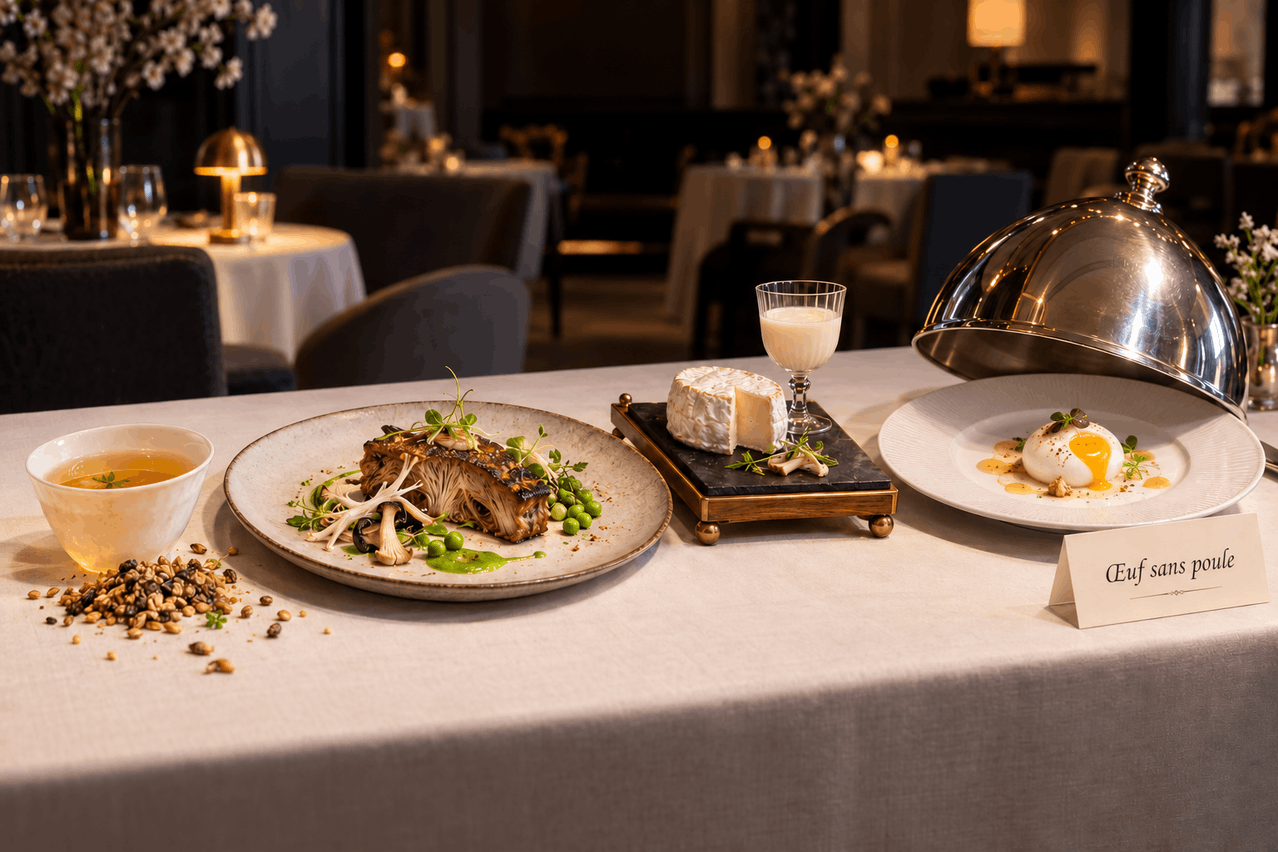
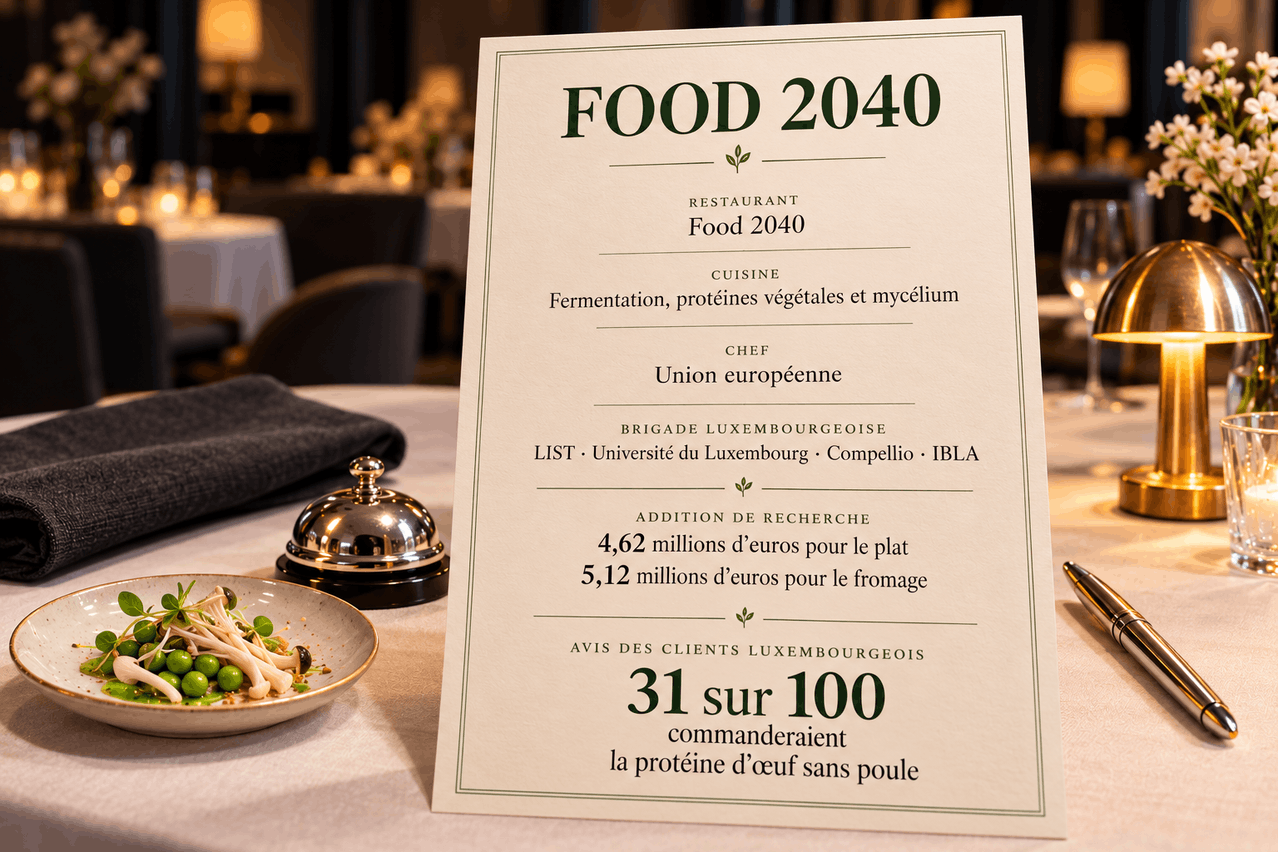
Food 2040: a gastronomic guide – projects linked to Luxembourg, research budgets and consumer feedback all brought together on a single map. (Illustration generated by ChatGPT based on photos of the various projects discussed.)
The booking is for 2040. The house does not ask about any allergies or dietary preferences. It asks just one question: to what extent are you prepared to accept that cooking should replace livestock farming?
Let’s make one thing clear before we sit down to eat: the restaurant doesn’t exist. The dishes feature products still under development as part of several European programmes. ‘Egg protein without hens’ is the scenario being put to consumers by the European Commission. We’ve put it all together in a menu to see what might end up on our plates, how much it would cost and why Luxembourgers are already hesitant to order. This is a purely speculative feature based on real facts, real projects and feedback from real Luxembourger consumers.
Palate cleanser: fermented stock and brewers’ grains
It is amber in colour. On the nose, it promises to be a full-bodied broth. The description is somewhat puzzling: the liquid is the result of a fermentation process used to produce mushroom biomass.
The recipe is part of the Plantomyc project. The aim of the project is to feed microorganisms with starch-rich by-products from pea processing. It also plans to use brewers’ grains – the cereal residue left over after beer production.
The aim is to produce biomass from mycelium, the filamentous part of fungi. The remaining liquid could be turned into a drink enriched with gamma-aminobutyric acid or a flavourful stock.
The economic concept is better than the name of the dish. A low-value raw material provides a source of protein. The fermentation residue yields a second product. The recipe minimises waste and maximises the revenue that can be generated from the same vat.
The Luxembourg Institute of Science and Technology is taking part in the project. Its EU contribution amounts to €88,347.79. The programme as a whole has a budget of €4.62m, funded entirely by the European Union.
The dish: pea steak with mycelium
The dish looks like minced meat. Yet no animal appears on the list of ingredients. The steak combines plant-based proteins with the mycelium biomass produced for the appetiser.
Peas provide the protein. Mushrooms are intended to improve what is often still lacking in plant-based alternatives: texture, flavour and mouthfeel. Plantomyc aims to create a minimally processed, nutritious product that is appealing enough to win over consumers beyond the vegetarian market.
We cannot yet assess the cooking process. The project must first manufacture and then test its prototypes. It will evaluate their composition, taste, nutritional value and their suitability for scaling up from experimental production to industrial-scale manufacturing.
This change in scale will determine the price eventually shown on the menu. Costs will include fermentation equipment, raw materials, energy, health and safety checks, and distribution. If the steak remains more expensive and less popular than the one it replaces, its run will end at the tables of the curious.
Cheese: plant-based, fermented, dairy-free
The cheese platter arrives without any cow’s, goat’s or sheep’s milk cheeses. It features a plant-based cheese and a kefir produced through microbial fermentation.
This time, the recipe comes from Delicious. The European project has a total budget of €5.12m, of which €4.5m is provided by the European Union. No organisations from Luxembourg are involved in the consortium.
Researchers want to address the main commercial shortcoming of many plant-based alternatives: consumers understand their environmental benefits, but then find themselves missing cheese from the very first bite. Delicious is therefore focusing on taste, smell and texture. It is also aiming to develop products rich in protein, fibre, vitamins and probiotics.
Chefs must help to define the desired qualities. Consumers will taste the prototypes. A technical and economic assessment will need to determine whether the cheese can move from the experimental kitchen to the shop shelves at an acceptable price.
Dessert: egg white without the hen
The last dish looks familiar. The protein is identical to one found in eggs. Yet it has been produced from microorganisms, without the use of any animals.
This dessert is not presented as a product already on sale in Luxembourg. It forms part of the scenario set out in the special Eurobarometer survey on innovative foods. The European Commission informs respondents that the ingredient complies with EU safety standards and that this is clearly stated on the label.
The room is emptying nonetheless. In Luxembourg, more than two out of three people surveyed would refuse to buy a food product containing this protein. Only 31% would accept it. Across the European Union as a whole, the figures stand at 54% and 42% respectively. The survey was carried out amongst 26,456 people across the 27 Member States between 22 May and 24 June 2026. In Luxembourg, 511 people responded between 26 May and 15 June.
The service: a label, but nobody believes the waiter
The company promises complete transparency. The production method, ingredients and origin are all listed on the label. This is exactly what 56% of respondents in Luxembourg are calling for in order to have greater confidence in innovative foods.
All that remains is to decide who will present the dish. The spokesperson appointed by the food industry is at a disadvantage: only 4% of residents would turn to them for reliable information on the safety and environmental impact of these foods.
Customers prefer to listen to a healthcare professional – cited by 39% of respondents – or a national food safety agency – cited by 37%. The European Food Safety Authority accounted for 35% of responses. Consumer organisations accounted for 34%.
A good label alone will not be enough, therefore. Consumers want to know the recipe, but they also want to know who has checked it.
The comments left on the table
“Too artificial,” would be the response from 42% of Luxembourg customers when asked about their main reservations. “What will the effects be in 20 years’ time?”, would ask the 44% who are concerned about the long-term health consequences. A third would call for more information on manufacturing, composition or origin.
The sector’s overall reputation is already poor. In Luxembourg, 62% of respondents have a negative view of novel foods. Only 29% have a positive view. The European average for a favourable view stands at 39%.
Younger people are less critical. Among 15–24-year-olds in Luxembourg, 46% have a positive opinion. This proportion falls to 33% among 25–39-year-olds, 23% among 40–54-year-olds and 20% among those aged 55 and over.
The problem is not a complete lack of information. Among residents, 69% had already heard of innovative foods before the interview. Thirty per cent consider themselves well-informed, which is three percentage points higher than the European average.
The bill
The price of the set menu hasn’t been printed yet. But the customers have set their limit.
Among the minority in Luxembourg who are willing to order egg protein without the hen, 52% would buy it if it cost the same as the traditional product. 21% are willing to pay more. The majority of the rest either want a discount or prioritise taste, brand and availability over price.
The restaurant could therefore open with a small clientele willing to support this new venture. It will only fill the dining room once it reaches the price levels of the dishes it aims to replace.
European grants cover part of the learning process: formulation, trials, testing, regulatory compliance and scaling up. They reduce the risk borne by researchers and businesses prior to the first sale. They do not guarantee either consumer acceptance or orders.
Critics’ verdict
The cuisine is ingenious. It turns pea waste into protein, brewery spent grain into a raw material, and the by-products of fermentation into stock. It promises to reduce the number of animals used and make better use of resources.
The service still needs to learn how to explain the dishes. The industry inspires little confidence. The labelling is reassuring, but does not dispel fears about artificial ingredients. And eight out of ten Luxembourgers fear that the widespread, poorly regulated use of these foods could threaten culinary traditions and rural heritage.
As for the Luxembourg team, it works mainly behind the scenes. The List is involved in plant proteins and mycelium. The University of Luxembourg has studied food microbiomes as part of the Circles project. Compellio is developing traceability as part of the TRUSTyFOOD project. The List and the Institut fir Biologësch Landwirtschaft an Agrarkultur Lëtzebuerg are working on pulses as part of the Legendary project.
Our rating: A promising kitchen, but a challenging dining room. Europe can fund the kitchens. To fill the tables, it will need to serve food that is good, safe, easy to understand and sold at a fair price. Luxembourgish consumers are not simply rejecting a piece of technology. They are still turning their noses up at the menu on offer. What about you?