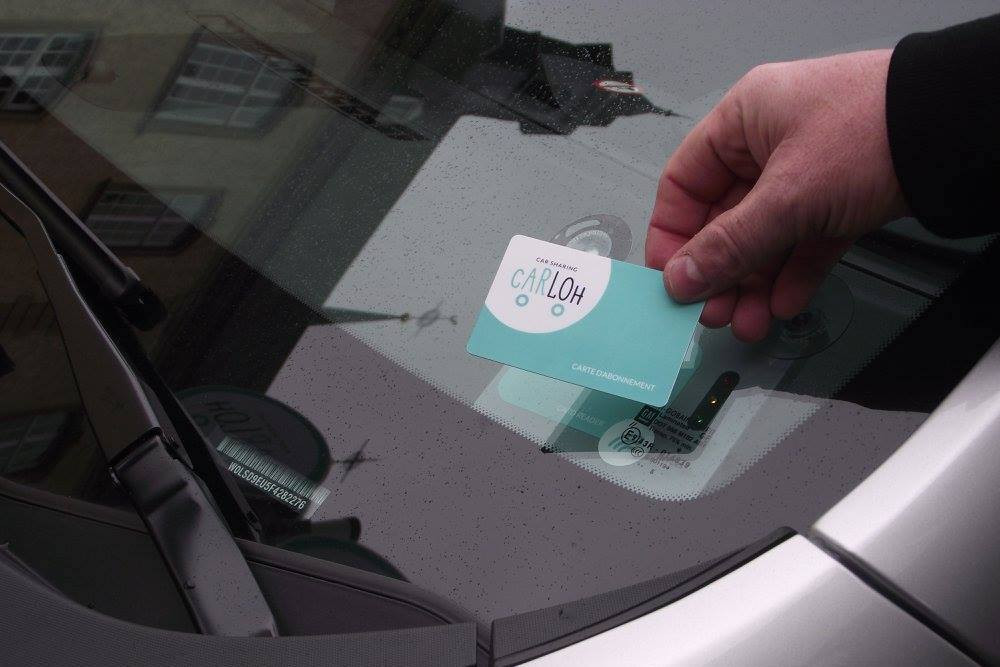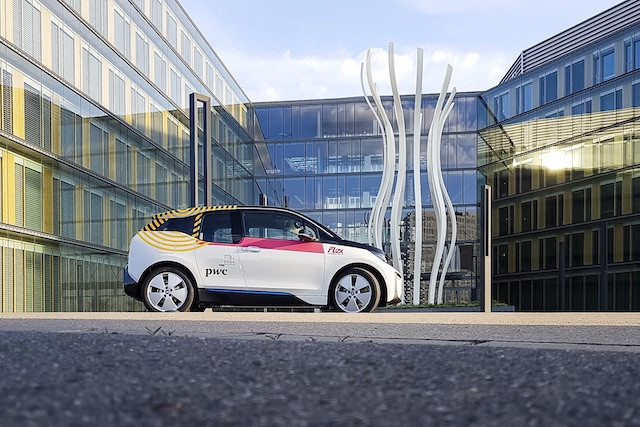
Each carsharing car should, “in the future,” replace 8 to 12 vehicles parked in Luxembourg. This is the objective set out by the ministry of mobility with its draft law on carsharing, presented on Monday 24 April.
To achieve this, it creates a legal basis allowing municipalities to “reserve parking spaces or parking areas on the public highway for carsharing vehicles.”
As a reminder, subscribers to such a service can rent vehicles after making a reservation. Instead of having to buy, maintain and insure a vehicle that is rarely used, “carsharing represents an interesting economic alternative for households and companies,” said mobility minister 
Specific signs and stickers
The law will allow municipalities to decide whether an operator can benefit from spaces, from which it will be able to demand a tax, and to indicate parts of the public highway dedicated to carsharing via specific signs. The operator will then operate a carsharing service for a fee and will need a concession from the municipality and an approval from the ministry of mobility, ensuring that it provides a “quality, transparent and accessible” service. This only applies to public spaces, not to carsharing stations located on private land.
User protection is also provided for. Subscriptions must be accessible to “anyone with a B permit.” The operator can always “adapt the conditions, including tariffs, but in essence they must not become discriminatory or contrary to the law.”
Regular maintenance or exclusion of vehicles that no longer comply are also part of the conditions. Specific stickers, issued by the Société nationale de circulation automobile (SNCA), have been created and will have to indicate the operator and the number plate.
Effectiveness analysis planned
The draft bill also provides for anonymised operating data to be made available in order to “evaluate the effectiveness of carsharing at private stations on the public highway.” It is part of the national carsharing strategy, presented in March 2022.
It aims to “reduce car density and its harmful effects on the environment, as well as the need for on-street parking and, ultimately, to optimise the use of urban space for the benefit of active mobility.” According to the ministry, private cars are “on average parked 95% of the time” and only in motion during the remaining 5%. A study was carried out in 2021 with several international experts on the potential of the practice in the grand duchy.
Residential areas targeted
But for the strategy to work, the stations must be set up “as close as possible to potential customers and in highly visible locations,” the ministry analyses. That is, “in residential areas, precisely where the private cars that carsharing is intended to replace are parked.”
It remains to be seen whether the introduction of a legal basis will have the desired effect. When asked, the ministry did not provide any numerical targets in terms of the number of dedicated spaces desired, beyond the 8 to 12 private vehicles that will be replaced by a shared vehicle in the future. The legislative timetable was also not given.
Currently, the Transport Portal lists two private players: Flex, from CFL, and Carloh. The former lists 47 stations on its website, the latter 22, concentrated in the capital.
This story was first published in French on Paperjam. It has been translated and edited for Delano.