In 2024, the mediation service of the Luxembourg Regulatory Institute (Institut Luxembourgeois de Régulation or ILR) received 117 requests, compared with 126 the previous year. The ILR ombudsperson is empowered to deal with requests related to energy (gas/electricity), postal services and electronic communications services.
While the total number has fallen slightly since 2023, the breakdown by sector has changed: disputes relating to electronic communications remained in the majority last year with 78 cases, but their weight is decreasing (98 in 2023). Requests in the energy sector rose to 32, while postal services generated seven requests, compared with just one in 2023.
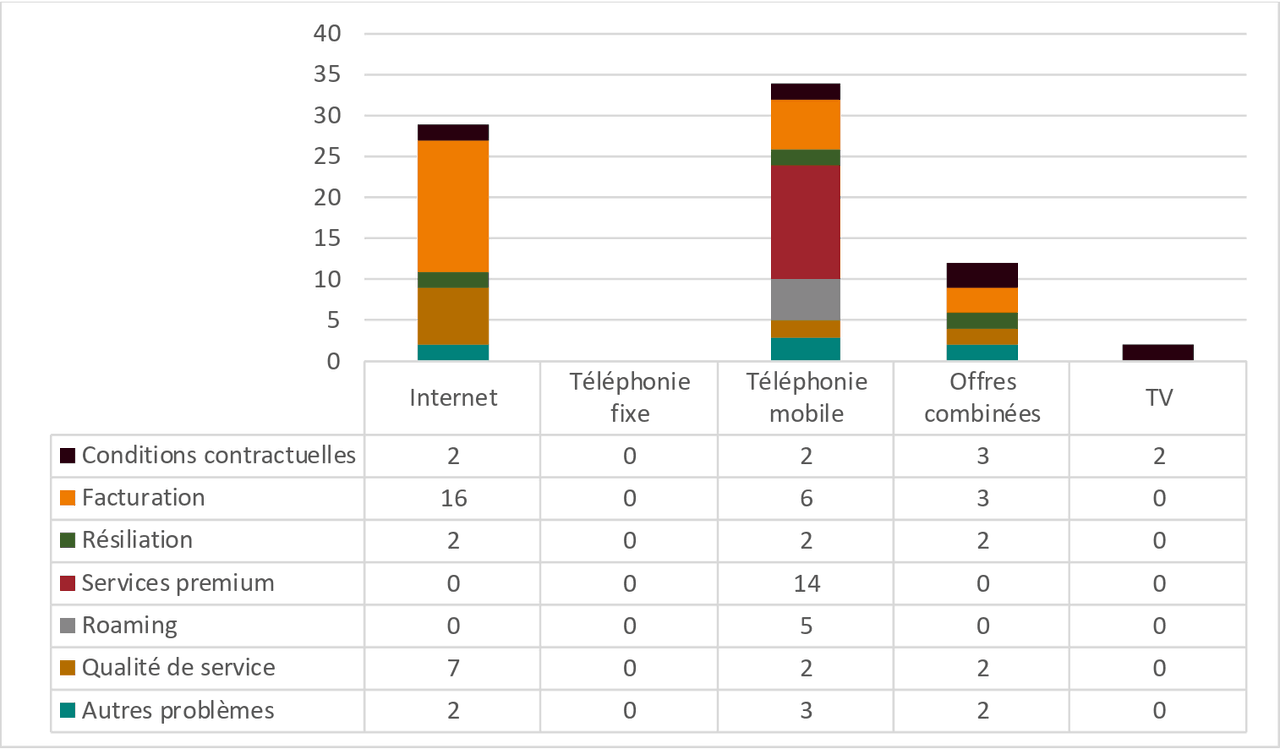
Details of mediation requests related to electronic communications services. Image: screenshot of ILR activity report
Disputes in electronic communications mainly concern internet and mobile phone services. Customers report billing problems, charges for premium services, service cuts, cancellation fees or unaccepted price increases. The ILR notes that “the majority of disputes concern internet and mobile telephony services.” No cases involved fixed telephony and only two involved television.
In this sector, 45% of defendants refused to take part in mediation. However, “in 39% of these refusals, the defendant made a proposal to the claimant to settle the dispute without recourse to the mediation procedure being necessary.” One third of cases resulted in an agreement. Withdrawals accounted for 9% of requests, and inadmissibilities, also 9%, related in particular to the absence of a prior complaint or to cases outside the ILR’s remit.
Energy: increase in mediations and the effect of the 2023 law
Electricity accounted for 24 disputes, natural gas for eight. The cases dealt with concerned metering errors, inconsistent statements, estimates deemed unjustified or high down payments. In a number of cases, the confusion of meters between neighbours or the incorrect connection of smart meters led to disputes. About half (52%) of mediations concluded with an agreement, compared with 16% that failed to do so.
Since 2023, a change in the law has required suppliers to participate in a mediation initiated by a residential customer in the electricity sector. This obligation is reflected in the statistics: the 16% of refusals recorded in 2024 came solely from cases involving non-residential customers.
Post: an increase in requests after a year of calm
Seven requests concerned postal services, five of which related to parcel delivery and two to mail delivery. Four mediations ended in an agreement, one in a refusal accompanied by a solution proposed to the customer. Two procedures were interrupted: one by the plaintiff’s withdrawal, the other by the defendant’s arrest.
A rapid, written and largely digital procedure
The mediation procedure comprises three phases: a written exchange between the parties, a possible hearing and a proposed solution if no agreement emerges. In the majority of cases, the dispute is resolved during the first phase. According to the ILR, “most disputes are settled at the beginning of the mediation procedure, during the written phase,” often thanks to additional explanations provided by the professional.
Three proposed solutions were drawn up in 2024: one in telecoms and two in energy. Only one was partially accepted; two were rejected.
The vast majority of applications (94%) are submitted online, up from 89% in 2023. The remainder are submitted by post or via the Consumer Ombudsperson. Six percent of the cases handled were cross-border, i.e. involving consumers living in France, Belgium or Germany. Three mediation procedures were initiated by professional customers in the electricity sector. No operator used the procedure against a customer in the other sectors.
A prerequisite: a written complaint
Before turning to the mediation officer, the consumer must send a written complaint to the professional. The service recommends allowing “around two weeks” for a satisfactory response. The ILR points out that “a written complaint is a prerequisite for any mediation procedure.”
This article was originally written in French.