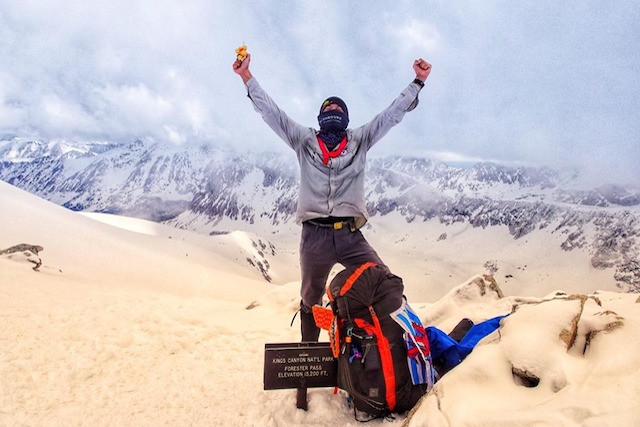
Christen, who reached the northern terminus of the trail last Wednesday, said he was also “well over” his €10,000 fundraising goal for the charity which supports children with cancer and their families.
When Delano spoke with Christen, he was buckling down in Vancouver, tending to his injuries. “My feet aren’t that good anymore,” he said, “In the morning, it takes me about 10 minutes just to stretch and walk normally.”
Although Christen said “giving up was never an option”, he did run into a few challenges along the way.
From snowstorms to rattlesnakes
He had expected to see bears and rattlesnakes--and he did. Around the El Cajon pass, he even saw a rarer black rattlesnake. “The sound they make is unforgettable. You hear that sound and you know they are the king of the castle.”
But the snowstorms proved more of a challenge. By the end of May, a blizzard was approaching after at least three big snowstorms, causing him to stay in the Sierra Nevada for more than 10 days. He and a hiking buddy made their way over the Cottonwood Pass and down to Lone Pine, thanks to a Luxembourg-based friend of Christen’s who warned him over his Garmin device to get out of the mountain because they’d seen “something big moving in”.
As for his fellow hikers, Christen said, “Some were six hours ahead of me, but they had to spend two days in a tent without moving, but it took a week to get out of the snowstorm. One of them had two of his big toes completely black because of frostbite.”
Because of potholes and snowdrifts, there were days Christen couldn’t feel the ground beneath his feet. In fact, Christen twisted his foot in a pothole around Mammoth Lakes. “I heart this foot cracking sound, my ankle swelled up, I could barely walk,” he said. After getting X-rays at a hospital, Christen was told nothing was broken but an inner tendon was badly injured and he couldn’t step on the foot. “The doctor said that the PCT was probably done for me now, but I told him why I was doing this and will continue, no matter what comes.” And so he got some injections and “spent the next weeks walking with a metal ankle cast in the snow which wasn’t very comfortable, but I gave my word not to give up.”

On a separate occasion near Mt Whitney (pictured), a group of hikers was ahead, using rubbish bags to slide on the snow, despite the fact that the snow was already beginning to melt because of the intense sun. At this point, Christen was hiking with some experienced mountaineers from British Columbia who had discussed whether to move forward, and suddenly the hikers ahead “caused a wet avalanche. There was nothing--just some boulders and then a free fall--so we hid behind rocks,” said Christen. “It was a very intense moment.”
“Never give up”
One of the highlights of Christen’s hike was at Lake Aloha. He recalls pitching his tent on a dark rock which had absorbed the sun and retained its heat, even though the lake itself was frozen and there was still snow around. “I woke up to the cracking sound of the lake, but the ground of my rock was still warm. I slept a lot in the snow in my tent and normally the ground is so cold you can’t even touch it.”
Christen says the people on and off the trail were “amazing”, from the “trail angels” who leave water supply for hikers to the fellow hikers themselves. “I also heard a lot from parents or people in Luxembourg who were inspired by the story but who can’t do such a trip anymore, and that gave me a lot of strength to move on,” Christen says, adding that his most important lesson of the trail was “never give up, and move on.”
Christen heads back to Luxembourg on 15 September but says he’s waiting another 2 weeks to close the fundraising account, after which time he plans on personally delivering the check to the foundation.
Read more about Christen's journey on “A journey on the Pacific Crest Trail” page