It’s a time of year when Americans tend to get a little homesick. We pine for nights lit up with fireflies, the smell of backyard barbecues in the air, the streets lined with crowds for local parades, sparklers dazzling the streets and nights of fireworks.
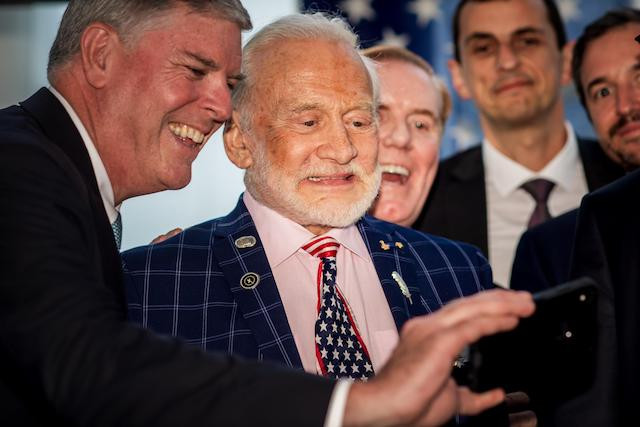
This year, things were a bit different. On Wednesday evening, the US Embassy in Luxembourg team and ambassador Randy Evans threw an unforgettable party at the Philharmonie celebrating not just the 243rd Independence Day, but also the 50th anniversary of the moon landing, with former astronaut Buzz Aldrin as one of the special guests.
As Luxembourg prime minister Xavier Bettel eloquently stated on the occasion, the first steps on the moon made by Neil Armstrong and Buzz Aldrin during their Apollo 11 mission still inspire so many even 50 years later, even those who weren’t alive to witness the landing. (Bettel reminded the audience that he was not yet 50 years old.)
And the words spoken by Buzz Aldrin on Wednesday kept inspiring. When he and Armstrong landed on the moon, Aldrin said there was a “light boom”, with “contact light” being the first words he heard upon landing.
“It’s a personal, visual experience,” Aldrin said of the mission, later adding: “I know how to admire the freedom of space…my expertise is not rocket launching, not landing--that was Neil’s job--I was making sure not to disturb his thinking.”
He added that his hope was that ordinary citizens and not just astronauts will eventually be able to take part in space travel.
After the speeches, Aldrin left the stage, and the crowd shifted his direction. One attendee was hoping to get a book signed. Another attendee had a first day of issue “Man’s First Landing on the Moon” postcard--with special postmarks to commemorate the occasion, as well as Neil Armstrong’s signature. (As for me, I was just happy to leave with a mug commemorating the occasion and a copy of the space MoU signed between Luxembourg and the US, both of which I will one day give to my daughter.)

First day issue postcard commemorating the moon landing, held by a Luxembourg-based attendee at the US Embassy celebration (who preferred not to be named).
Although both left without signatures, neither seemed disappointed. As I chatted with each of them, we all agreed it was a privilege just to be in the same room with Aldrin, one of only 12 to have ever walked on the moon.
Although I wasn’t alive then either, the moon landing was a story I had heard much about growing up. My father--hailing from the same state as Armstrong (Ohio)--was 13 years old at the time, an avid fan of the space programme from the Mercury missions. He always told me he was fortunate to have been that age then--the middle of the baby boomers, but old enough to be aware of the space race--and all this in a tough decade, full of riots in the streets, the Vietnam War, Cold War tensions.
As he and my grandfather watched the hours of leadup and the touchdown itself, he recalls being ready for a moment in history, equally recognising there were no guarantees at the time that it would be a successful one. Still a stargazer, he told me, “The thought that we could actually step foot on a foreign body was incredible.”

Apollo 11 crew members Buzz Aldrin, Neil Armstrong, and Michael Collins in a press conference the night before they began their historic first lunar landing mission. Photo: NASA
As one attendee on Wednesday told me, the moon landing gave the world something higher to aim for. It gave people hope beyond the tensions of the day, beyond any nation's borders.
On Wednesday evening, Aldrin talked about the post-mission tours. “It warmed us up to have the feeling that everyone felt that they were a part of that endeavor,” he said.
I think many of us in Luxembourg feel that too--part of a bigger endeavor, even if we aren’t directly involved in the new space sector. Personally, I’m eagerly watching the Artemis mission, which should see the first woman and another man walk together on the moon by 2024.
But it is an equally challenging time, with shifting geopolitics. US president Donald Trump has called space “a warfighting domain”. And, although some of the top US politicians have called it a new space race (along with players like Russia and China), not everyone in the space programme agrees with this.
It’s another reason last night was so refreshing. In Aldrin’s own words, “In retrospect, I’ve not really been satisfied with the decision-making and outcomes of some of the programmes that we’ve put in place. We’ve been around the world after our flight, we called it a giant step, and I think the programme of the future should be termed next-step space alliance. That’s an alliance of people, and not just space agencies of governments.”