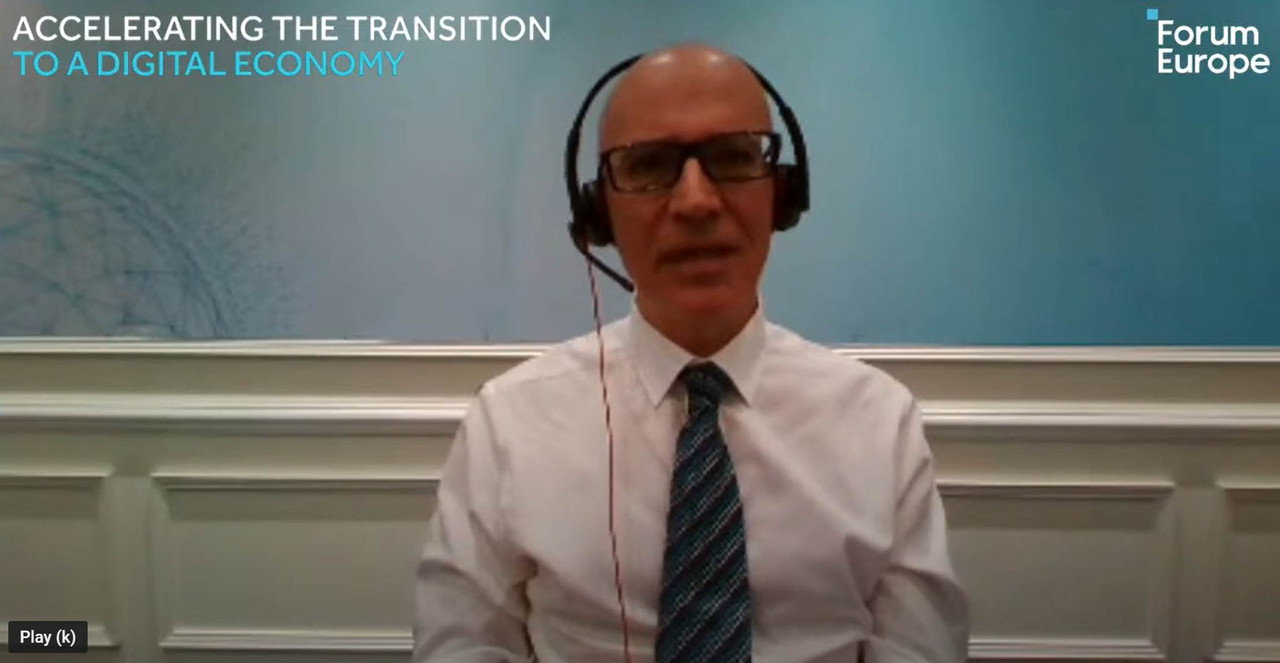
Forum Europe’s high-level interactive workshop, “Accelerating the Transition to a Digital Economy” in partnership with global ICT provider Huawei and consultancy firm, Arthur D. Little on Wednesday 9 December included the key questions: What are the digital trends emerging in the new normal to support Europe’s vision? How can European institutions work alongside national Governments and industry representatives to deliver a coordinated policy approach?
Andrew Williamson, Vice President Global Government Affairs and Economic Adviser, Huawei Technologies spoke about the macro-economic level, where the focus on recovery shows an alphabet soup of different shaped upturns. What stands out from the 2008 global financial crisis is that there is a much broader consensus now amongst economists that governments could help to shape it. “What governments have already done is important and now we’ve got to start thinking about the medium- to long-term recovery and the role they will play,” explains Mr Williamson. In all scenarios, a strongly involved government will contribute to the recovery.
With reference to the US but also other countries by extension, Professor Paul Krugman proposes a government led investment-centred stimulus, for more investment, and less concern about fiscal deficits. His view is that as long as we can get growth above real interest rates there is an opportunity for fiscal stimulus.
Professor Larry Summers considers the threat of ‘secular stagnation’ as a result of Covid-19. Risk aversion will increase, leading to more savings by households and less investment by businesses. Governments need to act as a backstop consumer of last resorts otherwise aggregate demand in the economy won’t be sufficient.
This echoes some main points from the keynote speech by Mario Grotz, Head of Directorate for Infrastructure and Technology, Luxembourg Ministry of Economy and Foreign Trade, who presented the Luxembourg government’s current vision and strategy for the digital economy. He explained the government's multi-specialization strategy, which focuses on small sub-areas of specific sectors, such as Industry 4.0 and Fintech, while ICT is not just a sector but a transversal competence needed to develop the different sectorial priorities of the government.
“Luxembourg is the EU digital pole and hosts critical European directorates and digital infrastructure,” explains Mr Grotz, who is also Member of the Steering Board at the European Space Resources Innovation Centre (ESRIC) Luxembourg and President of Luxinnovation. “One of the main challenges is to combine existing technology such as AI with new technology such as the HPC in order to achieve future growth.” Luxembourg is the host of the European High Performance Computing Joint Undertaking (EuroHPC JU). The aim of the EC Digital pole is to develop a critical mass of knowledge and expertise here; to evolve over the coming decade a centre of excellence and an important contribution to Europe’s digital single market. It is not just by chance that Luxembourg was selected as a digital pole: “we have heavily invested in ICT and have top notch IT infrastructure paired with a highly skilled workforce.”
Infrastructure of the future
IMF research finds that the best way for governments to spend taxpayers’ money in order to boost economic recovery is to invest in infrastructure. Many studies show the economic contribution that mobile broadband has made to countries around the world. An ITU study involving 130 countries provides compelling evidence that mobile, broadband and fixed broadband has contributed significantly to overall economic growth rates across countries.
“It’s not just about economic growth but about building resilience. Infrastructure as a foundation is important but the real boost for future growth will come from nurturing your domestic and international ecosystem,” emphasises Mr Williamson. Based on 2019 IMF forecasts, the implied economic bounce back for countries in 2021 is correlated to their digital economy: those with the highest levels of economic digitalization will experience the strongest economic recoveries.
Dive into the report Huawei and consulting firm Arthur D. Little released in July 2020 on Digital Transformation: “Think digital. Think archetype. Your digital economy model.”