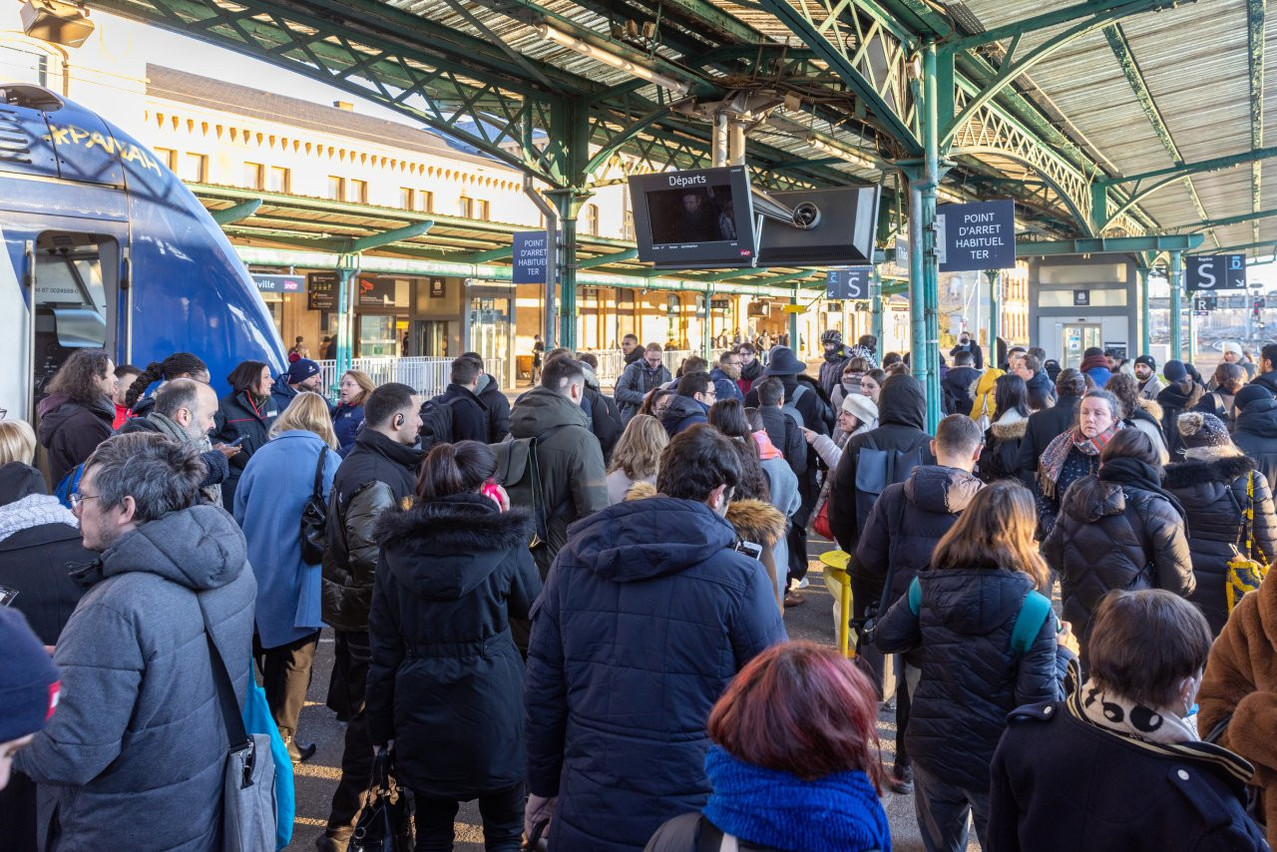
Border chronicle. It goes back to the evening of 7 October. End of the day at work. Back home. Sprinting to the main station. Fingers crossed that you won't be one of the last people on the platform, in order to maximise your chances of winning the Holy Grail - a seat on the TER, the World Cup of cross-border commuters.
Oh dear... It's packed. Good grief, the train you're looking for (the 6.09pm) has been cancelled! S-u-p-p-r-i-m-é, the eight letters of hell. A grim tale of abandoned luggage, as far as the CFL noticeboards report, always quick to point out with precision incidents that have occurred elsewhere than on its own stretches of track.
Juggling elbows, legs and what's left of clear-sightedness after eight hours on the job at the office, we rush to the next machine (the 6.15pm).
The beast finally arrives. But it will leave with a big fifteen-minute delay on the expected schedule.
It will leave, above all, bound for France with a barely believable crowd on board.
To represent ourselves (I promise, we counted): more than thirty passengers crammed standing up (gone, the Grail!), in the 6 or 7 square metre space (wet-finger estimate and with what was left of discernment at the time given the annoyance and suffocation that threatened) separating two compartments at the entrance and exit doors in each TER that Fluo card holders are accustomed to frequenting.
That's more than thirty castaways clinging to each other at the slightest movement of the rail (and they're common, I'll give you that!), The railway has nothing of the tranquillity of a frozen sea), so as not to collapse one on top of the other, like a game of dominoes. And that's not even mentioning the rucksacks that each person is towing on their shoulders, which also take up space.
After fifty minutes or so of transport in these conditions (for a monthly subscription of around a hundred euros), we wondered about the safety of these daily journeys. Hello SNCF? Is this really reasonable?
0.12 square metres per passenger
The first thing we wanted to know that evening was how much space was actually available, The surface area of a platform varies according to the type of train and the positioning of the platform in the train", we were finally told by the SNCF, twelve days after we had sent our questions.
In this case, concerning the journey on 7 October last, "for a TER 2N NG, the surface area is 3.64 square metres for the platform alone, excluding the corridor and stairs." That's 0.12 square metres per passenger, based on thirty people. Incidentally, the corridor and stairs were also duly occupied.
To make matters worse, "the train you are referring to unfortunately had to run as a single rather than a double on the day in question, as initially planned", according to French railways. In other words, half as many chances to breathe more or less normally and to be able to wiggle even a toe without trampling on your unfortunate neighbour, however horrifying he may have been.
It's the agents who decide
What caught the eye of the passengers on the Luxembourg-Metz at 6.15pm, on 7 October, was the staggering density of passengers accepted on board. It's not the first time, but it's still surprising - and irritating - as ever. "The capacity of a trainset varies according to the equipment used. For a TER 2N NG, a short train corresponds to 339 seats and a medium/long train to 678 seats", SNCF explains.
That's all very well, but what about standing passengers? And above all, what about safety conditions on board? "Following the example of buses, trams or metros, the main reason why a train would be prevented from running would be the impossibility of closing the doors", replies the SNCF, without giving any figures as to the maximum capacity of a TER, whether short, medium or long.
"It is the agents operating the train, i.e. the controller and/or the driver, who authorise the departure of a train, in liaison with the operational supervision centre," it adds. In short, as long as nobody ends up with a shin stuck out, everything runs smoothly. Whatever the density on board.
340 more seats, but at 5.15pm only
Happy passengers on the 5.15pm train from Luxembourg. Since mid-September they have had a train with 340 extra seats than normal. "This train is running (...) at one of the busiest times of the day," SNCF said, without answering a question as to why it was not running in other, equally popular slots.
For the rest, "the composition of the trains we operate is thought out thanks to periodic counts carried out by a service provider commissioned by the Grand Est Region", "which enable us to use affluence statistics", details the French side.
"The aim is to ensure optimum capacity on the busiest trains. The list of the busiest trains is shared with the organising authorities. In addition, SNCF Voyageurs TER frequently conducts major qualitative and quantitative studies on French travel, on a national and local scale, in order to provide the Organising Authority with transport offers that are as close as possible to French people's mobility needs."
"Unacceptable conditions"
In conclusion, SNCF assures: "The situation experienced [on 7 October] was exceptional." Before apologising to passengers who "travelled in unacceptable conditions".
No response, however, regarding the means of recourse for those subscribers considering that the minimum service and comfort expected had not been respected on 7 October. Or so many other evenings. Or so many other mornings. Especially for those boarding from Hagondange, Uckange, Thionville or Hettange-Grande. Travelling standing up is a trick you have to take.