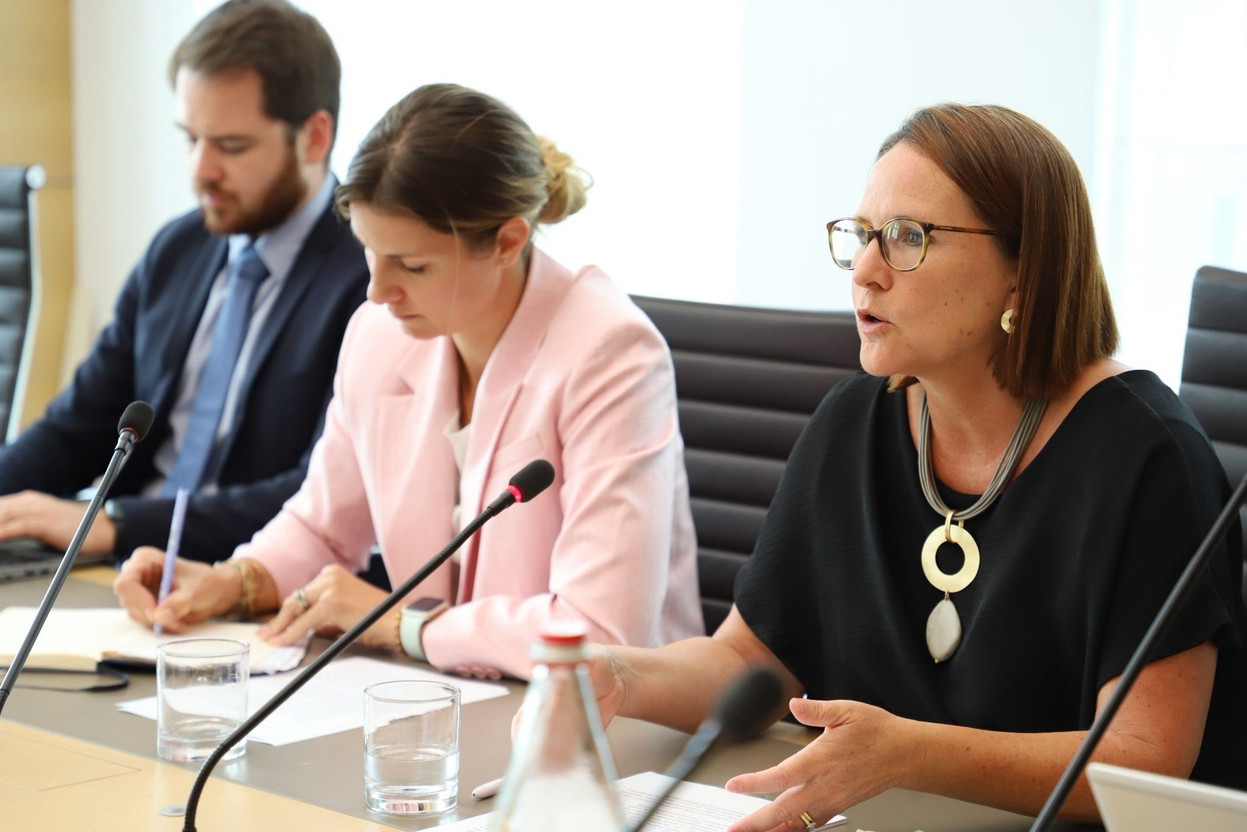
“In the age of AI, it is vital to look after continuing training. Unfortunately, the opportunities are not what they should be. We need a framework,” said the president of the Chamber of Employees (CSL), 
1. Steering training through three
The CSL advocates the creation of a committee bringing together employees, employers and public authorities to set priorities, evaluate existing schemes and reform continuing training in a transparent way that is adapted to the different sectors of activity.
2. Get (real) training throughout your life
The chamber wants every employee to be guaranteed a real right to training throughout their career, with concrete schemes for training or retraining.
3. Making employers responsible
To do this, employers “should be required to provide for a proportion of each employee's working time to be devoted to training”, details the CSL, for whom the measure would benefit both employees and the competitiveness of companies.
4. Removing obstacles to training
Time, funding and personalised support. On the question of time, the CSL wants to reform dedicated individual leave “to enable employees to follow long or qualifying training courses”. In its view, “80 days over an entire professional career, capped at 20 days over a two-year period, is far from enough”. As for funding, she proposes “introducing grants [...] to cover the training costs incurred”. Finally, she suggests “a high-quality personalised guidance service to support projects to upgrade skills or retrain”.
5. Better recognition of foreign qualifications
For the CSL, the recognition of qualifications obtained abroad must be simplified and accelerated in order to make better use of the skills available in Luxembourg.
6. Better recognition for VAE too...
That is, according to the chamber, transforming the validation of experience gained (VAE) into a simplified, supported scheme focused on the skills actually acquired.
7. ... and back it up with specific leave
Objective: to enable employees involved in VAE to have dedicated leave to complete their process.
8. Obtaining diplomas while working
The CSL would like to see the development of continuing training courses leading to diplomas, which are modular and compatible with employment to enable adults to obtain recognised qualifications.
9. Guaranteeing the quality of training courses
His roadmap also includes the introduction of a "national quality system", presented as simple and useful for guaranteeing the relevance of continuing training courses without adding to the administrative burden.
10. Rethinking training from secondary school onwards
The CSL is calling for a reform of initial vocational training, arguing for a complete overhaul of the lower cycle of secondary education, with more vocational guidance and the widespread use of discovery placements to help young people make their choices. In its view, apprenticeships should be better supervised thanks to digital tools shared between high schools and companies, better recognition of the role of tutors and improved allowances.
The CSL also calls for the creation of a status for disabled apprentices. Finally, it stresses the need for evolving, multilingual pathways open to higher education, as well as the rapid adaptation of programmes and facilities in the face of technological, ecological and economic transformations.