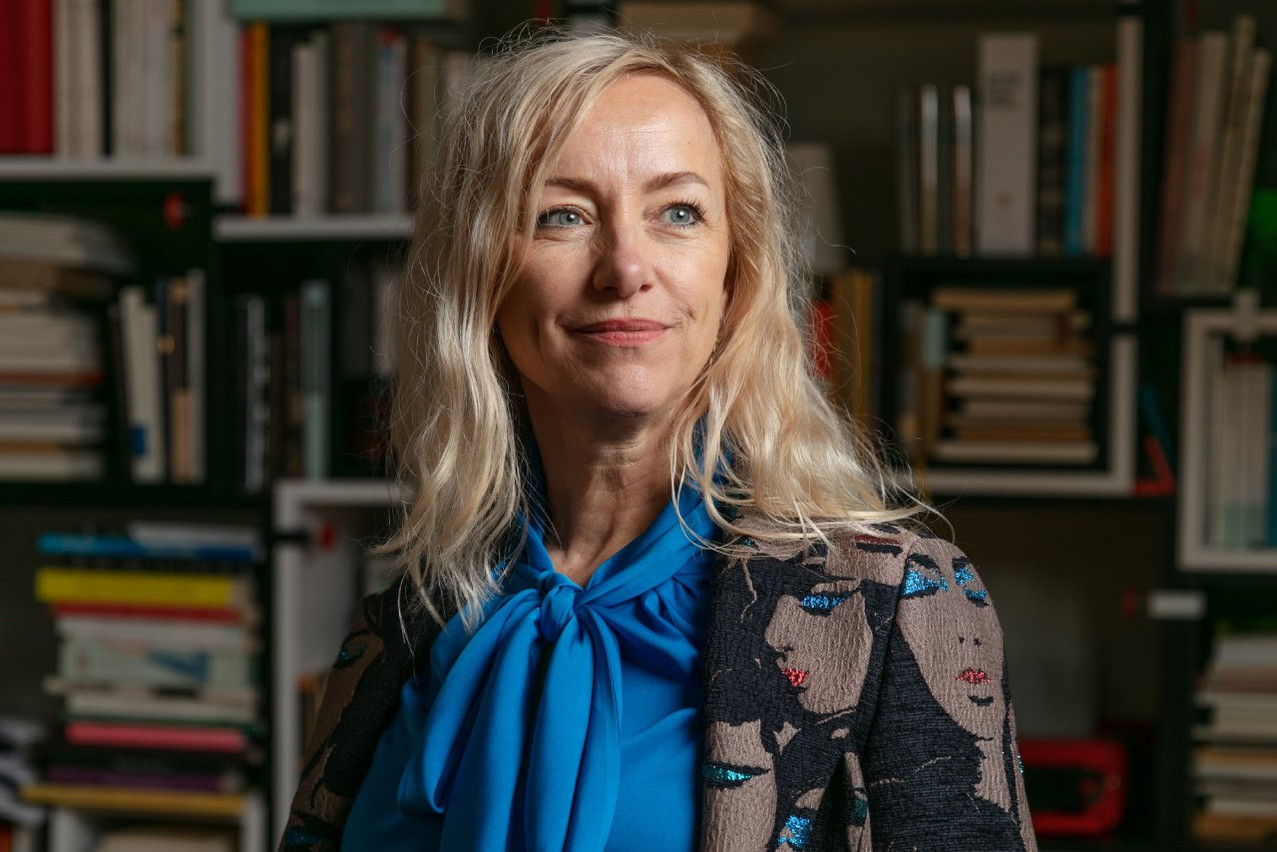
“Awaken your talents!” The injunction sounds like a cry from the heart. Subtitled “Comment identifier votre potentiel et trouver enfin votre voie” ("How to identify your potential and finally find your way"), the book, published by Belgian publisher Racine, will be available for purchase from 19 November. Its author, 
Taking her subject head-on, Charlier has included this guide as part two in a trilogy. The first book, released in 2021, is called “Activez les talents de votre entreprise” (published by L'Attitude des héros). The trilogy will come full circle in 2026 with a publication devoted to the next generation, which will explore “how not to extinguish the talents of our children.”
“For the first book, I started from the corporate world because that’s where everything happens--at least in VSEs and SMEs--and that’s where the lever for transforming society lies, rather than in the political sphere. With this second book, the idea is to model my approach, my theory, what I do for each individual,” explains Charlier.
Her approach consists of identifying nine intelligences (interpersonal, rhythmomusical, visuospatial, kinaesthetic, naturalist, existential, logicomathematical, linguistic, interpersonal) that each of us is invited to “activate” by taking matters into our own hands. For Charlier, both school and university education and the corporate world lock us into corsets, instead of encouraging us to ‘explore’ our possibilities.
In the preamble to your book, you state that it’s a mistake to decide on a career path. The question we should be asking ourselves, you write, should no longer be what profession to pursue, but rather identifying the talents that drive us.
Béatrix Charlier: Each of us has talents, but the educational process in central Europe tends to show us the opposite, by pointing out where we’re not good and highlighting our mistakes. There’s a tendency to deconstruct our confidence. There is also a tendency to ask us to reproduce knowledge contained in books rather than to awaken our intellectual curiosity.
People often come to me for answers to existential questions. I don’t have the answer... I’m not a guru, I’m not here to take over for someone else. The first thing to do is to know what our strengths are. If, at a given moment, I want to access something, I can. I ‘just’ need to activate a dormant talent or potential. Schools and universities reproduce curricula, teaching courses that are sometimes totally out of date... At university, we don’t necessarily train for jobs, we train for knowledge. And here we’re missing the point, since 85% of the new professions by 2030 still don’t exist and we’re going to see certain professions disappear. It would be beneficial to provide more training in curiosity, analysis and so on.
The ‘war for talent’? Let’s start by working with the resources we have in our companies!

It’s up to everyone to take the lead?
Schools and universities can’t do everything. It’s up to each individual to look at his or her own development. But do we still have time to ask ourselves certain questions in a context of infobesity and permanent short-termism? We have much less time to think, we’re more in consumer mode. That’s the way things are.
It’s also a time of ‘talent wars.’ At least that’ what we’re hearing... For me, it’s a totally stupid notion. Let’s start by working with the resources we have in our companies! The war is not on talent, it’s on commitment. In central Europe, 87% of people are not committed. They say so themselves. One of the explanations for this figure is that they are not aware of their strengths and potential. But when you deploy your strengths and potential, you enjoy doing things. You’re not just looking for external recognition, you’ve got self-esteem, you’re in your flow. You don’t calculate the time you spend doing things, because you enjoy doing them. That’s the promise of the book. My model is based on the idea that we are all mutants. We’re not a finished product, we’re more than that.
What do you mean by ‘mutants’?
When we are stimulated by our contexts and the reality around us, and depending on what we are going to experience, the people we are going to work with, the challenges we are going to face, the crises we are going to go through, our multiple intelligences are going to be stimulated. What we experience enriches us, fertilises us, changes our outlook and our approach to the world. Today, we are not what we were twelve months ago.
You know the saying, you don’t swim in the same river twice. That’s what's interesting. Today, it’s very difficult to say that a person will stay in the same place for the rest of their life. The world is speeding up, stimuli are accelerating, crises are coming one after the other, and everyone has to respond in their own way. We become several versions of ourselves. Augmented versions, enriched and positive if possible.
The book invites us to ‘liberate’ our talents. Each of us may be much more intelligent than we realise?
There are nine multiple intelligences, but as they have five levels of activation, there are 378 possible combinations. That’s 378 ways of being intelligent! That’s why the concept of the talent war makes me smile and at the same time saddens me. We have untapped potential for intelligence in business.
I certainly hope that Gen Z will overtake me. That’s what evolution is all about!

Where do things go wrong?
In management. Management is too much associated with a title and promotion. A manager with talent for the job is a sheep with five legs. He himself is not aware of his own talents. He’s between a rock and a hard place, he has to make his numbers, and so on. It’s a question of managerial skill and interest in people. Not all companies are aware of the potential within them. They can end up extinguishing talent rather than helping it to emerge.
Yet there is so much to be gained by changing the average. That’s what Charlemagne did. The Carolingian revolution consisted of surrounding ourselves with more intelligence. But the war of egos also does a lot of damage. For example, it’s very complicated to be overtaken by young talent. I myself am coached by Gen Z. They’re certainly not the most expert generation, but they’re the ones with the keys to tomorrow. And I very much hope that they will overtake me. That’s what evolution is all about!
Any counter-examples?
On the other hand, I have clients who are very aware of this problem and who have set up in-house academies designed to unleash talent. Even SMEs with 30 people! In my view, this strategy should spread like wildfire. These companies have succeeded in taking a very difficult risk, which is that of managing people who are changing. You’re going to rely on some people to develop, and not all of them will succeed. Or when you trigger a development, you may trigger an additional freedom, and the person will leave you. So it’s not necessarily in line with the notion of retaining employees. But that’s what I call the free movement of talent. If companies increased the average level of intelligence or unleashed more talent, perhaps they’d also trigger more turnover, yes, but they’d pick up talent from elsewhere.
You say that each of us can contribute to the world around us. Isn’t that a bit demagogic? Not everyone is at the same level of responsibility, not everyone has the same role to play...
My answer is very simple. With a group of entrepreneurs, we met Pierre Rabhi [the founder of the concept of ‘happy sobriety,’ who died in 2021] four years ago at his home on the Cévennes plateau. I’m going to tell you exactly what he said to us that day. Being a contributor has nothing to do with the responsibility or level of responsibility of an individual within a company, or his level at all. Contributing is a matter for each and every one of us. It’s a way of building tomorrow’s world for our children and grandchildren. The sword of Damocles is hanging over us…
We are talking about the survival of humanity, nothing more and nothing less. By doing our bit and doing it as well as we can, we can all make a contribution. From the cleaning lady who makes our offices a pleasant place to live, to the company director who shows courage by taking some tough decisions. It’s a whole chain. And I believe in this chain. Because it makes sense.
My book gives us the tools to activate or reactivate our intelligences, so that we can be free to make our own choices.

You’ve developed what you call the ‘pyramid of talents’ to help people get closer to who they really are. How is this an innovative method?
It’s based on [American developmental psychologist] Howard Gardner’s theory of multiple intelligences. It’s a much maligned theory, but one that I’m a fervent advocate of because it’s a theory that thinks outside the box. And it’s based on the observation of individuals. Gardner believes in plural intelligence. At first, I thought it was really marketing. But, no, it’s not. It’s true, he’s right, and I can prove it with my 5,000+ datasets. Everyone is intelligent, everyone is different. But not everyone can do everything. And a majority of people are not in the right place.
The talent pyramid is not a test or a psychological approach. There are no predefined profiles, no one fits into a box. I’m still discovering new things. It’s really the field that teaches me, that suggests hypotheses that I verify by recurrence. And these become lines of code, if you like, in my theory. It’s an empirical approach that has enabled me to build it. It’s also an approach based on the mistakes I’ve made.
In the eight years I’ve been coaching individuals and companies, I’ve made a few mistakes along the way. I asked myself why. The answer: until you take the first step, you haven’t set anything in motion. And that first step is self-knowledge. And this first step is deactivated in some schools from the age of eight. The talent pyramid is a way of putting things back in order. The logic that corresponds to a child’s development can be applied to an adult’s development. My book gives you the tools to activate or reactivate these intelligences, so that you are free to make your own choices.
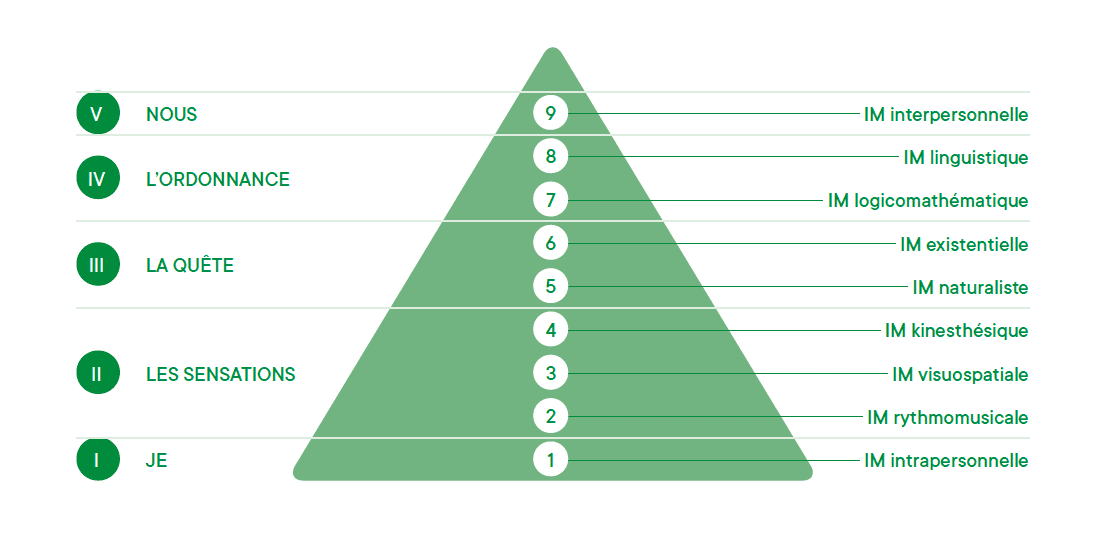
The pyramid of talents devised by Béatrix Charlier is based on five degrees and nine intelligences. “Each degree we pass brings us closer to the next, enriching our knowledge of ourselves and transforming us into an improved version,” she writes. Image: “Réveillez vos talents,” published by Racine.
You emphasise our ‘strengths,’ our ‘intelligence’ and our ‘talents,’ as we have heard. But you say nothing about our weaknesses...
I’m not banking on weaknesses. We hear enough about them as it is! In any case, we’re not going to reinvent the butter slicer by making up for our weaknesses. In my opinion, highlighting our strengths is the most important lever.
You already have a third book in the pipeline. Why did you decide to write it for children?
Blind to our own talents, we are also blind to the talents of our children. To describe intelligences, Howard Gardner observed people. Just as every parent should observe their child, allow themselves the time to engage in activities with them, to feed them with different inspirations... They would then begin to understand that their child has talents. All this is a path towards reconciliation, towards a new generation, with new codes.
This article was originally published in French.