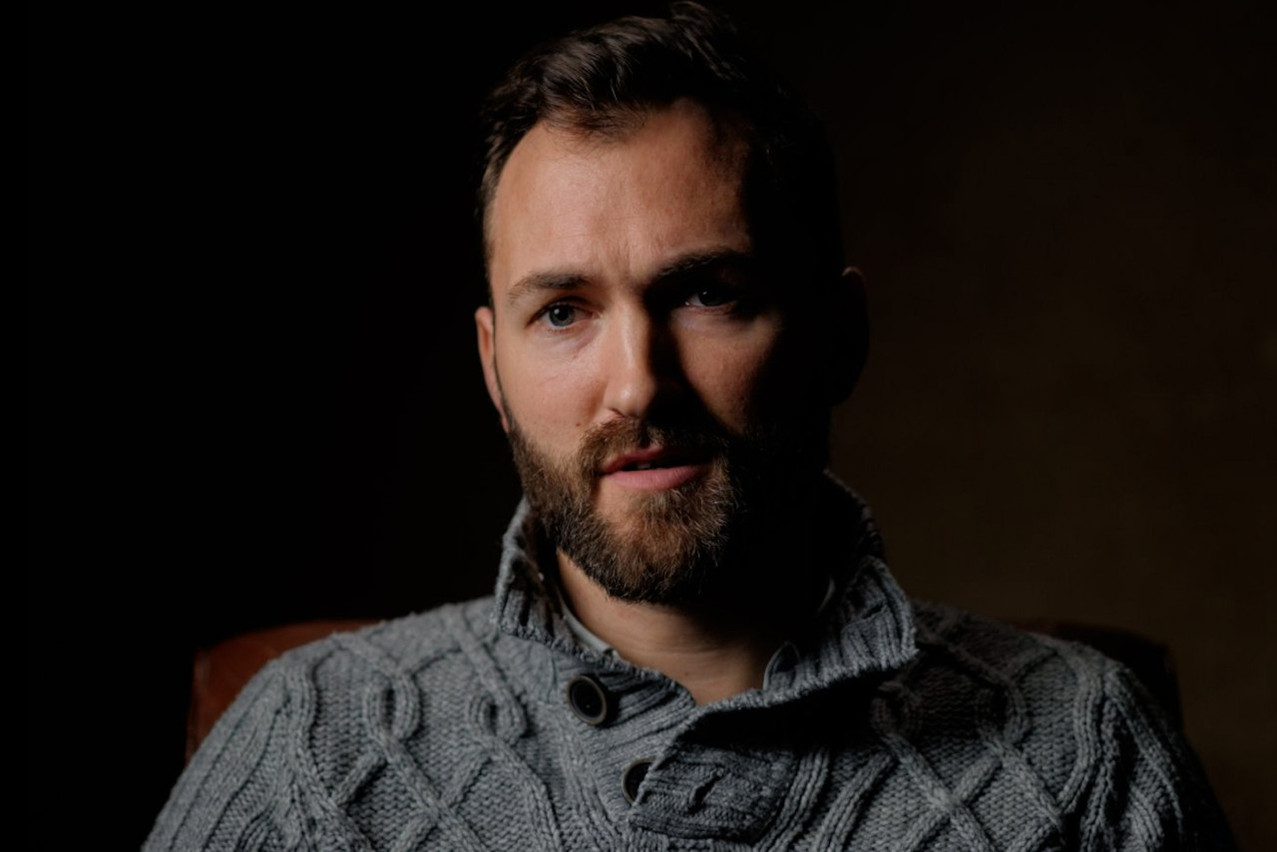
It’s difficult to give a precise account. All we can say is that in 14 years in the armed forces, ten of which were devoted to special operations and five of which were spent in the sensitive role of group leader, Louis Saillans (a pseudonym to preserve his anonymity in part) took part in “several dozen” operations in the field. He’s cold and thoughtful. Determined and “primitive.”
The setting: Africa and the Middle East. The missions: freeing hostages and capturing jihadists and terrorists. A life on a knife-edge. His story is set out in a book, titled “Chef de guerre” and published in 2021 by Mareuil.
This page has now been turned. At the age of 38, this family man has put away his weapons. On 26 September, at the invitation of business club B17, he travelled to Luxembourg to give a conference on management. The day before, he agreed to give Paperjam a video interview from the Breton town of Lorient, where he now lives. Clear-spoken, neatly trimmed beard, open pink shirt, suit jacket... Far from a cliché. But as close as possible to what he has known and been through. Inspiring, in more ways than one. What does it mean to be a boss?
1. Leadership
“Is it innate or acquired? It’s a great philosophical question, one that has been asked by all the great thinkers since antiquity,” says Saillans. “I’ll give you a Gascon answer: it’s a bit of both.”
“When I joined the army, I wasn’t very outgoing. I was even a bit shy. But I think I was shaped by contact with soldiers. In an elite unit, you’re expected to have great strength of character--if only to be able to live and be legitimate among these guys. That was the first step.”
“The second was to find your position. It’s very subtle in these units. It requires a lot of commitment, a lot of investment.”
“When I started as a commando, I was seen as the new kid on the block, with no experience, still innocent and a bit naive. That changed after a boxing session with my then boss. I’ve always liked boxing, I’ve always practised it. During that session, I expressed my personality. I showed my determination. And my boss felt that determination. He felt it physically because I was clearly getting the better of him. From that moment on, he changed the way he talked to me. There was no longer any sort of condescension towards the new guy. That’s when I really started to become part of the group. Things evolved little by little.”
When I took over as leader, I had to invent myself.

“As for being head of a group unit... That’s a different dimension. I’d done my homework, I knew I had a personality, a character. But when I took over as leader, I had to invent myself. I could no longer just be an operator who does his job well. It’s not enough to do your job well, you also have to know how to ‘sell’ yourself. And, paradoxically, that’s something you don’t necessarily learn.”
“General Bigeard, a veteran of Indochina and Algeria, had this phrase: ‘You have to do what you have to do and let people know what you are doing.’ I subscribe to this formula. Because it’s not enough just to do things, you also have to shine, pump up your muscles a bit. Not in an artificial way. But to show what you’ve done and put it forward--that requires a bit more energy, it means not just looking after your gun and your bag.”
“What you don’t necessarily know from the outside in the units is that you’re often in competition with other groups. So we have to say why we deserve the lion’s share of the future operation. There’s a ‘selling’ issue that’s found in a cryptic way in companies. I ‘sell’ my group by clearly explaining why we are the most legitimate.”
“Positioning also means taking your place in a group. We’re taught that you always have to be in the middle of the crowd. Because that's where you see things best. That’s where you step back from the front. I have a rather rebellious temperament. So I’ve chosen to always be out in front. It was there, in fact, that I could see things as quickly as possible, and that I could guide the rest of my group. It was a bit unconventional.”
“I had to learn to go a bit beyond what I’d learnt as an operator, to break out of the patterns and go a bit beyond. This risk-taking gave me legitimacy with the guys. They understood that I was just as committed as they were, that I didn’t have a privileged position compared to them.”
2. Team cohesion
“Is it the leader who creates cohesion? Or does the cohesion create the leader? I lean towards the second option,” says Saillans.
“The leader has to initiate things in order to generate movement and momentum. Carlos Ghosn (former chairman of Renault and Nissan) said that a leader must have a vision. He’s 100% right. In the talks I give, I observe that all major companies need a grand guiding vision, even if it seems remote and inaccessible. It helps to justify what we’re doing at the very bottom of the tree.”
“One day, president Kennedy went to Cape Canaveral. We were in the middle of the Star Wars with the Russians. During his visit, he came face to face with an employee sweeping the floor. The sweeper’s reply: ‘I’m helping my country get to the moon.’ That’s exactly right. Employees should not be confined to their job. They have to be part of something bigger, something more beautiful. Which is a bit more motivating...”
Shared suffering creates a cohesion that is far more important than any moment of joy or success.

“Another element: suffering. Shared suffering. Whether it’s a strenuous hike that you do in a group or a difficult moment in a company where you stick together. It creates a cohesion that is far more important than any moment of joy or success. This suffering really creates something.”
“In my role, I’ve always had to deal with men who pushed hard. I didn’t have to push them, they were the ones pushing. I had to keep them in check. A very comfortable position. But from then on, you had to deal with each person's personality. I juggled between a form of paternal benevolence and strict authority, where I tried to be uncompromising. Like this time, before a colossal operation, when we set off deep into the Sahel to capture a major jihadist leader who was wanted everywhere. I had imposed a very strict rotation in the composition of the groups. That day, one of my men saw the list and discovered that he wasn’t part of the operation. He came to see me in the tent and asked me to change it. Sorry, I can’t do it. It’s the rota, we decided on it together, and you approved it too. You can’t go against it, I can’t go against it. We nearly came to blows... But in the end, he understood. I would have loved to have had this guy with me though, he was a great soldier. But I had to impose this form of justice, otherwise I wouldn’t have been able to justify myself to the others.”
3. The pressure
“The boss has no right to be stressed. And if he is, he has no right to show it. I’m uncompromising on this point; for me, it’s part of the framework of command. The leaders that I admired the most were those armed with an Olympian calm in the field. They were always equal to themselves. When things start to go wrong, you want someone with a good head on their shoulders.”
I’ve learned to build up an artificial calm, which allows me to sort out my thoughts.

“I’ve learned to build up an artificial calm. At times like this, I become slower than usual, which helps me to sort out my thoughts. And not to rush. My heart rate drops. It’s something I’ve conditioned beforehand. With experience, of course. But also with proprioception, by visualising a bit in advance what might happen. Preparation helps enormously. The human brain is very good at that. You can condition it.”
4. Decision-making
“I need the state of tranquillity I’ve just mentioned, where I stop thinking about my basic actions as a fighter, where I take a step back, the time to connect as much information as possible, to understand the situation as best I can.” says Saillans. “Once the decision has been made, I return to my fighting stance. Think like a strategist and act like a primitive. It’s a commando adage that I’m very fond of.”
5. Doubt
“We do everything we can to avoid it. We do a lot of preparation, we consider every possible scenario. Ideally, we’ve already planned for what’s going to happen. And then...”
“During an operation, in broad daylight, an old man dressed in a long djellaba approached us. There had already been a shooting session before, and we had neutralised the terrorist. And this old man approached us, in a very determined manner, about a hundred metres away. Under his djellaba, it was impossible to tell whether he was hiding a weapon or explosives. He gets closer... We call out to him. Then they fired warning shots. But he continued to walk straight towards an operator. OK, this is very, very serious. The doubt was there. We showed our teeth. The man stopped at the last moment, at the last limit. Two more metres and we should have fired on him. It ended well. But we could have had an innocent death on our hands if we hadn’t chosen to take that buffer moment to curb the doubt.”
6. Dissent
“When there are problems in a team, we’re going to get to the bottom of them, right to the end,” says Saillans. “If you bury the problem, you know that tomorrow it will reappear. The main objective is always the most important.”
“There’s a very strong feeling between members of the same commando. Even if we don’t get on, we’re all driven by our duty to the group. If a guy I don’t like gets shot, I’m going to do everything I can to try and rescue him. And he’ll do the same...”
Many phases of war can be found in the business world.

“Nobody joins the group if they’re not devoted to their colleagues. I come back to cohesion. It has to be total. It’s almost like a family. That’s why so many of the guys go on to become godparents to each other’s children. It’s an extremely strong bond, almost like in the mafia. Your word is more important than anything else.”
“The result is enormous pressure. This is particularly the case for new recruits, because a newcomer has to demonstrate that he's capable of committing as much as we are.”
7. The company, a battlefield?
“The comparison is apt insofar as many of the phases of war can be found in the business world,” says Saillans.
“When you go looking for a customer, you’re going to gather information about that customer beforehand. You try to find out who they are, what they’re looking for and what their needs are. To understand them better. If you do that, you have an advantage: you’ll know where to manoeuvre and where not to. It’s the same for operations. We’ll consider every possible scenario and prepare every possible solution. In business, it’s the same. And you’re also going to have to manage the imponderable.”
“I often hear that situations are different because on the one hand there’s life and death at stake, whereas in business it’s all about turnover and results. I don’t think that's justified. There are a lot of parallels.”
“When a company is badly managed and employees lose their income, things can go very far. These are also the issues that all managers, all leaders, all company directors have to deal with.”
This article was originally published in French.