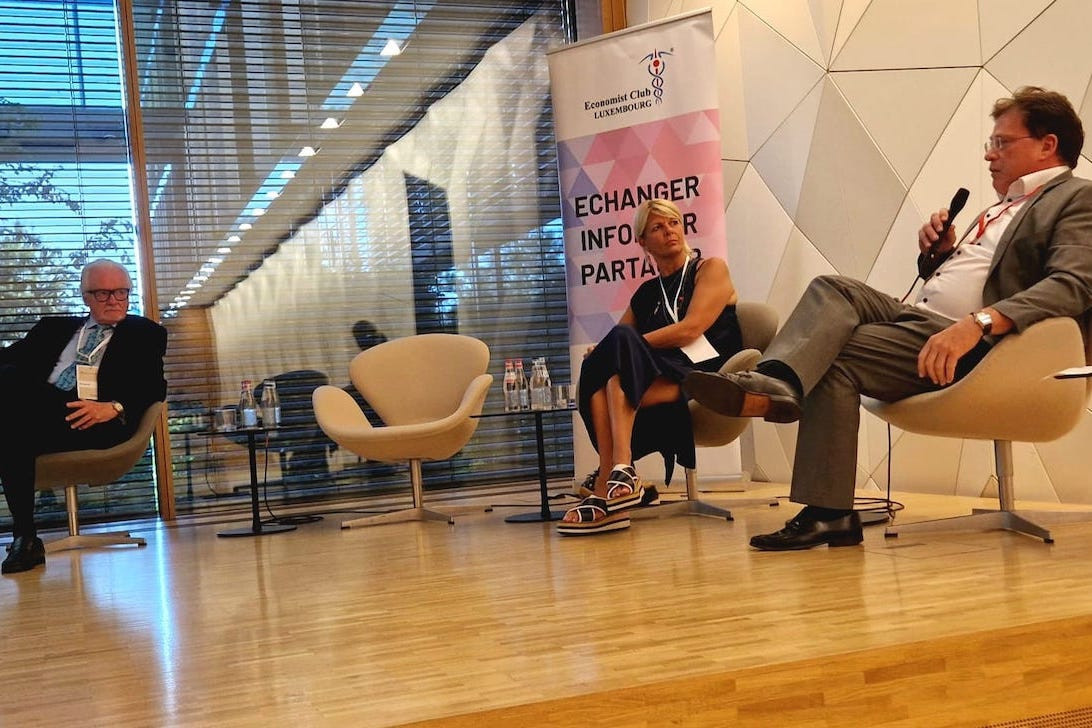
Luxembourg’s growth model is also at the heart of the Economist Club members’ reflections, especially as the country has, as the speakers said, “a special relationship” with growth.
For 
When asked why there has been no shift from expansive to intensive growth, 
Allegrezza goes on to point out that Statec’s next long-term forecasts--the last of which were published in 2017--will show that the country is going to face massive problems. “And not just because of the trend in social spending, which will still require resources amounting to 10% of GDP. We’re going to face some big challenges that we’ll be able to mitigate through smart, inclusive and, above all, more productive growth.”
The war for talent
In addition to growth and pensions, there is one subject that has the members of the Economist Club, and former president 
Henzig made the following observation: “Luxembourg does not have enough qualified resources to make available to companies. In a normal year, internal employment increases by some 13,000 jobs, while the national education system generates around 3,500 graduates. Today, 74% of internal employment in Luxembourg is made up of foreigners with no national education. The proportion of university graduates in this population is high, at around 40%.”
This weakness, he goes on, “is attributed to a lack of education, continuing training and higher education programmes, and a lack of approach to identifying the skills to be developed and improving the employability of national employees in the private sector. Luxembourg is the world champion in attracting foreign skills. Without this success, Luxembourg would not exist. But the world is changing and employees need to adapt. That’s why it’s important to give employees and managers the opportunity to take part in ongoing training to help them adapt successfully. Studies show that Luxembourg does not have the necessary infrastructure to offer structured continuing vocational training tailored to the needs of the economy and its employees.”
Advertising the benefits of training
What needs to be done? “The first step in improving the situation is to make companies and employees aware that vocational training determines Luxembourg’s future, and to raise collective awareness,” says Henzig. In his view, this requires government action to support the creation of an adult training ecosystem by putting in place measures to encourage individuals and companies to play an active part in acquiring skills.
Read also
“This goes hand in hand with a national continuing training strategy that supports initiatives and ensures the information, supervision and quality of such training. Providing a structuring national framework for adult training, while ensuring quality control, is one of the prerequisites for successfully implementing adult training that is adapted to meet the socio-economic challenges that citizens and, above all, the working population have to face. The aim is to provide continuing education with all its transformative potential, paving the way for a collective and sustainable future.”
The challenge of artificial intelligence
“We need to produce the talent that we can’t find in our own country,” comments Ries, for whom Luxembourg companies have never bothered too much about how to train their staff because they have managed to attract talent. “With digital transformation and the arrival of artificial intelligence, we will all be looking for the same talents and the same skills. We will be competing with other economies. Competitiveness will play a role. A person with talent and knowledge is economically very rational. So they will go where it is most attractive to go, where they can make the most of their human capital. So Luxembourg’s attractiveness, which has been very strong in the past, has been dented and the economic centre must be preserved if we want to continue.”
Read also
Training will also have an impact on the development of artificial intelligence, as well as on the digital and sustainable transitions. “This will enable us to move from expansive growth to mixed expansive and intensive growth,” says Muller. But these transitions still need to be successful, and there is a risk of a skills bottleneck. “In Luxembourg, one of the countries whose economic activities are most exposed to these transformations, the skills we need today will not be the same as the skills we will need tomorrow. And we are already starting to see what we call ‘skill depth’ in the market, i.e., this disconnection between existing skills and the skills needed to stimulate economic activity. There is a real challenge here in terms of training, but also in terms of mobility. Mobility is not part of the Luxembourg culture. We’re going to have to reallocate the workforce across the different activities, and that’s going to be a real challenge.”
She continues: “Innovation must not be stimulated blindly, but in a planned way. We know very well which innovations are more likely to generate intensive growth. And it is towards these innovations, towards the companies that are the bearers of these innovations, that public money must go in a more targeted manner because--whether it is for social purposes or to stimulate growth--the stimulation, targeting and efficiency of the investment of public money to be able to create more wealth is really decisive. And I believe we have the means to do this. But I don’t think we’re yet making sufficient use of everything that exists in the research sector to be able to support this transformation, which is going to be relatively challenging.”
This article was originally published in French.