(To our readers: the Paperjam editorial team was in Dudelange on Thursday and Friday to meet the political, social and economic players in this municipality of 22,000 inhabitants. This article is part of that "concentrated" approach. We hope you enjoy reading these articles.)
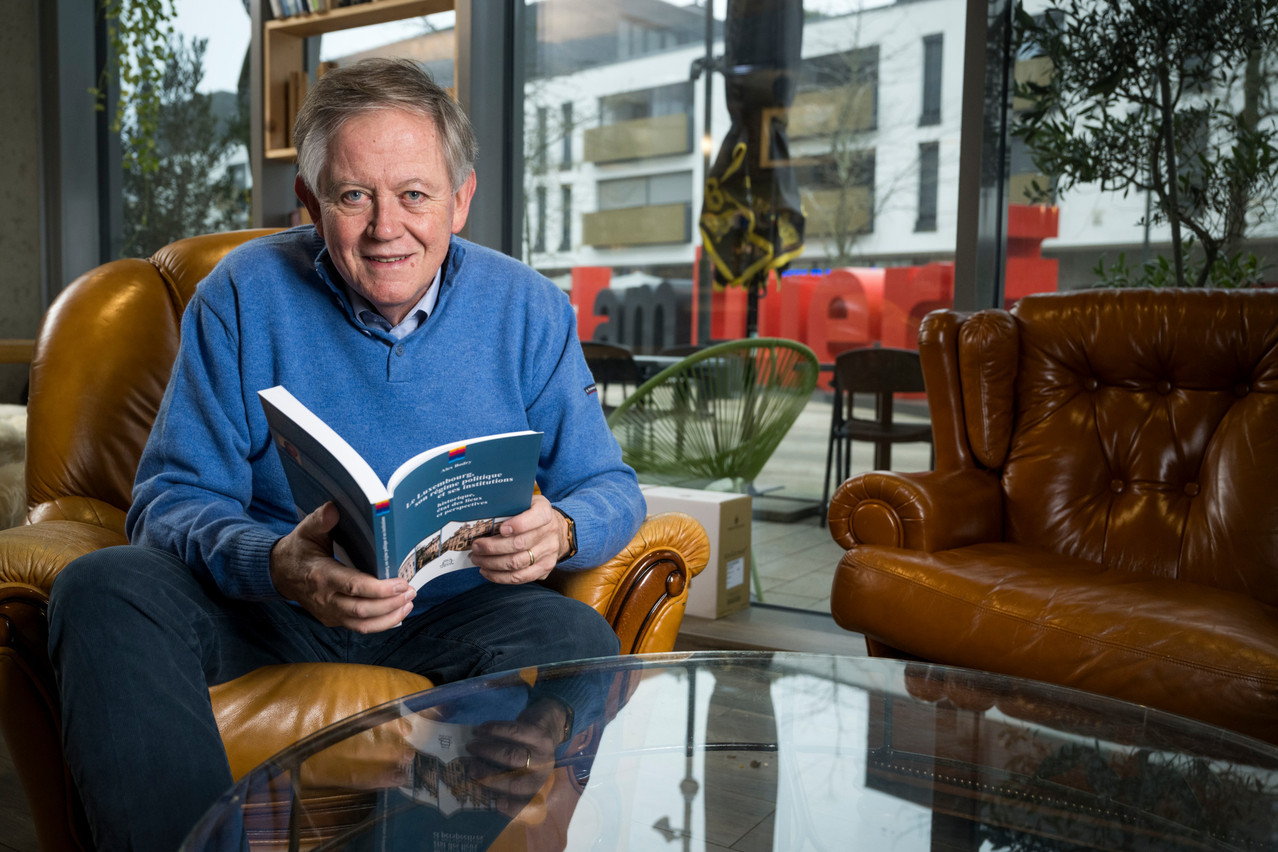
Member of Parliament from 1984 to 1989 and from 1999 to 2018. Mayor of Dudelange from 2004 to 2014. Honorary mayor in 2015. Several times minister in the governments of Jacques Santer and Jean-Claude Juncker from 1989 to 1999. President of the LSAP from 2004 to 2014. A member of the Council of State since 2020 and vice-president of the institution since 2024, 
Why did you embark on this adventure?
“I needed to pass on my experience. And I wanted to present our institutions in a way that got off the beaten track and called a spade a spade. I wanted to do away with presentations that are too focused on texts and that don't take account of political reality and real life. This book is a blend of constitutional law, political science and the day-to-day practice of institutions. I wanted it to be interesting for legal experts, but also accessible to people interested in politics. But be warned, this is not a popular work either.”
Do you think people are still interested in politics today?
“Do I think so? I see a lot of young people around me who are interested in politics, and that’s a good thing. However, there is perhaps more mistrust and a greater demand for politics, which it does not always meet. I hope that this book will also stimulate debate. The provocative style I use here and there could help.”
How are the institutions faring?
“Pretty well. Even if I see a few flaws and a lot of areas for improvement. What Luxembourg’s political life suffers from is a certain lack of questioning. There is a routine to institutional and political life, and moments of questioning are rather rare.”
“Over the last fifteen years, we have worked hard on the constitution. And the revised constitution includes a number of important changes that are not necessarily perceived as such by everyone, particularly with regard to the monarchy. This is certainly the chapter that has undergone the most changes in the texts, even if it now simply reflects the practice of the institutions. In a parliamentary democracy, I believe that a politically and legally unaccountable monarch cannot have any real powers. It is essentially a symbolic and representative function. It is on this point that we have made the most progress towards modernisation compared with the old texts.”
You talk about loopholes. What do you think are the main ones that need to be addressed?
“These flaws are less to do with the texts than with practice. Look at the Chamber of Deputies. On paper, we have an extremely strong parliament. But the reality is that, as in virtually all parliamentary democracies, it is the government that concentrates most of the powers. I would like to see a realisation across the political divide that it is important to strengthen Parliament in relation to the government in our institutional system.”
“Some decisions have been taken that are a step in the right direction. One example is the creation of a scientific council that will enable MPs to rely on their own experts rather than those of the government.”
“The fact remains, however, that when it comes to drafting legislation, bills are relatively rare compared to government bills. As for amendments, in the vast majority of cases they come, formally or informally, from the government. The Chamber of Deputies must realise that this situation needs to change. The only area in which Parliament has actually retained its primacy is that of the constitution. This is not the case in all countries: in some, many constitutional revisions are initiated by the government. Here, however, the most recent constitutional revision was initiated by Parliament.”
Are MPs ready to take on this role, in opposition to the government they support?
“I’ve always had the political and institutional balance of power in mind. There are issues where the interests of the institutions must take precedence over the interests of the political parties. It is essential, particularly for the majority parties, to realise that they are not just there to defend the government’s positions at all costs, but that they must have their own positions.”
“And that’s where the Conseil d’État comes in. The Council of State plays the role of a second chamber thanks to its impact on legislation. A Council of State whose role is little known.”
The coalition agreement refers to a reform of this institution. Where do we stand on this issue?
“The government’s intentions remain rather vague for the time being. The office of the Council of State has had a meeting with the prime minister. The discussions focused on the classic points, i.e., the deadlines for issuing opinions and increasing the number of councillors of state precisely in order to speed up procedures. The Council of State itself has taken steps internally to improve the situation. But on this point, the situation remains difficult. Through no fault of our own.”
“The number of formal objections is increasing. This is a strong trend. But the fact is that laws are often poorly drafted. We come across a lot of texts that are not quite ready, that are inconsistent. And there are also complicated texts that ministries have sometimes taken up to two years to draft. So we can’t ask the Conseil d’État to issue an opinion in two months.”
“This is all the more regrettable given that the Conseil d’État can be consulted before a text is drafted by the government and now, since the constitutional revision, by the Chamber of Deputies.”
Is the Conseil d’État a technical or political institution? The controversy that followed the failure of the LSAP’s nominee, Max Leners, in November seems to indicate otherwise.
“As regards the specific case of Max Leners, I don’t want to make any comment. As the vote was secret, I can only assume that the candidate put forward by the Socialist Party was perhaps in the eyes of some too young or too far to the left. But that’s just personal speculation.”
“As for the question of whether or not the council of state is a political body, Parliament has always seen it as a political body, not just a legal one. Some of its powers are those of a second chamber in many countries. It is the master of the clocks and as such exerts a great deal of influence over the tempo of legislation and reforms.”
“And through its formal objections--and therefore the absence of a second constitutional vote--it exerts strong pressure on the content of legislation. Formally, I can’t recall a single text being rejected for political reasons. The refusals are motivated by legal reasons. But behind the legal arguments can lie political considerations.”
“The last time the Council of State did not issue an exemption from the second vote was eight years ago. It concerned a text relating to the civil service, a highly technical text. This means that, in almost 100% of cases, the opinion of the Council of State is followed. So it’s a very effective weapon.”
This article was originally published in French.