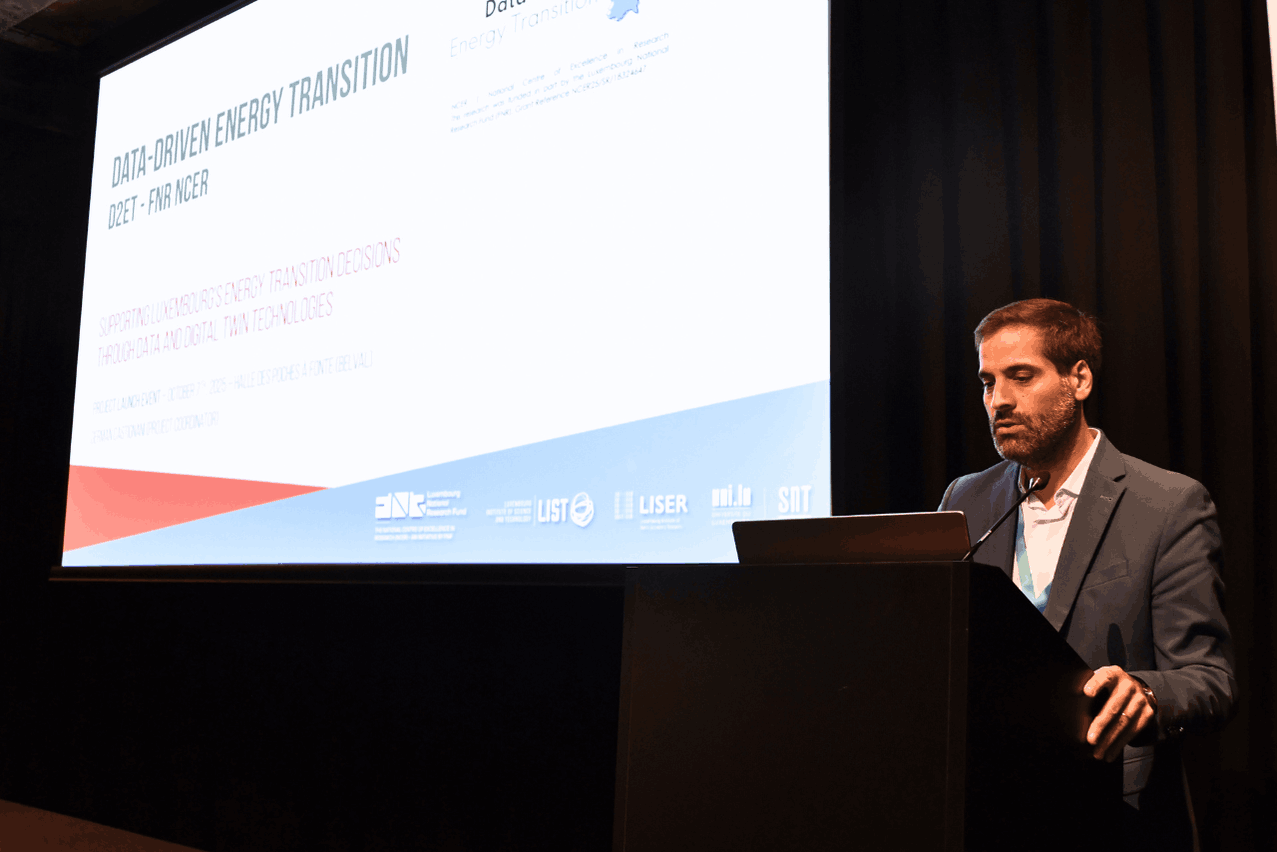
Luxembourg takes a major step in its climate strategy with the launch of the Data-Driven Energy Transition (D2ET) initiative on 7 October. This new national digital twin is designed to support decision-makers, grid operators, businesses and citizens in making data-driven, reliable decisions. Its ultimate goal: to accelerate the energy transition while ensuring security, fairness and efficiency.
Promoted by LIST, in partnership with the Interdisciplinary Centre for Security, Reliability and Trust (SnT) at the University of Luxembourg, the Liser, as well as Creos and Encevo, the initiative benefits from co-funding by the FNR.
A strategic tool for climate action
Integrated into Luxembourg’s National Energy and Climate Plan, D2ET supports the country’s targets to cut greenhouse gas emissions by 55% by 2030 and to reach 37% renewable energy in final consumption.
The digital twin consolidates data from electricity, heat, gas and hydrogen systems, combining it with technical, economic, social and environmental information. It enables simulation and optimisation of different energy scenarios, assessing their costs, emissions and social acceptance.
A public policy test
D2ET acts as a virtual laboratory for researchers, public authorities and industry stakeholders. It allows them to test regulations, investment strategies and innovations before implementation. Over time, the platform will evolve into a collaborative innovation hub, where energy stakeholders can develop and compare complex scenarios.
An interdisciplinary alliance
The strength of D2ET lies in the complementarity of its partners: List contributes its expertise in digital twins and artificial intelligence; SnT focuses on cybersecurity, machine learning and energy markets; Liser brings insight into social dimensions, citizen engagement and public policy support; and Creos and Encevo provide experience in smart grids and the energy transition across the Greater Region.
A vision beyond energy
The project’s ambition extends well beyond the energy sector — its data-driven and model-based governance approach could inspire progress in urban planning, mobility, healthcare or resource management.
As German Castignani, head of the digital twin innovation centre at List, explains: “This digital twin is not just a technological tool. It’s a collaborative platform designed to make our systems smarter, more resilient and more inclusive.”
Backed by €4 million in funding through the FNR’s National Centre of Excellence in Research (NCER) programme, D2ET reflects an ambitious collective vision: to position Luxembourg as a European model of innovation serving climate action and social well-being.
For more information, write to info@list.lu or visit www.list.lu.
A full version of this article is also available in French.