
At the heart of long-term wealth management lies a simple concept: Diversifying an investment portfolio can improve the ability to preserve and grow wealth over time. For that reason, portfolios have typically included a spread of equities and bonds, classically with 60% in equities and 40% in bonds.
In recent years, however, faith in that equity/bond allocation has been shaken. Think of the 2025 Trump tariff turmoil, 2022 inflation surge and 2020 Covid-19 bear market. In all three market corrections, equities and bonds proved highly correlated and fell together.
That has accelerated the search for ways to further diversify portfolios, including by investing in private markets. Unlike equities and bonds, private market assets are not traded daily. They are, therefore, generally less affected by market corrections not accompanied by recession, making them a potentially useful hedge against equities and bonds.
Beyond diversification, investing in private markets offers opportunities to access companies not listed on public markets, including potential future champions of mega-trends such as decarbonisation, digitalisation and deglobalisation. While private markets are characterised by elevated risk and long-term horizons, they offer the potential of an outsized illiquidity premium to those with the appropriate profile, risk appetite and investment horizon.
For these reasons, the role of private markets in investing is increasing. Previously limited to institutions and the ultra-wealthy, private markets are now far more accessible to retail investors thanks to the introduction of the European Long-Term Investment Funds (ELTIF) 2.0 regulation in 2024. Further, the industry is expanding fast globally, with estimates projecting that such assets will increase from USD 13 trillion today to more than USD 20 trillion by 2030.[1]
Defining private markets
The term “private markets” covers a vast universe, much of which has been in existence for decades and even centuries. There are four broad types of investment, encompassing everything from the private equivalent of an equity, or stock, to loans to companies.
Private equity is the largest private market asset class. Since taking off in the 1980s buyout boom, it has provided growth capital for many leading businesses, including fast-growing US tech companies. Private equity funds acquire stakes in companies, typically aiming to improve their profitability and value over periods of three to seven years, then exit that investment.
Private debt (or credit) has grown rapidly in the past 15 years as stricter regulations have led some banks to withdraw from certain areas of lending. Private debt funds now provide about USD 1.6 trillion in credit to companies.[2]
Additionally, infrastructure encompasses assets that support our daily lives – ranging from transport links like roads and airports, to renewable energy and the data centres that fuel artificial intelligence.
Finally, real estate funds acquire physical buildings of all types, aiming to profit from rental yields and any rise in capital value.
The benefits
In terms of investment returns, the benefits of adding private markets investments to a portfolio can be significant. Consider that private equity and private credit outperformed stocks and bonds on a risk-adjusted basis over the 15 years from 2008 to 2023, while private real estate performed in line with stocks.
Equally, private market investments have generated strong risk-adjusted returns (see chart), judged by comparing returns against price volatility. Of course, past performance is not necessarily indicative of future results.[BA1]
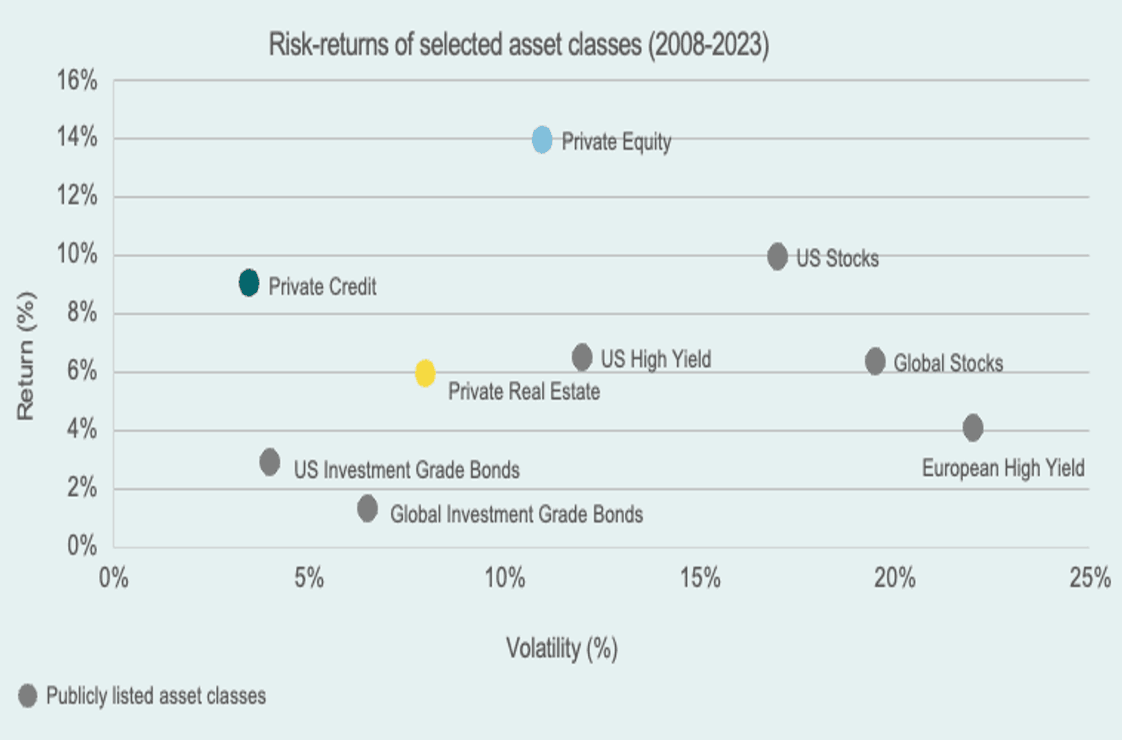
Figure 1; Blackstone, Morningstar Direct for the 15-year period ending March 31, 2023. Past performance is not a reliable indicator of future performance. Preqin. September 2024
The challenges
As with all investments, private markets come with challenges.
Depending on the type of private market investment, their illiquidity means they may require commitments of three to 10 years, although semi-liquid ELTIF funds are designed to be sold far more frequently. Similarly, private assets can take years to mature. They’re hard to value, requiring in-depth financial analysis and valuation models that rely on assumptions about future performance. There are also regulatory and operational challenges. Finally, selecting the right managers and investment opportunities requires expert due diligence.
Navigating complexity
Despite these challenges, private markets are now playing a greater role in long-term wealth preservation and growth. Just as some institutional investors have increased their holdings over time, some wealth managers are also now integrating them into client portfolios.
Finally, it is important that investors understand how private markets fit within a diversified portfolio and align with their individual financial goals and timelines.
[1] Source: Preqin, September 2024, Carne Atlas, August 2024. Blackrock 2025 Private Markets Outlook. https://www.blackrock.com/ca/institutional/en/insights/private-markets-outlook.
[2] Preqin. September 2024.
Learn more on Quintet Private Bank website.