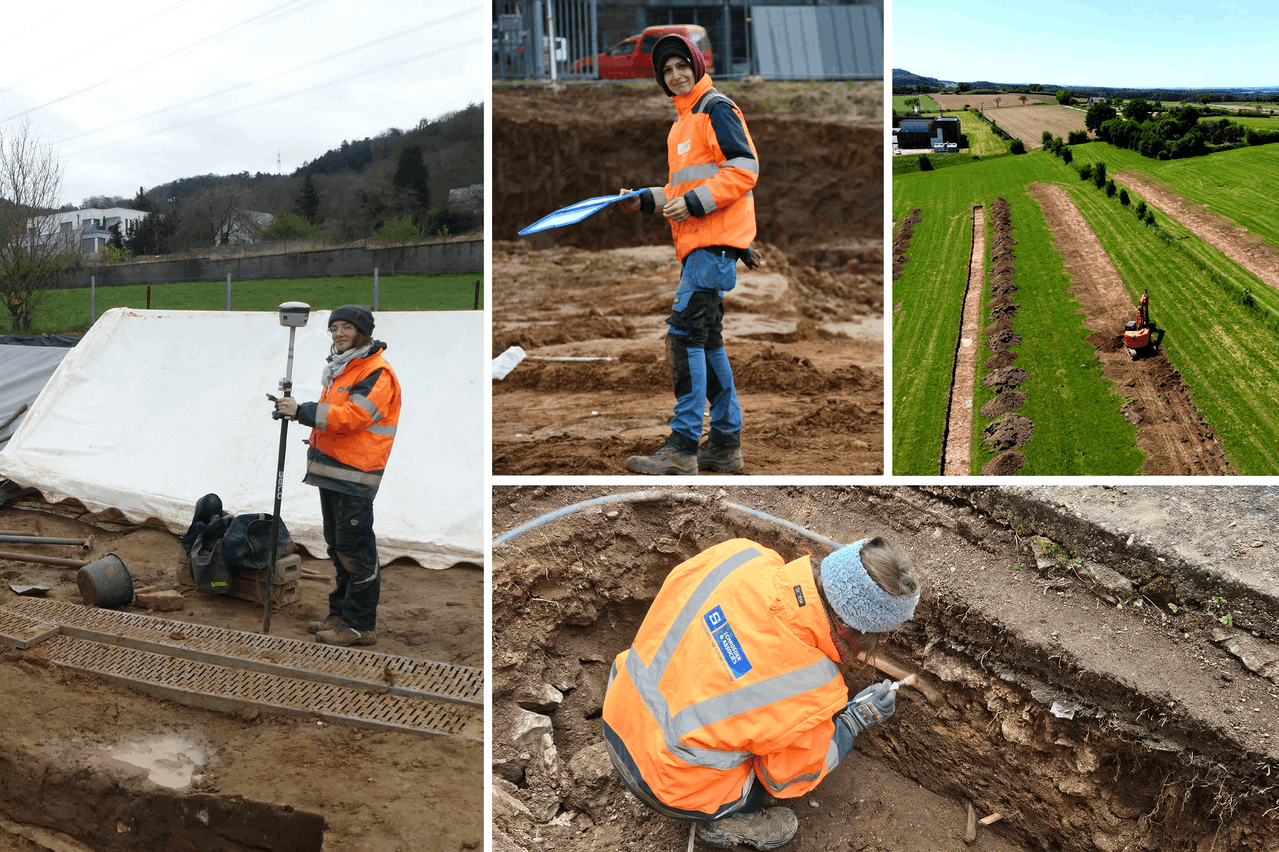
What is the role of archaeology in Luxembourg today?
Currently, around a hundred archaeological projects are active in Luxembourg, involving approximately fifty archaeologists. At Schroeder & Associés, our first excavations began in 2021, and we are now engaged in two significant projects. Compared to countries like Belgium and France, archaeology is a relatively recent field in Luxembourg.
Additionally, the status of archaeologists remains unrecognized in Luxembourg. Our work is conducted under the direction of the State and the Institut National de Recherches Archéologiques (INRA). We conduct surveys, monitor construction work, and carry out excavations, compiling reports that are submitted to INRA. They then decide whether to proceed with the project. In this sense, we often find ourselves “between a rock and a hard place.”
What types of projects do you carry out within the engineering office?
Our work involves prospecting, monitoring, and surveying land prior to construction – whether for residential areas, road redevelopments, or shopping centers. These investigations are essential for obtaining planning permission. If archaeological findings, such as ceramic fragments, structures, or walls, are uncovered, INRA steps in to determine the next course of action: either allowing the work to continue or halting it due to the site’s archaeological significance.
How important is it to study the pottery found?
Ceramics are the most commonly found material at excavation sites. They are invaluable for dating a site, identifying its function, and understanding its regional characteristics. Ceramics also shed light on consumption and supply patterns, and, in some cases, can even indicate social status.
Is archaeology fieldwork or office work?
Archaeology is a balance of 50% fieldwork and 50% office work, though this can vary depending on the project’s scope, challenges, and budget. In the field, we perform excavations, followed by analysis and research to place objects in their historical context. Everything must be meticulously documented, as excavations inevitably destroy layers of soil, much like peeling back layers of a millefeuille. To reach a Roman layer, for instance, the upper medieval layers must be removed. What remains is the report documenting our findings.
What are the main stages in an archaeological project?
An archaeological project typically involves three main stages: diagnosis, excavation, and reporting. Everything is based on documentation – each survey and excavation results in a detailed report.
What are the main challenges encountered in the field?
The weather is one of our biggest challenges. Bad weather can halt our work and delay deadlines. Another significant challenge is maintaining scientific rigor. It’s crucial to follow strict stratigraphic logic to preserve objects and record each element correctly.
Are customers aware of the importance of excavations?
Not always. We often need to raise awareness about the importance of our work. Some clients focus solely on time and cost, and when a survey reveals an archaeological site, the excavation delays can lead to dissatisfaction. People’s sensitivity to these issues varies.
Another challenge is the theft of objects from sites. Excavations can attract undue attention, fueled by public fascination with archaeology, à la Indiana Jones. When media coverage heightens interest, it sometimes brings ill-intentioned individuals.
What skills are essential in this profession?
Scientific rigor is critical in this profession because we must work precisely and methodically. Passion is equally important, as the working conditions can be challenging. Curiosity and an investigative mindset are necessary for thorough research. Lastly, working within an engineering office requires adaptability to client demands, respect for national policy, and diplomacy in client interactions.
More information on our website.