
Synthetic risk transfers, a once-niche corner of bank finance, now provide capital relief on about €750bn of assets across the euro area, the UK, the US and Canada, drawing closer scrutiny from global regulators as the market expands and more risk migrates to private funds.
The Basel Committee on Banking Supervision, hosted by the Bank for International Settlements in Basel, set out the scale and fault lines in a report published on 17 February 2026, concluding that the structures in use today appear more prudent than the credit risk transfer deals that flourished before the 2008 Great Financial Crisis, but warning that blind spots in disclosure and bank financing of the trades merit continued monitoring.
What are synthetic risks
Synthetic risk transfer is a way for a bank to shift credit risk without selling the underlying loans. The bank keeps ownership of the assets and continues servicing them, but transfers all or part of the potential losses on a defined portfolio to an outside investor through a contract.
In practice, the bank selects a pool of loans, most often corporate credit, and buys protection on a particular slice of losses. If defaults rise and losses reach that slice, the protection seller pays out. The economic exposure moves even though the loans remain on the bank’s balance sheet.
A defining feature is “tranching”, which splits losses into layers. Banks often retain the first-loss piece and the senior exposure, while transferring risk in the middle, the mezzanine tranche. The Basel Committee notes that the Basel framework requires at least two tranches with different degrees of credit risk, and that the ability to show meaningful risk transfer is what underpins regulatory capital relief.
How they work
Unlike pre-crisis securitisations, which often moved loans into special-purpose vehicles and sold bonds backed by their cashflows, synthetic structures typically shift risk through a guarantee, a credit default swap or credit-linked notes. The bank keeps the loans, but sells a defined slice of potential losses to an investor.
The attraction for banks is operational and regulatory. The Basel Committee identifies capital and credit risk management as the main motivations, allowing lenders to reduce the capital they must hold against a loan book while keeping client relationships and loan servicing in-house. For investors, the appeal is exposure to bank-originated corporate credit without having to own or manage the underlying loans.
The committee illustrates why the incentive is strong with a stylised €2bn corporate loan portfolio. In its example, the bank keeps the first losses (on1% slice), buys protection on the next layer of losses (on 8% portfolio) and retains the rest (91%).
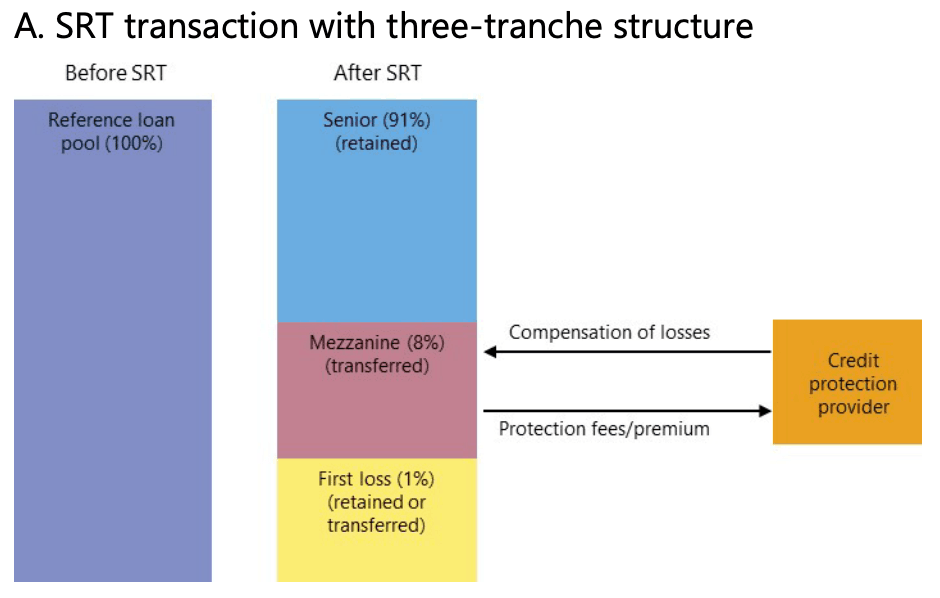
Stylised example of three-tranche structure … BIS / screenshot from the report
That middle layer is the one that drives most of the capital relief. Once protection is bought on an 8% slice, the bank’s capital requirement falls to €41.8m from €88m, a 52.5% reduction.
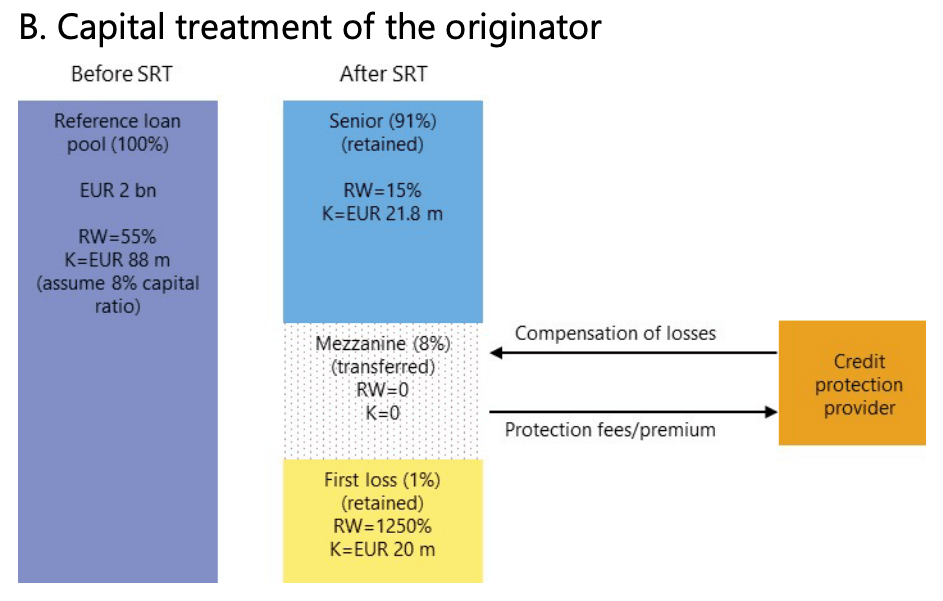
… and associated capital relief. BIS / screenshot from the report
Why regulators are uneasy
The investor base is dominated by private investment funds, the report says, with pension funds and insurers also participating and public sector entities playing an important role in some jurisdictions. The committee adds that transactions are often privately placed, contributing to limited visibility outside specialist circles.
A central concern is the growing interconnection between banks and non-bank financial intermediaries. The Basel Committee highlights that some investors enhance returns by leveraging their positions, including through repurchase agreement financing that can be provided by banks. That matters because it can blur the narrative of risk leaving the banking sector. If banks are funding the very investors selling them protection, part of the exposure can loop back to the banking system in a different form.
How big is it
The Basel Committee estimates that protected assets in Canada, the euro area, the US and the UK total about €750bn, equivalent to 1.1% of total bank assets across those jurisdictions. It puts the share of protected assets within individual jurisdictions between 0.9% and 1.8%, with an average of about 1.1%, and describes the market as particularly vibrant in those regions.
Corporate loans are the largest asset class protected, the report says. It cites external research suggesting that at end-2024 the average listed bank in the EU, the UK and Switzerland had protection covering about 12% of its corporate loan book, with some outliers above one-third. The report also cites estimates that the corresponding capital relief can reach up to 47 basis points of the Common Equity Tier 1 ratio for the average bank in that sample, while noting that many banks, including some global systemically important banks, have not issued material volumes.
How bad it is
The Basel Committee’s report is neither alarmist nor complacent. It says the post-2008 regulatory and supervisory reforms make today’s synthetic risk transfers simpler and subject to more scrutiny than pre-crisis credit risk transfer structures, but it also points to perceived blind spots.
Disclosure of synthetic risk transfer activity and its impact on bank capital remains limited. It also warns that supervisors are still at an early stage of understanding banks’ financing of synthetic risk transfer positions, with no comprehensive data on the scale of such financing and some supervisors concerned about insufficiently prudent practices.
The committee also flags a broader system risk. If banks become reliant on these deals for capital relief, credit supply could become more dependent on non-bank risk appetite. In a downturn, if investors pull back, protection could become scarcer precisely when banks want it most, amplifying the procyclicality of lending. That’s the risk.
What it means in practice
Synthetic risk transfers are not a retail product, but their effects can filter through to households and businesses. If the market functions as intended, it can support credit availability by freeing regulatory capital, particularly for corporate lending, without forcing banks to sell assets.
If, however, risk transfer increasingly depends on leveraged private funds, or if banks end up reabsorbing exposure by financing counterparties, the system could be more fragile in stress. That can translate into sharper swings in bank risk appetite, tighter credit conditions and higher borrowing costs when the economy weakens. The Basel Committee’s message is that the tool can be useful, but that its growth, opacity and links to non-bank finance warrant closer supervision before the next downturn provides a real-world test.
The full report is available here.