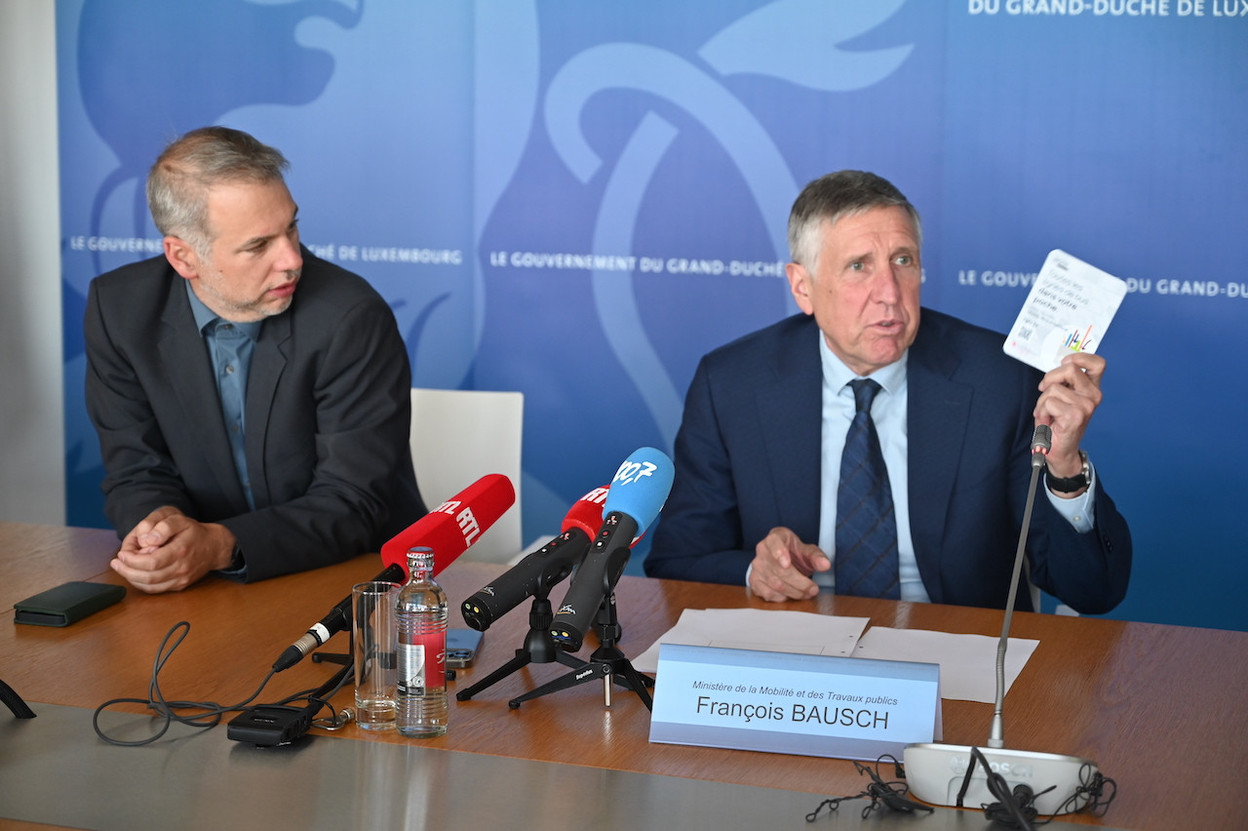
Jeremy Zabatta: Free public transport will cost €800m in 2023. Is this the price of free transport, and not only the €41m represented by the transport tickets that are no longer sold?

That’s a pretty high cost, isn’t it?
I think we have to look at this free travel with a more global view. You have to look at the gain that an urban public transport network has on the economy in general.
When the work in Luxembourg station and on the line to Bettembourg is completely finished, by 2028, there will be a train every seven minutes during rush hour.

Let’s come back to the figure of €800m. This is a significant amount within the budget of the ministry of mobility and public works. Should it remain stable, decrease or increase in the coming years?
This budget will increase. In the CFL financing law, which will take effect in 2025 for a period of 15 years, we have provided for increases such as indexations, but also an increase of 5% in expenditure per year, simply because we have planned to increase the service capacity on the railways and continue to invest in rolling stock. Moreover, the future CFL train should very soon be delivered for a test phase in Luxembourg. When the work in Luxembourg station and on the line to Bettembourg is completely finished, by 2028, there will be a train every seven minutes during rush hour. This will be a substantial increase in capacity.
Compared to last year, the budget has increased by just over €100m due to the increase in capacity and frequency of the public transport network, both on the railways and on the tram and RGTR buses. In the coming years, with the tram extensions, the big reorganisation of the RGTR network that we want to do in the south of the country, the public transport budget will therefore increase as we have a huge mobility programme up to 2035.
Read also
Today it costs €800m, so it is likely that in the coming years public transport will cost the state more than a billion euros a year... Who will have to pay for it?
In our Modu project, we have defined four actors involved in mobility: the individual, the state, the municipalities and the companies. In the next legislative period, we will have to think about taxation and the responsibility of companies for financing mobility. For example, the introduction of a transport tax for companies, similar to what exists in France, where companies are subject to a very small tax. The revenue from the tax is used solely to finance public transport. This is a model that I find interesting, among other models, which will have to be adapted to the Luxembourg model with perhaps thresholds for small companies with less than 50 employees. This will obviously require discussions and debates in order to create an efficient mobility system.
Does Luxembourg have the means to achieve its ambitions in terms of mobility, while the government does not want to see its debt increase?
It is always a question of political priority. When you no longer have the financial means, you have to make choices. But if we start not to see mobility as a priority, it is a fatal error. This will be to the detriment of the country’s attractiveness and its quality of life. In my opinion, there are areas where we cannot make savings: health, education, social security, housing and mobility. Let’s add culture, which is also an important area but often requires a smaller budget. Making savings in these areas will ultimately lead the country into an even greater deficit, as it will negatively impact the country’s economy.
I am convinced that the performance of this bridge will be extraordinary. It will connect Esch-sur-Alzette to Belval, where at the moment the population has no possibility of walking or cycling unless they take risks.

A petition has been opened asking for the return of public transport with a fee to guarantee users the respect of timetables on the network. What do you think about it?
Honestly, I don't understand the arguments put forward in this petition. Even if I make people pay for public transport starting tomorrow, it will not change the punctuality of the different types of transport. Bus schedules will be respected when we have enough bus lanes. The train timetables will be even more respected when the modernisation works are completed and will allow an increase in capacity. The tram is punctual. The quality of public transport has nothing to do with the €41m loss of revenue from ticket sales. By opting for free travel, we have not reduced the range of transport services. On the contrary, we are the world champions in terms of investment in public transport. The problem is that we waited far too long to do so. If we had reduced the quality of our transport network, then I could understand that people would prefer to pay for a certain quality of transport. But we have done the opposite.
Isn’t the cost of some infrastructure too high? Let's take the example of the future footbridge between Belval and Esch-sur-Alzette, €47.5m, for 1.9 km of cycle track, including a 1.2 km footbridge, which is 25 million euros per kilometre...
This question is never asked when it comes to building a bridge for individual cars. I am convinced that the return on this bridge will be extraordinary. It will connect Esch-sur-Alzette to Belval, where at the moment the population has no possibility of walking or cycling unless they take risks. A university has been built in Belval and students cannot easily get to Esch-sur-Alzette. This bridge will be a great asset for the economic development of Esch and it will once again give a very good image of Luxembourg in terms of architecture and mobility, just like the bicycle bridge under the Adolphe Bridge, which recently won an international prize (the Footbridge Award in the New Life category). Moreover, the price per square metre of this footbridge is double that of the one that will link Belval and Esch (editor’s note: €6.2m for a length of 200 metres).
In 2020, free public transport attracted media from all over the world. Is this still the case?
Yes, and I am still often asked to speak about the Luxembourg mobility concept. But I always insist on specifying that it is an urban public transport network, because it could not be transposed to a whole territory like France or Germany where distances are sometimes very great. But I think that on the scale of an urban agglomeration such as Berlin, Frankfurt or Paris, cities with the same problems and specificities as Luxembourg, which is a large urban area with a high population density and strong attractiveness, our mobility project becomes an undeniable asset for the attractiveness of the country.
This story was first published in French on Paperjam. It has been translated and edited for Delano.