Working time and pension reforms were both central to last October’s general election campaign, the former directly and the latter, you might say, by omission--perhaps because it isn’t a subject that brings people together.
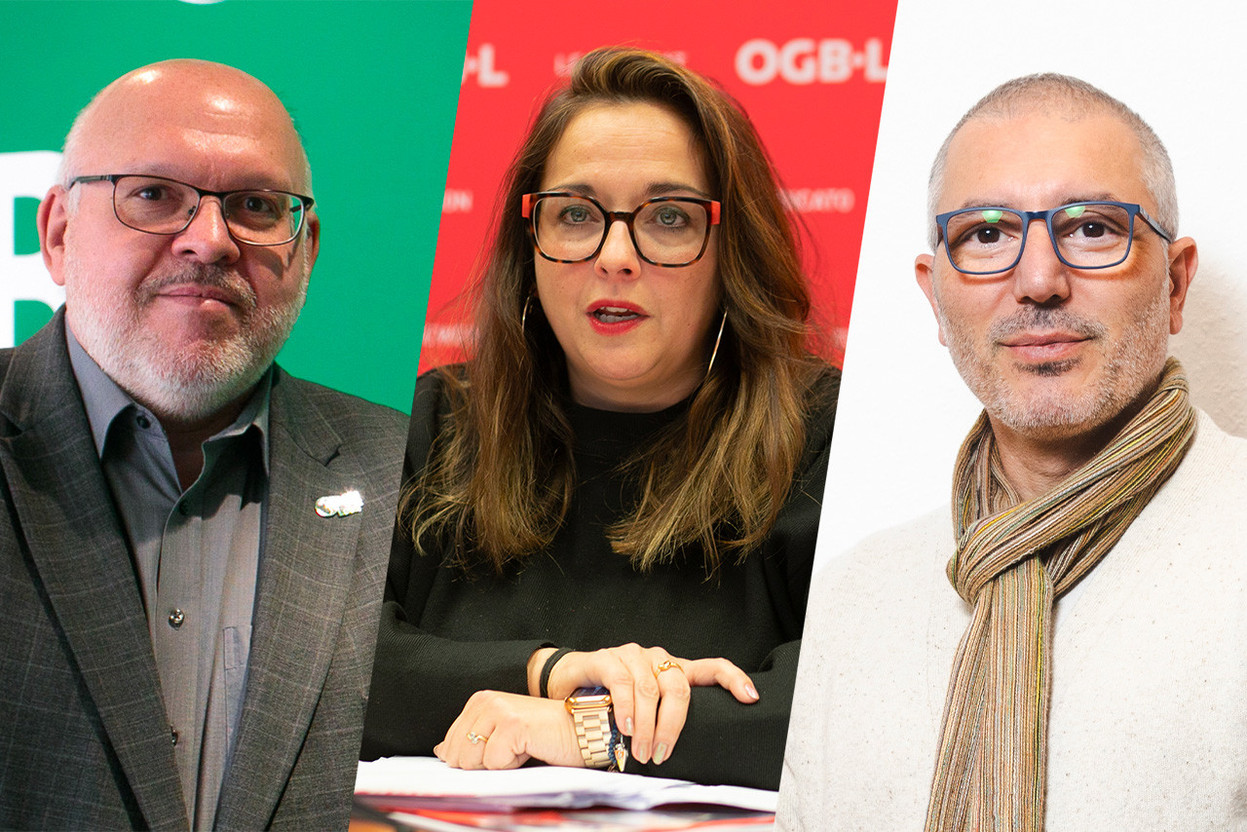
But ahead of the social elections on 12 March, pensions are very much in the spotlight. LCGB president 
It’s not enough to be a mathematics specialist...

“The financing of the system is sustainable up to 2045. I don’t know of many countries where that’s the case,” says Dury. “For me, that means we have time to find the solutions needed to make the system sustainable.”
The issues to address are contributions and additional funding sources, as well as how equal the private and public pension systems are. As he points out: “We have a system in the private sector, financed by contributions, which caps pensions at five times the social minimum wage. And alongside that we have a public system with no cap and which is financed by the state budget--in other words by taxpayer money.”
The figure of 
Hiding your intentions during your campaign is dishonest!

The OGBL has a similar take: general secretary 
“Also to put forward our ideas,” she adds. “We are still banking on social dialogue and the famous Luxembourg model.”
Back is also annoyed that the subject was absent during the legislative election campaigns but that, mere weeks after the vote, the line is that the system is not viable. “Hiding your intentions during your campaign is dishonest!” she says. “It’s revolting to hear people say that pensioners are fine and that they aren’t at risk of poverty. It’s simply not true. At a time when retirement home prices are rising so much that most normal, middle-class people are excluded, to say that we’re going to touch pensions is unacceptable. Just as it is unacceptable to hear that the system is no longer financially sustainable. We have a reserve of €24bn. That’s a huge amount! Rather than attacking the weakest, let’s try to rethink the mechanisms and calculation methods. Let’s try to see how we can perpetuate our system and our reserve--a reserve that ultimately serves to maintain our triple A rating. We can’t say that, financially, we are at the foot of the pensions wall. That’s not fair. Every time it has been said, it has been wrong. It will be wrong this time too.”
She continues: “We have to preserve the system as it exists and try to improve it wherever possible. We need to maintain this system, which is financed on the basis of solidarity--the best model in the world. Hearing the minister talk about developing the second and third pillars worries me. That would be tantamount to creating class pensions.” Back’s priority is the 2012 reform, which provides, in the event of insufficient funding, for a limit on pension adjustments--based on the understanding that indexation would continue to apply--and for the abolition of the end-of-year allowance. “For the average pensioner, this represents €1,000 a year. That’s a lot of money. Let’s try to increase the minimum pension instead.”
We aren’t opposed to an increase in contributions.

Back says she is ready to discuss all issues “in line with the Luxembourg tripartite model.” Everything, including funding. “We aren’t opposed to an increase in contributions. We don’t necessarily like it, but it’s the fairest way of doing things. It would apply to everyone, companies, high earners… we’ve always said that, if we had to, it would be the first thing to do. But the minister seems to have ruled that out, if I’m reading correctly the interviews she’s given to the press.”
Regarding other avenues for funding, Back talks about the removal of the ceiling on contributions: “Today, pension contributions are only paid up to a certain level: five times the social wage. Removing the ceiling would mean that very high earners would have to contribute.” She also mentions a wealth or solidarity tax. “There was a Liser [Luxembourg Institute of Socio-Economic Research; editor’s note] study that found 42 possible sources of funding. We have a choice.”
“Pension reform is inevitable if you look at the figures,” is the position of Aleba president 
Working time: reduction versus flexibility
The question of working time raised a few hackles during the legislative election campaigns, as the LSAP took up the issue and drew in its opponents. A dividing line was quickly found: those who support less work without loss of pay, and those who don’t. The latter group--in which the CSV and DP find themselves--emphasise greater working flexibility in lieu of a shortened workweek.
According to Dury, working time is an essential issue for a trade union. “When we talk about trade union organisation, we talk about negotiating collective agreements, and one of the key elements of these collective agreements--apart from pay and working conditions--is the organisation of working time.”
He continues: “[Any reform] should be done within a legal framework which, without being simplistic, is simpler than the current framework; and the social partners should be given the opportunity to negotiate the reference working time via collective agreements. At present, an employee’s total working time must not exceed an average of 40 hours per week over a period of four consecutive weeks. This reference period could be extended to twelve months. Above all, we would like the organisation of working time in companies to be a matter for joint decision between the employer and the staff delegation. Dealing with the subject on the ground would avoid polemics.”
We're not against reducing working hours, but it has to be done on a case-by-case basis.

Back points out that, historically, the OGBL has been in favour of a reduction in working hours without a reduction in salary. “But the subject was not on the agenda,” she says. “It was the UEL [Luxembourg Employers’ Association; editor’s note] that brought the subject up at the last tripartite meeting. Since then, we have been expecting an offensive. During the parliamentary elections, we said that voting for the DP or CSV would mean a deterioration in working conditions in the direction of greater liberalisation and flexibility. And we can see that, in this area, the coalition programme has taken up the main points of the election programmes.”
Asked what her dream reform would be, Back mentions that the current law on working time should be retained, and that working time should not be made any more flexible. “It’s already very flexible in Luxembourg, in almost all sectors. We already have the option of having a one-year reference period. This is done in certain sectors, the only quid pro quo being to negotiate it in a collective agreement. The possibility exists in social dialogue. It would be regrettable and truly harmful if this were imposed by law without any obligation for social dialogue. After that, if someone proposed a reduction in working hours, we’d talk about it. But we don’t have a quantified objective. The time has come to reduce working hours. It’s happening all over Europe, even in the UK in some companies. We want to open the debate to try and find the right compromise, using the benefits of the digital and green revolutions to create positive spin-offs for employees and the economy. But this has to be done on a sector-by-sector basis and through legislation.”
Mendolia shares these views. “We’re not against reducing working hours, but it has to be done on a case-by-case basis. We can’t generalise a reduction in working time to sectors that don’t lend themselves to it--in any case in a dogmatic way. Without having to take firm and definitive decisions on the subject, there are always ways of reducing working hours, particularly through a degree of flexibility. For the next banking and insurance agreements, we will be proposing the possibility of buying days off. We are in favour of wellbeing and efficiency. If people feel good and are fit, the work will get done better.”
This article was originally published in Paperjam. It has been translated and edited for Delano.