The spectre of economic retaliation measures that had been looming over Russia finally became real. The Kremlin's recognition of the independence of the pro-Russian separatist regions of Donetsk and Luhansk triggered a new round of EU sanctions against Moscow, including the freezing of the assets of 351 Russian Duma deputies and a visa ban for the Schengen area. The sanctions also affect some 30 Russian individuals and institutions, including banks.
This could be only the first set of sanctions. According to recent statements by several Western leaders, the aim is to directly affect Russia's ability to refinance its debt. To this end, member states are considering preventing Russia from accessing European financial markets.
Such actions of economic warfare could well turn the future of EU-Russia trade relations upside down. As far as Luxembourg is concerned, the Chamber of Commerce told Paperjam that it has about 60 Luxembourg companies active in Russia on its internal registers. However, fewer than ten of them have a real presence in Russia, citing in particular Paul Wurth, ArcelorMittal, Accumalux and Arendt & Medernach.
Stable economic relations
According to the Luxembourg Chamber of Commerce, the grand duchy exported the equivalent of €598m to Russia, including €407m in goods and €191m in services. The goods most exported by Luxembourg to Russia are chemical industry products, plastics, wood pulp, electrical appliances and transport equipment.
At the end of the 2000s, a number of Luxembourg companies from the industrial sector set up their production facilities on the territory of Russian regions.

Oleg Prozorov, CEO and member of the board of the Belgian-Luxembourg Chamber of Commerce in Russia, tells Delano’s sister publication Paperjam that “at the end of the 2000s, a number of Luxembourg companies in the industrial sector set up their production facilities on the territory of Russian regions”, without being able to name names, “because under the current conditions, their shareholders do not want to publicise their successful development in Russia.”
The chamber brings together more than 150 Belgian, Luxembourg and Russian companies.
“Economic relations between Luxembourg and Russia have always been quite stable,” says Prozorov, adding: “Perhaps in terms of numbers compared to Luxembourg’s neighbours--Belgium and the Netherlands, Germany, France--they are not so pronounced, but in recent years they have developed especially actively in the field of cooperation, sustainable development and green finance.”
Unwelcome sanctions
The CEO of the Belgian-Luxembourg Chamber of Commerce in Russia criticised the new sanctions. “To succeed in the development of trade and economic relations, any restriction is always detrimental. At the chamber, we expected that the situation with the covid-19 pandemic would unite nations and that economic relations would be actively re-established once it was over. But unfortunately, today we only see an increase in risks and threats. History shows that every crisis is always followed by growth and the sooner we move to the second phase, the better.”
The chamber and its members are “saddened by these destructive processes between Russia, Ukraine and the European Union,” he says. They rely “on the wisdom of politicians and their willingness to find a compromise.” On the other hand, Prozorov stresses that the tasks of the Chamber of Commerce he represents “include the development of trade relations and the protection of our members’ activities in Russia”. But he adds: “We do not participate in political processes.”
While Luxembourg companies have chosen to set up in Russia in whole or in part, conversely, Russian companies have taken up residence in Luxembourg. “Russian banks and companies in the financial sector, as well as high-tech developers, have chosen Luxembourg because of the grand duchy’s favourable and open business climate,” says Prozorov.
Russian banks and companies from the financial sector, as well as high-tech developers, have chosen Luxembourg because of the favourable and open business climate in the grand duchy.

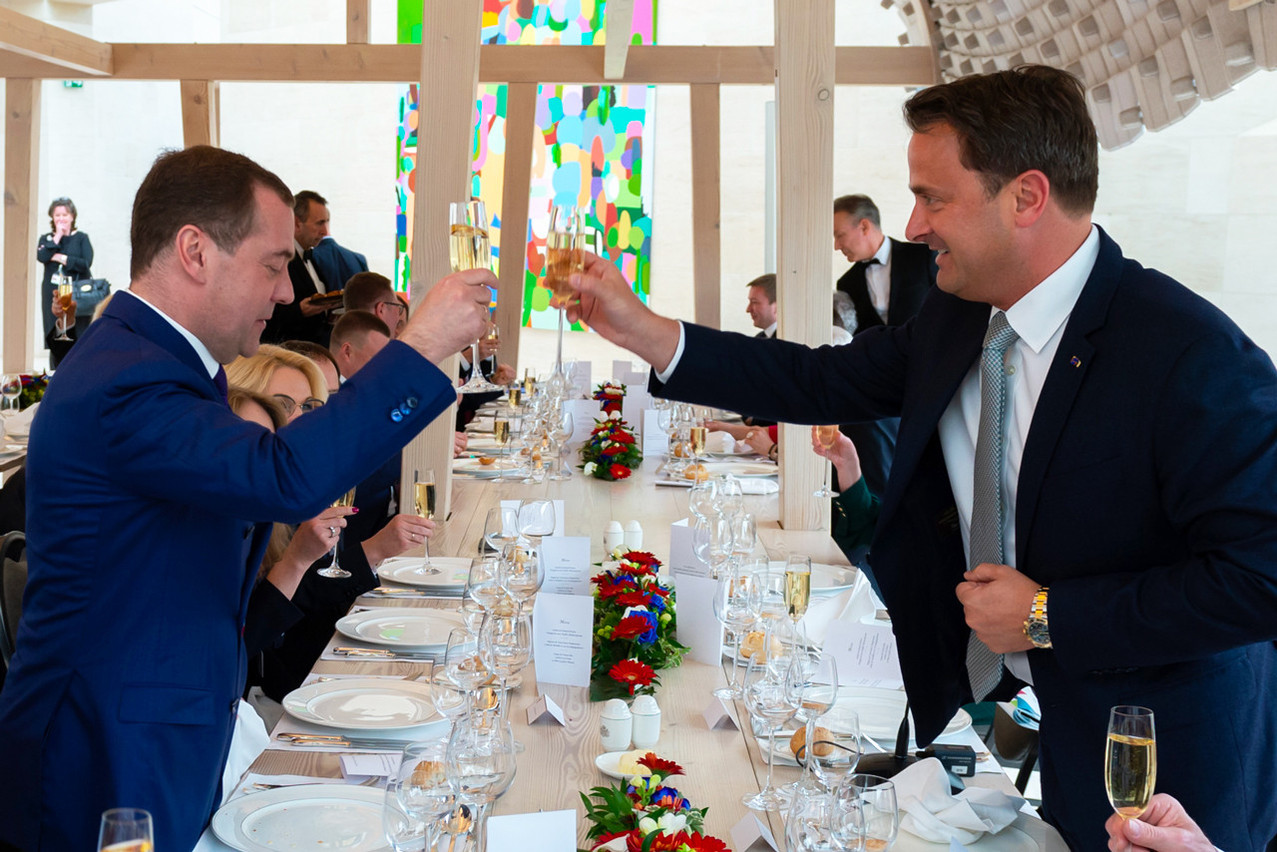
Beyond commercial exchanges, the political world, both on the Russian and Luxembourg side, want to embody the role of catalyst for cooperation between the two countries. In March 2019, the last official state visit of the then Russian prime minister Dmitri Medvedev ended with the signing of two agreements-- on the modernisation of the economies of the two countries, and Russian-Luxembourg cultural cooperation for the years 2019 to 2021.
This meeting also laid the foundations for a future agreement in the space sector. The American embassy in Luxembourg had published a press release prior to the 2019 visit, not hesitating to compare Luxembourg to Crimea. For his part, Medvedev, at the end of his visit, had hinted at the idea of appointing the Luxembourg prime minister, Xavier Bettel (DP), as a privileged mediator between Russia, the European Union and the United States.
This story was first published in French on Paperjam. It has been translated and edited for Delano.