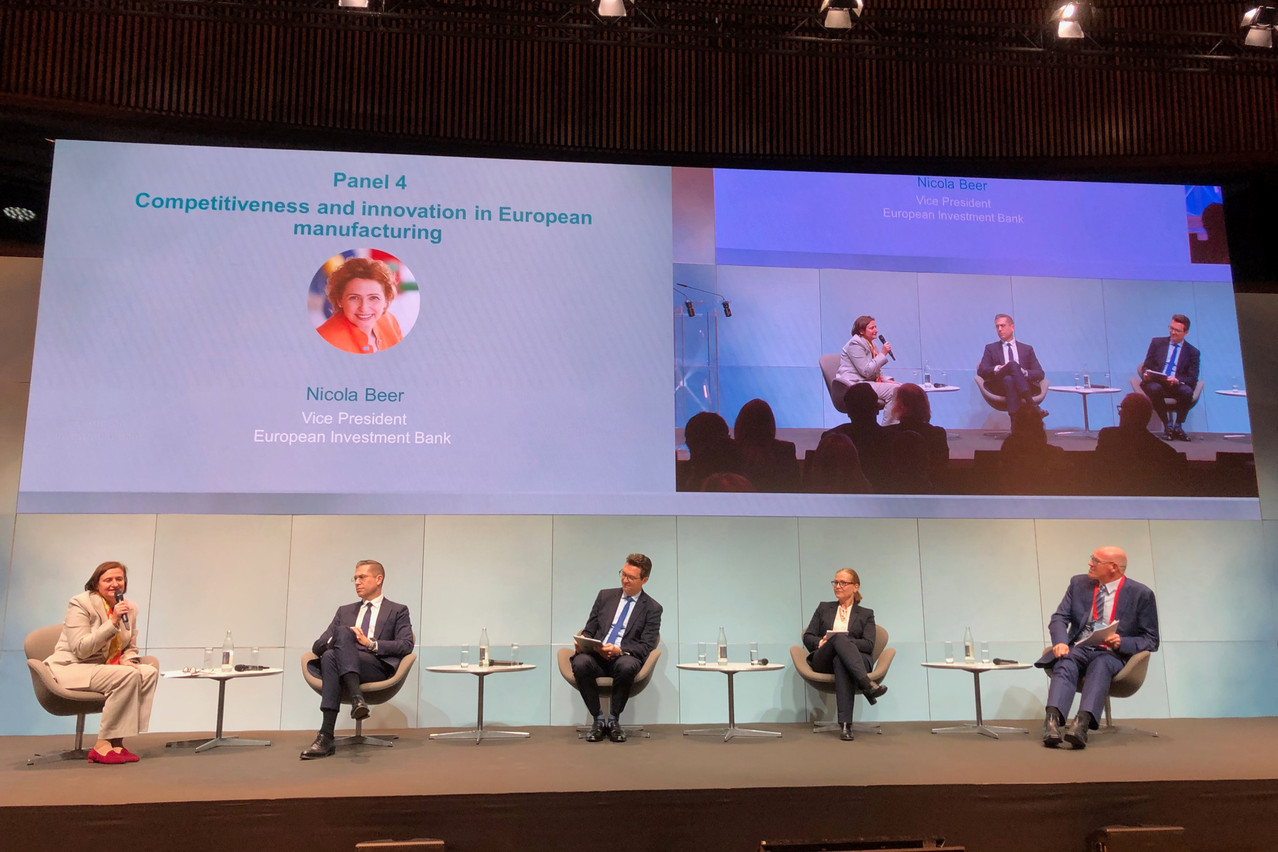
“Industrial activities have not been sexy in the last years,” said Mathias Miedreich, chief executive officer at Umicore. He thinks that working in a battery giga factory is nowadays “something sexy for your people.” Umicore is one of the companies which “actually take the critical minerals… and make active materials out of that and power the batteries.”
Manufacturing doing its part for the green transition
“Concrete is vitally important for the [green] transition to renewable electricity, to make dams and wind farms. It's fully recyclable and durable,” said Nicola Kimm, member of the managing board and chief sustainability officer at Heidelberg Materials (HM). She noted that the European Investment Bank has financially contributed to research, development and innovative efforts on carbon reduction and circularity of HM.
As cement and concrete represents about 8% of global emissions, HM is looking at different formulations for circularity, or replacement of the cement. Kimm explained that two-thirds of their emissions come from the reaction to make cement. Consequently, HM is looking at the carbon capture utilisation and storage (CCUS) technology to address its “unavoidable emissions.”
To make the CCUS model work, Kimm explained that HM needs “a carbon price to make the business case work… attractive funding cost… and CCUS allowed in all countries.” She takes pride that HM will be the first company to deploy CCUS at scale in Norway through the EU Innovation Fund and local funding in Norway.
Tackling CO2: there are other ways
But “without focusing on nature, we won't get there [to net-zero emissions],” said Martin Berg, CEO at Climate Asset Management. “Roughly 25% of all emissions are related to nature, so we can do whatever we want in the society, we won’t get there.”
He suggested that there is “huge opportunity” in using nature to remove CO2, “not only through trees, but also through soil.” He thinks that the EU CO2 removal framework supports his approach. Berg noted that that some companies are building skyscrapers made from bamboo. “It is actually not trees; it is grass.”
Ensuring the strategic autonomy of Europe
“I think innovation is very important to create autonomy. You've got to support something that is new, and that breaks the mould and barriers. Otherwise, how can we be competitive with a cost environment like Asia?” said Björn Zikarsky, CEO at Pure Batteries Technology.
We have 80% of the nickel, the manganese and lithium… in Eastern Europe, Germany, New Caledonia and Finland… the question is whether we want to mine them or not?”
Moreover, Zikarsky suggested that the Critical Raw Materials Act is a “great thing” but it needs to be implemented. “We have the systems, we have the structures in Europe… it's all about integrating the supply chain. We always used to say in the refinery business, you build a refinery, and the material will follow. So, we got to build really cool, efficient and cost-effective refineries.”
Moreover, automation will be key to compete against countries such as China which does not have much “natural resources but have a lot of refining,” said Miedreich.
Importantly, autonomy will be supported by relatively easy access to key metals. “We have 80% of the nickel, the manganese and lithium… in Eastern Europe, Germany, New Caledonia and Finland,” said Zikarsky. “The question is whether we want to mine them or not?”
Recycling may solve several ailments
More intensive recycling is another way to avoid relying on the world outside the EU. “I definitely have faith that Europe can achieve 25% of metal recycling because there’s too many clever people…and support from the authorities,” stated Zikarsky.
The beauty of metallurgy … is that you can run down a battery until it’s completely dead… and the metal comes out as fresh as you would get it from a mine
However, Miedreich is not too optimistic about the “metallurgical extraction of materials” from batteries as he considers it as a very complex process and many companies “underestimate the capex that is needed” to make it work. He noted that that 60% of the material in batteries is from European sources, a figure that will have to increase to close to 100% to meet the EU’s very challenging electric car targets in the 2030s.
Delano asked Miedreich about the merit of using second-hand batteries to build energy storage units to supply power grids at peak times. “It makes of lot of sense…it is already commonly used… in what is called the second-life batteries, which are not yet dead with 70% [of their original capacity].” He added: “the beauty of metallurgy … is that you can run down a battery until it’s completely dead… and the metal comes out as fresh as you would get it from a mine.”
Interestingly, Miedreich noted that “battery recycling is the only way for the industry to meet the CO2 legislation [requirements]… by recycling, you get that down by 90%-95%.” Zikarsky confirmed that the CO2 reduction when recycling batteries is “much bigger than getting primary materials out of mines and processing it.”
Funding the scaling: ongoing roadblocks in Europe
“There is seed and venture funding, when working on concepts and new innovative ideas… but when it comes into scaling things up in an operational and industrial sense, there's not a lot of support,” observed Zikarsky. Consequently, these ventures will too often end up in the arms of US, Canadian and Asian companies with greater financial power and the technology will be “implemented faster and where they live.”
As for the Norwegian wealth fund, Zikarsky thinks that Europeans must invest in equities and not be shy about taking risk. “In the US, when you take risks and you fail, they say that's wonderful. Now you learned it, go do it again.”
Efficiency: reducing input and improving processes
Miedreich thinks there is a need for “a technology efficiency of the application of those laws.” Umicore is working on using less nickel and cobalt in the production of batteries and increasing the “efficiency in the processing and the supply chain,” a crucial consideration as “30% of the metals is lost in the production process from the mine until it is in the electric car.”
How Europe can strengthen the competitiveness of its industries
Miedreich sees the EU’s green deal and other regulations such as the Critical Raw Materials Act, Net-Zero Industry Act (NZIA) and the European Chips Act positively as they “set a benchmark globally.”
Kimm added that the EU Emissions Trading System (EU ETS) has been of great help for HM “to create long term planning or decarbonisation activities.” She also noted that she found the Carbon Border Adjustment Mechanism constructive, as it will “set a level playing field” in favour of European companies against firms outside the EU who have lower carbon-intensive production standards.
However, Miedreich and Kimm are frustrated about the delayed implementation of these acts due to slow permitting, lack of consistency, red tape, administrative efforts and different standards for every country (applications related to concrete or the percent of recycled content). On the other hand, Kimm sees favourably the harmonisation works being developed with the EU on concrete.
Miedreich, in addition, noted that he was concerned about the single market losing its way as individual states are competing against each other with ever greater financial packages to attract companies to their jurisdiction.