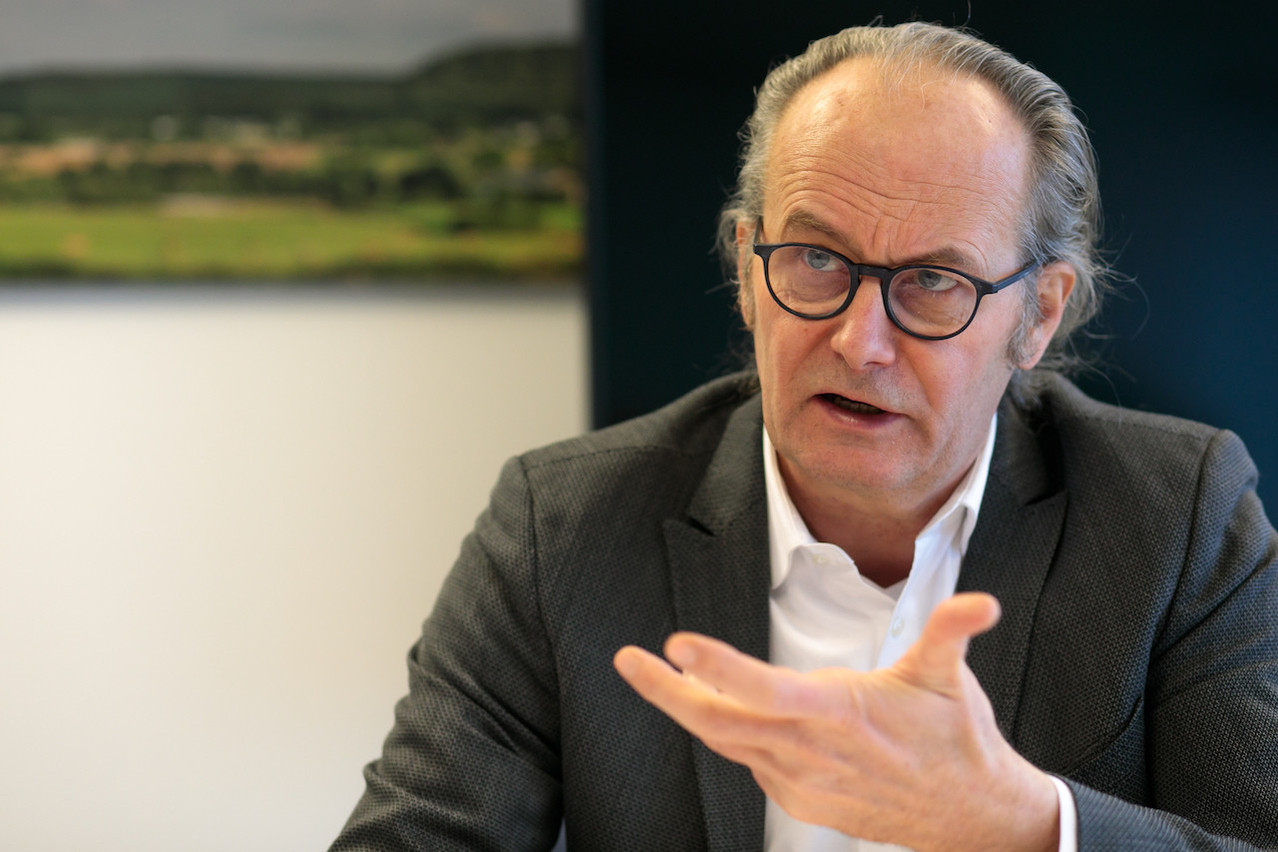
The significant rise in the price of gas and fears that Russia may turn off its supply in response to the economic sanctions issued by the European Union have caused concern over inflation. But Luxembourg energy minister Claude Turmes (déi Gréng) says that with worldwide shipping supplies still functioning, there is no problem securing petrol delivery.
“There is a problem that will become more acute now, with energy prices,” Turmes told RTL television on Thursday. “I think we are now in a scenario where we have to expect that energy prices could remain high next year. We will have to take appropriate measures if that is the case.” The government has planned an extraordinary meeting with energy suppliers for Monday 28 February to discuss strategy.
The minister said that Luxembourg needs to be prepared for the possibility that gas and petrol supplies from Russia will cease at some stage. “We are ok for this winter, but if we want to get through next winter we have to ensure we have full tanks at the start of winter,” said Turmes.
Addressing the problem of inflation, Gilles Moëc, chief economist at AXA Group, explains that “natural gas has become crucial for the dynamics of purchasing power.” To illustrate this, he points out that "the direct effect of rising gas prices already reduced real disposable income by 0.5% over one year in December 2021".
Bruno Colmant, group head of private banking at Degroof Petercam, told our sister publication Paperjam that the consequences of the Russian invasion of Ukraine will persist and accentuate the current economic difficulties. “We are seeing an increase in the price of raw materials, food products and gas,” Colmant said. “It shows that this invasion will aggravate the inflationary trend we have been in for six months now.”
We see an increase in the price of raw materials, food products and gas. This shows that this invasion will aggravate the inflationary trend that we have been in for six months now.

This is without counting the indirect impact of gas on the price of electricity. “Gas-fired power stations are now the 'marginal supplier' without which the demand for electricity cannot be met,” Moëc explains. As the correlation between gas and electricity prices has become obvious, Moëc says that “this channel has further reduced purchasing power by 0.7% over one year in December 2021.”
Limited alternatives
In the short term, it may prove difficult to find an alternative to Russian supplies, even though Europe has already increased its capacity to receive liquefied natural gas from the US and Qatar. The latter, though, have limited room for manoeuvre to increase their own respective production. Moreover, the capacity of European seaport terminals to receive liquefied natural gas from the US and Qatar cannot exceed 40% of the member states' total demand. Another problem is that the intra-European gas distribution network relies mainly on road transport and it will be difficult in the short term to increase the current fleet of 15,000 vehicles.
2022 is going to be very tough in terms of energy and food inflation. The latent problems are aggravated and take on a greater dimension now.

“Increasing the contribution of coal, as was already the case last year in Germany, is not acceptable given its huge carbon footprint,” notes Moëc. “Increasing the share of nuclear energy supplied to distributors at below market prices is generally not an option outside France.” Unequivocally, the collapse of the security integrity of the EU's direct neighbourhood could therefore be an opportunity to rethink overall energy strategy.
In the meantime, Colmant says that “2022 will be very hard to live with in terms of energy and food inflation.” The invasion of Ukraine has merely aggravated latent problems that have now taken on a more important dimension, he says. It is therefore natural, according to Colmant, that the European Central Bank (ECB) should be the focus of attention.
The European Central Bank will be one of the key players in dealing with the fallout from an exacerbation of tensions with Russia...

The role of the European Central Bank
A view shared by Gilles Moëc: “The European Central Bank will be one of the key players in dealing with the fallout of an exacerbation of tensions with Russia, which would result in even higher energy prices.” This could then prompt the ECB not to accelerate its normalisation policy. “The room for manoeuvre to accommodate a geopolitical shock with monetary policy therefore seems particularly narrow,” Moëc explains.
At the end of January, we were told that the ECB had started to analyse the geopolitical risk posed by a possible Ukrainian conflict for the euro zone. The ECB reported that it would be ready to inject liquidity in the event of systemic consequences, just as it had undertaken “unconventional” monetary policy measures since the start of the covid-19 pandemic.