Poverty is a major phenomenon in Luxembourg. According to Statec, 18.8% of the population was at risk of poverty in 2023, a proportion that has been rising steadily in recent years. In other words, 122,450 people were living on less than the poverty line of €2,282 a month. By way of comparison, the gross unskilled minimum wage is set at €2,637 (gross).
Specifically, it is single-parent households that are most likely to tip over to the wrong side of the index. The risk rises to 24.1% for such households, compared with 9.4% among the over-65s. Another cause often put forward as an explanation for the increase in the risk of poverty is the widening of pay inequalities. According to the Chamber of Employees, 12% of employees are at risk of poverty, 7% of part-time workers and 11% of full-time workers. That first figure, i.e. 12%, is the highest proportion in the eurozone, and it has been rising at an average annual rate of 2.6% since 2010. Faced with figures and a phenomenon that no one denies, what can be done?
Not just a question of money
If it were enough to put money on the table to make poverty disappear in Luxembourg, the problem could be solved today. In purely financial terms, the resources seem to be there: 47% of the budget goes into Luxembourg’s social policies, i.e. €14.3bn. That percentage that has remained stable since the government took office.
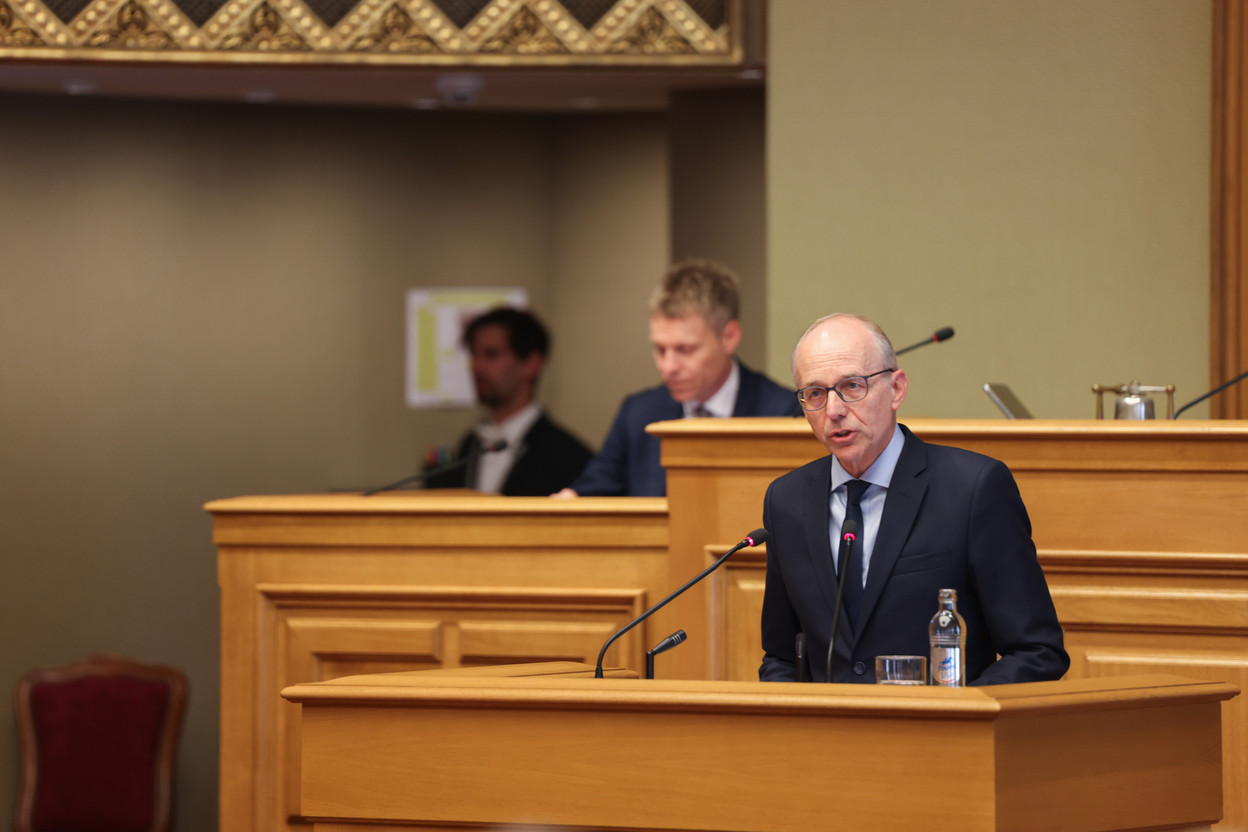
In presenting the latest budget, finance minister 
And yet the problem isn’t purely financial: “Almost half of public spending goes into social policy,” said 
A one-stop social shop
And, on this point, Frieden is in line with the Luxembourg Institute of Socio-Economic Research (Liser) which, in a study entitled “Precariousness and (Non-)use of Financial Aid in Luxembourg,” found that the rate of non-use reaches 80% for the rent subsidy and 40% for the cost-of-living allowance, “the only two forms of assistance for which the use rate can be calculated.” Liser offers three explanations for the very high non-use rate in Luxembourg. The primary one is a lack of understanding of the information. This is followed by “the time-consuming nature of regularly renewing applications and the length of time it takes to obtain a response.” And last is what Liser calls the “significant psychological cost of asking for help.”
Faced with this situation, the prime minister has announced the creation of a “one-stop social portal,” an internet platform to centralise requests, provide information on rights and make it easier to file applications. The platform will operate on the “once only” principle, understanding that citizens need only submit their supporting documents once, with administrators expected to communicate with each other to speed up the processing of cases within their remit. While a budget of €2m was released in the 2025 budget, this platform is not yet operational--but it should be by the end of the year, believes family minister 
Waiting measures
Waiting for this one-stop shop to come into operation, the family ministry in July introduced automatic payment of the cost-of-living allowance (AVC) and the energy allowance to recipients of the inclusion allowance. “Thirty percent of recipients of the inclusion allowance, who are also eligible for the cost-of-living allowance and the energy allowance, do not apply for them,” Hahn commented at the time. “The automatic granting of these two benefits is not only an important step towards administrative simplification, but also helps to combat non-uptake.” The deadline for applying for the AVC has been extended to 31 December 2025 and a second annual application will be possible. Also introduced: an online eligibility calculator, the sending of the pre-filled form to beneficiaries from the previous year, and multilingual information tools.
The result? 11,000 people have automatically received their cost-of-living allowance or energy allowance, without having to apply for it. In addition, some 20,000 pre-filled forms were sent to the beneficiaries concerned. “A concrete and targeted action against poverty,” commented
With the aim of also combating the non-use of municipal social benefits, the minister announced that the National Solidarity Fund (FNS) will, in the future, automatically communicate to the municipalities the data on recipients of the cost-of-living allowance residing within the territory of the respective municipalities. In this way, local authorities will be able to introduce automatic payment of local subsidies based on the cost-of-living allowance. “The ultimate aim would be for everything in this area to be automated and for the citizen to have nothing left to sign up for,” said Frieden.
A national plan eagerly awaited
The central element of the government policy is the drafting of a national action plan to prevent and combat poverty. This plan, announced in the coalition agreement, must involve the social partners and stakeholders on the ground. Its drafting has been entrusted to a dedicated inter-ministerial committee. Its creation was announced on 25 October 2024 and validated by a government order dated 10 January 2025.
The task of the Interministerial Committee for Preventing and Combating Poverty is to coordinate policies for combating poverty, to participate in the work of preparing and drawing up a national action plan, and to implement the measures emanating from said plan. It has six members representing, respectively, the ministries of family; digitalisation; national education and youth; housing; health; and labour. Its members will be appointed for a period of five years. It is not yet known who will sit on it or when its work will begin.
The slowness of this process is a source of criticism for the opposition in the Chamber of Deputies. As if to underline the impact of property prices on the standard of living of households, on 2 May the Government Council announced the creation of an administration for individual housing subsidies. This administration (Administration des Aides Individuelles au Logement) will constitute ‘a major change to our current organisation,” according to the housing ministry.
The cornerstones of the initiative are the centralisation, simplification and acceleration of case processing, as well as improved communication with citizens. Affordable housing was not forgotten in the last budget.
€35,000
This is the amount spent per capita annually by the government, according to the Idea foundation. Seven areas account for the bulk of public spending: old age (11.2% of public spending or €6,969 per resident), basic and secondary education (4.8% of public spending €3,038), transport (4.5% of public spending or €2,797), sickness and disability (4.3% of public spending or €2,797), family (3.1% of public spending or €1,941), general services (2.4% of public spending or €1,492) and medical products and equipment (2.1% of public spending or €1,284).
Welfare benefits in Luxembourg
The four main welfare benefits in Luxembourg are unemployment benefits; the social inclusion income (Revis); the cost-of-living allowance (AVC) and the energy premium; and the education package (Mammerent).
The aim of Revis is to help households on modest incomes and to provide basic means of subsistence for anyone who meets the relevant conditions. It is made up of an inclusion allowance and an activation allowance.
The AVC and the energy premium are specific allowances for households on modest incomes. They are granted on a means-tested basis by the FNS. Since 2025, Revis recipients have automatically benefited from the cost-of-living allowance and the energy allowance.
The education lump sum is intended for the parent, or any other person in place of the parents, who has devoted themselves mainly to the education of one or more children. Entitlement to the lump-sum parenting allowance is available from the age of 65. Mammerent should not be confused with “baby years” periods taken into account when calculating pensions.
In addition, there are advance and recovery of maintenance payments, income for the severely disabled (RPGH), gerontological care, rent subsidies, rent guarantees, legal aid, social third-party payment and financial and/or material assistance. These last two aids are managed by the social offices of the municipalities.
The government’s roadmap
—On 27 November 2023, the Government Council adopts the adjustment of the personal income tax scale to four index brackets from 1 January 2024. Bill 8343 is passed by the deputies on 20 December 2023.
—On 13 December 2023, the Government Council extends until the end of June 2024 the aid scheme to promote sustainability, the rational use of energy and renewable energy in housing (“Klimabonus Wunnen”) and mobility (“Klimabonus Mobilitéit”). These subsidies were partially reformed and extended on 19 June 2024 until June 2026 following the prime minister’s State of the Nation Address on 11 June. Bill 8405 is published in the Mémorial on 9 December 2024.
—On 22 May 2024, the Government Council approves the amendment to the amended Grand Ducal Regulation of 17 August 2011 specifying the financing of child and family social assistance measures.
—On 24 July 2024, the Government Council adopts various measures designed to support people on low incomes in meeting energy costs and to help finance the additional cost of energy products and electricity borne by integrated centres for the elderly, care homes, supported housing for the elderly and psychogeriatric centres. These measures are announced in the State of the Nation Address and are contained in Bills 8423 and 8424, respectively, both published in the Mémorial on 16 December 2024.
—On 25 October 2024, Frieden announces the establishment of an Interministerial Committee to prevention of and fight against poverty, as provided for in the coalition agreement. A government decree of 10 January 2025 validates this.
—On 15 November 2024, the government validates the 2.6% increase in the amounts of the minimum social wage (non-qualified), the social inclusion income (Revis) and the income for severely disabled people (RPGH). The measures are effective from 1 January 2025.
Social measures that came into force on 1 January 20025
—New adjustment to the income tax scale to neutralise 2.5 index brackets. Up to a gross annual salary of €52,400, single-parent households will no longer pay tax for the 2025 tax year. People receiving the minimum social wage are exempt for this income from tax.
—Increase in pensions of 1.6% to bring them into line with changes in the average level of contributory salaries. This increase is provided for by law (article 225bis of the Social Security Code).
—10% increase in the cost-of-living allowance. The Government Regulation of 17 July 2024 on the granting of a cost-of-living allowance for the year 2025 adapts the terms and conditions of allocation in order to facilitate access to this social benefit and combat non-use. In particular, recipients of the inclusion allowance will receive the cost-of-living allowance automatically.
—The energy allowance aimed at combating the risk of fuel poverty and supporting vulnerable households in a targeted manner has been renewed and its amount tripled subject to conditions (per Government Council Regulation of 17 July 2024 on the granting of a cost-of-living allowance for the year 2025). The Tax Credit Equivalent (ECI) has been made permanent and increased to €90 for recipients of the basic flat-rate amount per adult. The measure is contained in Bill 8424, passed on 4 December 2024.
This article, originally published in French, was written for the June 2025 issue of Paperjam magazine published on 21 May. The magazine content is produced exclusively for the magazine. It is published on the site to contribute to the full Paperjam archive. Click this link to subscribe to the magazine.
Is your company a member of Paperjam Club? You can request a subscription in your name. Let us know via club@paperjam.lu.